
On this page 13 sections
Article at a glance
- Reading time
- 19 minutes
- Article length
- 3,983 words
Choose what you want to learn first
This guide builds the foundation: quality tiers, movements, expectations, and the key terms buyers run into early.
Quality tiers (AAA vs Super Clone)
What changes across tiers, what doesn't, and how to set realistic expectations.
Open: Quality levels →Movements explained
Automatic, meca-quartz, chronograph — what matters for reliability and daily use.
Open: Movements guide →Fake vs replica (clear definitions)
Key differences in intent, build goals, and what buyers mean by each term.
Open: Fake vs replica →Before you decide (risk control)
Buying framework (full process)
The complete step-by-step flow: expectations, tiers, movements, pricing, seller checks, and timelines.
Open: Full buying framework →Payment safety
Payment verification checks, scam patterns, and chargeback basics — explained clearly.
Open: Payment safety →Problems & care (ownership reality)
Durability, daily wear limits, common issues, and habits that extend lifespan.
Open: Owner guide →Prefer browsing this topic like a library? Open Replica Watch Knowledge Library →
Replica watches are one of the most searched and least accurately described product categories online. Marketing language, inflated quality claims, and simplified comparisons create more confusion than clarity — particularly for buyers approaching the subject for the first time. This guide exists to change that. It explains what replica watches actually are, how quality tiers differ in practice, what movements deliver in daily use, what factory differences mean for the buyer, and where the line between realistic expectations and marketing fiction actually sits.
This is the educational foundation of our content structure. It does not encourage purchase decisions — it builds the knowledge that makes every other guide on this site more useful. Buyers who understand the market before entering it tend to have more realistic expectations and fewer surprises after delivery.
What Replica Watches Really Are (And Are Not)
What the Term "Replica Watch" Actually Refers To
A replica watch is a non-genuine timepiece designed to visually resemble a luxury watch design. The goal is aesthetic similarity — not authenticity, heritage, or investment value. Replica watches are produced independently from original manufacturers and do not follow the same design approvals, material sourcing, or engineering processes. The term "replica" itself does not indicate quality. It simply describes intent: visual resemblance to an existing design. Many people use "fake" and "replica" interchangeably, even though they describe different intentions and quality levels. For a clear explanation of how the two terms differ in real-world use, see our fake vs replica comparison guide.
What Replica Watches Are Designed to Offer
Replica watches are designed to provide access to a specific design language at a fraction of the genuine price. They give buyers a wearable alternative for daily styling, an introduction to mechanical watch ownership, and the ability to experiment with designs and references that would otherwise be financially inaccessible. They are chosen for casual use, rotation wear, and curiosity-driven exploration of watch design — not for the ownership experience that accompanies a genuine luxury timepiece.
What Replica Watches Are Not Intended to Be
Replica watches are not genuine replacements for original watches, financial or collectible assets, perfect mechanical equivalents, or products with manufacturer-backed guarantees. They are not built to the same engineering standards as the watches they resemble, and no replica watch — regardless of how it is marketed — is produced at true one-to-one equivalence with a genuine model. Understanding this distinction early prevents frustration later and sets the foundation for a realistic ownership experience.
Understanding Replica Watch Quality Levels
Quality in replica watches exists on a genuine spectrum. Two watches may look similar in photographs yet feel very different in hand — and perform very differently over months of daily wear. Quality levels influence not only appearance but also durability, comfort, movement reliability, and long-term usability. Understanding these differences early is what separates buyers who are satisfied from those who feel misled. For a complete tier-by-tier breakdown covering A, AA, AAA, AAAA+, and Super Clone — including materials, movements, and realistic expectations at each level — see our in-depth quality levels guide.
Entry-Level Replica Watches
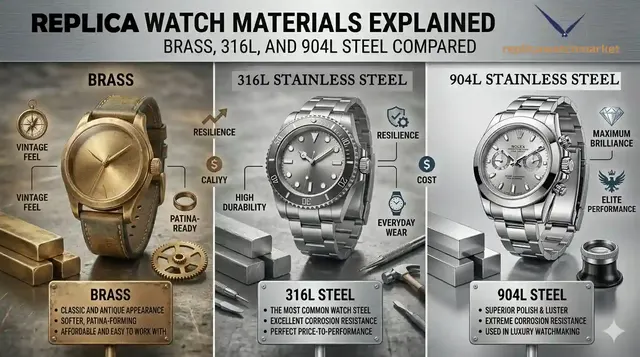
Entry-level replicas focus on basic visual resemblance at the lowest possible price point. Cases are typically made from brass-based alloys with thin plating rather than solid steel — the result is a noticeably lightweight watch that may look acceptable out of the box but shows wear quickly as plating fades or chips. Movements at this tier are low-grade quartz or basic automatics with inconsistent accuracy and limited lifespan. These watches are not designed for daily wear over extended periods, and longevity should not be a primary expectation. Entry-level replicas suit first-time buyers exploring the market or those planning short-term, occasional use.
Mid-Tier Replica Watches
Mid-tier replicas aim for a balance between cost and build quality — and this balance is what makes them the largest segment of the replica market. Case shaping and brushing improve noticeably, dial printing is more accurate, lume application is more consistent, and movements are more stable than entry-level options. The overall feel in hand is substantially more convincing than A or AA grade production. At normal viewing distance, visual similarity to the genuine reference is strong. Mid-tier replicas suit buyers who want a functional daily watch without paying the premium that AAAA+ or Super Clone production commands.
High-End Replica Watches
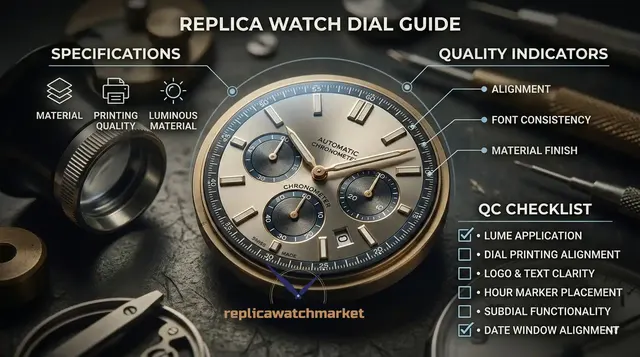
High-end replicas focus on visual accuracy and mechanical refinement within realistic production limits. At this tier, sapphire crystals with anti-reflective coating replace mineral glass — for a full breakdown of crystal types, coating quality, and what to check in QC photos, see our Replica Watch Crystal Guide. Case construction and finishing also step up meaningfully at this tier — for a detailed breakdown of case materials, lug geometry, and finishing quality across grades, see the Replica Watch Case Guide. Dial printing sharpness, index alignment, and lume application are assessed to tighter tolerances — for a complete breakdown of every dial element and a QC checklist, see the Replica Watch Dial Guide. Movements are reliable automatic calibers or meca-quartz hybrids chosen for the specific requirements of each reference. Quality control is tighter — either through factory processes or additional seller-side inspection. Even at this level, replicas remain approximations rather than equivalents, but the gap between the watch in hand and the genuine reference narrows to a point that experienced buyers notice and value. For a practical checklist of what to evaluate before purchasing at this tier, see our guide on how to choose a high-quality replica watch.
Quality Tier Comparison Table
| Aspect | Entry-Level | Mid-Tier | High-End |
|---|---|---|---|
| Case finishing | Basic | Improved | Refined |
| Dial accuracy | Approximate | Mostly accurate | Highly accurate |
| Movement reliability | Low–Moderate | Moderate | Moderate–High |
| Longevity expectation | Short-term | Medium-term | Medium-term |
| Price consistency | Low | Moderate | Higher |
Movements Explained: What Powers a Replica Watch
Common Movement Types Used in Replica Watches
Replica watches are powered by three main movement types: automatic mechanical movements, meca-quartz hybrid movements used primarily in chronograph models, and standard quartz movements found in budget-tier production. Automatic movements wind themselves through wrist motion and provide the continuous sweeping seconds hand associated with mechanical watches. Meca-quartz hybrids combine a quartz timekeeping base with mechanical chronograph functions — offering reliable sub-dial operation without the complexity of a fully mechanical chronograph. Quartz movements are accurate and low-maintenance but remove the mechanical experience that most replica watch buyers are seeking. Each type has different implications for daily use, serviceability, and long-term reliability. For a detailed breakdown of how these movement types compare in practice, see our movements guide.
Reliability, Accuracy, and Maintenance Expectations
Replica movements are designed for function, not precision certification. Accuracy of a few seconds per day gain or loss is normal for mechanical replica movements and is not a defect — it is a characteristic of the movement type. Serviceability varies depending on caliber and local watchmaker familiarity. Users should expect acceptable daily accuracy rather than chronometer performance, and should treat replica movements as more sensitive to shock and moisture than their genuine counterparts.
How Movement Choice Affects Daily Use
Movement choice affects more than timekeeping. It determines case thickness — some calibers require deeper cases that affect how the watch sits on the wrist. It determines the smoothness of the seconds hand sweep, which distinguishes automatic from quartz behavior. It affects power reserve stability — how long the watch runs when left unworn. And it determines long-term serviceability, which shapes the realistic lifespan of the watch as a functional object. Choosing a replica watch without understanding its movement consistently leads to durability disappointments that would have been avoidable with basic information. For a focused breakdown of how different movement architectures compare in replica production, see our Swiss vs Japanese movement analysis.
Movement Overview Table
| Movement Type | Accuracy | Serviceability | Common Use |
|---|---|---|---|
| Automatic | Good | Varies by caliber | All quality tiers |
| Meca-quartz Hybrid | Good | Moderate | Chronograph models |
| Quartz | High | Easy | Budget and entry models |
"1:1", "AAA", and "Super Clone" Claims Explained
Why These Labels Exist in the Replica Market
Labels such as "1:1," "AAA," and "super clone" exist primarily as marketing shorthand rather than technical classifications. The replica market lacks standardized quality definitions, which allows sellers to use simplified terms to communicate perceived value quickly — particularly to buyers who are unfamiliar with how production actually works. These labels help create hierarchy and influence expectations, but they do not correspond to fixed materials, manufacturing tolerances, or performance benchmarks. The same label may describe very different watches depending on factory, movement choice, and assembly standards. Understanding why these labels exist is the first step toward evaluating replica watches based on tangible factors rather than names.
What "1:1" Really Means in Practice
"1:1" generally suggests visual similarity at a glance — that the replica closely follows the dimensions and design language of the genuine reference. It does not mean identical materials, identical manufacturing processes, or identical mechanical performance. No replica watch is produced at true one-to-one equivalence with a genuine watch. The term is a marketing signal, not a technical specification, and buyers who treat it as the latter consistently encounter surprises that would have been avoidable with more realistic expectations.
Marketing Language vs Manufacturing Reality
Marketing terms simplify complex manufacturing realities in ways that favor the seller's narrative. Two watches labeled "1:1 AAA super clone" may differ significantly in case geometry, dial printing accuracy, movement origin, and assembly consistency — because none of those labels carry defined production standards. The practical implication for buyers is straightforward: evaluate replica watches based on specific material specifications, confirmed movement type, and seller QC process — not based on terminology that any seller can apply to any product without verification.
Terminology Reality Table
| Term Used | What It Implies | Reality |
|---|---|---|
| 1:1 | Perfect copy | Visual similarity only — no technical standard |
| AAA | High quality | No fixed definition — varies by seller |
| Super Clone | Near-identical | Higher production quality — still limited by materials |
Factory Differences and Why They Matter
What "Factory" Means in the Replica World
In the replica context, "factory" refers to independent production groups with their own tooling, material suppliers, assembly processes, and quality control standards. Factories are not interchangeable — they produce meaningfully different results even when working from the same reference design. Understanding that factory origin determines much of the actual quality of a replica watch is one of the most practically useful pieces of information a buyer can have before entering the market.
Differences in Case, Dial, and Finishing
Factories vary in case geometry accuracy, dial alignment and print clarity, lume consistency, bezel action and tolerance, and bracelet finishing quality. For a detailed breakdown of bezel types, insert materials, and finishing quality across replica grades, see the Replica Watch Bezel Guide. For a detailed breakdown of bracelet and strap construction quality across replica grades, see our Replica Watch Strap & Bracelet Guide. These differences explain why two visually similar watches — same reference, same marketing description, similar price — can feel noticeably different in hand. The factory that produced the watch determines the quality of execution across every visible and tactile element, and this is a variable that marketing labels do not capture.
Assembly Standards and Quality Control Variations
Quality control is inconsistent across factories. Some prioritize volume over refinement — producing large quantities with broader tolerance acceptance. Others apply tighter standards to case finishing, dial alignment, and movement regulation before shipment. This inconsistency directly affects out-of-box condition, long-term reliability, and consistency between units of the same model. A seller who adds a second inspection layer on top of factory QC — checking dial printing sharpness, bezel alignment, surface transitions, and caseback fit before shipment — closes a meaningful gap that factory QC alone leaves open.
Factory Impact Table
| Area | Higher-Standard Factory | Lower-Standard Factory |
|---|---|---|
| Case finishing | Clean, consistent transitions | Inconsistent — varies unit to unit |
| Dial alignment | Precise | Variable — off-center common |
| QC checks | Systematic | Minimal — volume-focused |
Expectations vs Reality: What Most Buyers Misunderstand
Visual Expectations vs Real-Life Wear
Studio photographs consistently present replica watches in conditions that do not reflect daily wear reality. Controlled lighting hides edge sharpness inconsistencies, softens light reflection differences, and eliminates the minor alignment variances that become visible when the watch is worn on the wrist and examined at normal interaction distance. These are not defects — they are normal within replica manufacturing tolerances. Buyers who form their expectations entirely from product photographs often experience a gap between expectation and reality that is not caused by a quality failure but by the difference between studio conditions and real-world wear.
Minor Imperfections and Mechanical Tolerances
Small visual or mechanical inconsistencies do not automatically indicate defects. Replica watches operate within broader manufacturing tolerances than genuine watches — a reality that reflects production cost, not carelessness. A dial marker that sits fractionally off-center, a date window that shows a thin sliver of the previous date at midnight, or a caseback gasket with minor surface texture variation are all within normal tolerance ranges for replica production. Understanding the difference between normal tolerance variation and actual quality failures prevents unnecessary frustration and allows buyers to evaluate their watches accurately.
Long-Term Use and Durability Considerations
Replica watches are not designed for decades of use. With reasonable care — avoiding water immersion, protecting from impact, storing properly — medium-term durability is achievable, particularly for mid-tier and higher models with reliable movements. Longevity expectations must remain realistic: a well-maintained automatic replica worn daily in normal conditions will perform reliably for a reasonable period; a low-grade entry model subjected to the same conditions may fail within months. The difference lies in movement quality, material grade, and owner habits — not in inherent fragility.
Replica Watches Compared to Genuine Watches
Where High-End Replicas Come Close
High-end replicas may approach genuine watches in visual proportion, dial layout, and wrist presence. At a distance or casual glance, the similarities between a well-made AAAA+ replica and its genuine reference can be convincing — case dimensions follow the original, dial printing is sharp, and surface finishing reflects the correct combination of polished and brushed elements. For buyers whose primary goal is visual appeal in daily wear environments, high-end replicas deliver an experience that is meaningfully close to what the genuine design looks like on the wrist.
Where Replicas Will Always Fall Short
Replicas fall short in material sourcing, engineering tolerances, movement longevity, and brand heritage — and these gaps are structural rather than fixable through improved production. The steel used in genuine Rolex production is processed and finished to standards that replica factories do not replicate. The movements inside genuine watches are developed over years and tested to performance benchmarks that replica calibers are not held to. The heritage, manufacturer warranty, and resale value that accompany a genuine watch do not exist for a replica under any circumstances.
Why the Overall Experience Is Fundamentally Different
A genuine watch represents far more than visual design. It reflects decades of engineering refinement, material research, manufacturing standards, and long-term testing. Every component is developed within a controlled system that prioritizes consistency, durability, and performance over time. This depth of development creates an experience that extends beyond appearance and into reliability, precision, and heritage. Replica watches, by contrast, are built around approximation rather than origin. Their purpose is to visually resemble a design — not to replicate the full engineering process behind it. While high-end replicas may achieve convincing proportions and surface-level details, they operate within different material constraints, broader mechanical tolerances, and simplified quality control. Understanding this difference is what allows buyers to approach replica watches with accurate expectations — and to find genuine satisfaction within the limits of what they actually are.
Who Replica Watches Are (And Are Not) For
Replica Watches Make Sense If You…
Replica watches are a reasonable choice for buyers who appreciate watch design and wrist presence without the financial commitment or ownership expectations of genuine luxury watches. They suit people who understand that mechanical limitations exist and are comfortable with the idea that replicas prioritize appearance over heritage. For those who value versatility, casual wear, and stylistic experimentation — and who approach the purchase with realistic expectations about what they are buying — replica watches can serve as functional, satisfying accessories that deliver consistent value within their design parameters.
Replica Watches May Not Be Right If You…
Replica watches are less suitable for buyers who expect perfection, long-term precision, or enduring mechanical performance comparable to genuine luxury production. They are not appropriate for collectors seeking investment value, buyers who want manufacturer-backed service or warranty support, or those for whom brand authenticity and historical heritage are essential parts of the ownership experience. If long-term reliability, resale value, or the assurance of genuine manufacture are important considerations, genuine watches remain the more appropriate choice — and no amount of quality tier labeling in the replica market changes that fundamental reality.
How This Knowledge Hub Connects to Other Guides
Reading Buyer's Guides with the Right Expectations
Buyer guides across this site are written with the assumption that readers already understand how quality levels, movements, and factory differences affect real-world use. This foundational knowledge makes buying advice more useful and prevents the confusion caused by marketing terminology and unrealistic comparisons. For readers who want to see how these principles apply to a specific brand, our Rolex replica buyer guide offers a structured example of how quality tiers, movement choices, and factory differences translate into real-world model comparisons across Submariner, Datejust, and GMT-Master II.
Understanding Watch Types Before Choosing a Reference
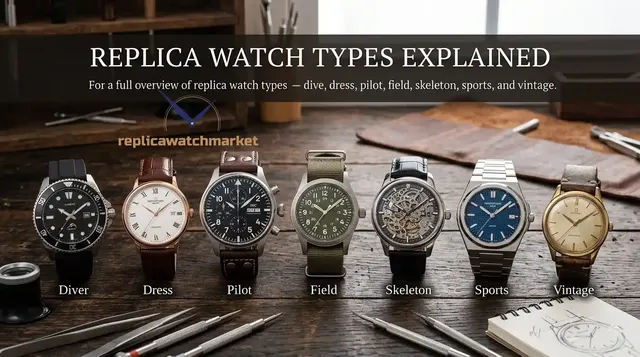
Before exploring brand or model guides, understanding the seven main watch categories — dive, dress, pilot, field, skeleton, sports, and vintage — provides a practical framework for evaluating any reference. Each watch type has its own design logic, quality checkpoints, and movement requirements that directly affect what to look for in QC photos and how to set realistic expectations. For a complete breakdown of all seven categories and what distinguishes a well-executed replica in each, see our Replica Watch Types Explained guide.
Understanding Common Problems Before They Happen
Problem-focused articles on this site expand on the realities discussed here — mechanical tolerances, quality control variation, long-term durability limits, and what distinguishes normal wear from actual failure. Reading these guides early helps buyers recognize which issues are expected within normal replica production and which require attention. The most useful starting point is our replica watch problems and care guide, which covers the most common ownership issues and how to avoid them.
Preparing for Care, Maintenance, and Daily Use
Care and daily use guides build directly on the movement limitations and material differences explained in this guide. Understanding why certain materials corrode faster, why certain movements are more sensitive to shock, and what daily habits accelerate wear allows owners to adopt practices that reduce failure risk and extend the usable life of their watches. For the practical daily use and care foundation, see our replica watch care guide and our materials guide.
Final Thoughts: Building Realistic Expectations Around Replica Watches
Replica watches are best understood through knowledge rather than assumptions. Quality levels differ in ways that matter in daily use. Movements vary in reliability and serviceability in ways that affect long-term ownership. Factory differences produce results that marketing labels do not capture. And the gap between replica and genuine watches is structural — not something that better marketing language can close.
This guide exists to provide clarity rather than persuasion. When expectations align with reality, buyers approach replica watches calmly and informed — and tend to have more positive experiences than those who enter the market based on photographs and promotional descriptions alone. Knowledge does not change what a replica watch is. It changes how well you understand it before you buy one.
Replica Watch FAQs: Quality, Expectations & Common Misconceptions
Are replica watches the same as genuine watches?
No. Replica watches are independently produced timepieces designed to visually resemble luxury watch models. They are not manufactured by the original brand, do not use the same engineering processes or material sourcing, and do not carry manufacturer warranties or heritage value. High-end replicas may achieve strong visual similarity, but the overall experience — mechanical precision, material quality, and long-term reliability — remains fundamentally different from a genuine watch.
What does "1:1 replica watch" actually mean?
"1:1" is a marketing term used to suggest close visual similarity to the original model. It does not represent a technical certification, a verified manufacturing standard, or identical materials. In practice, "1:1" means the replica closely follows the dimensions and design language of the genuine watch. No replica watch is produced at true one-to-one equivalence in every detail — and buyers who understand this distinction tend to have more realistic expectations going in.
Do replica watch quality levels really differ?
Yes, significantly. Quality varies across entry-level, mid-tier, and high-end replicas in terms of case finishing, dial accuracy, movement reliability, bracelet construction, and long-term durability. Two watches may appear similar in photographs but feel very different in hand. Marketing labels such as "AAA" or "super clone" do not correspond to fixed manufacturing standards — actual quality depends on factory, movement choice, and assembly consistency. For a detailed breakdown, see our quality levels guide.
Are replica watches reliable for daily use?
Mid-tier and higher-tier replica watches with quality automatic movements can provide reliable daily performance under normal wear conditions. Accuracy of a few seconds per day is normal and not a defect. Long-term reliability depends heavily on movement type, care habits, and exposure to moisture or shock. Entry-level replicas are less consistent and more sensitive to daily wear stress. For a realistic overview of daily use expectations, see our daily wear guide.
Why do replica watches from different factories feel different?
Replica watches are produced by independent factories with their own tooling, suppliers, and quality control standards. Factories vary in case geometry accuracy, dial alignment, lume consistency, bracelet finishing, and assembly precision. This is why two visually similar watches — same reference, similar price — can feel noticeably different in hand. Factory origin is one of the strongest determinants of actual quality, and it is a variable that marketing labels do not capture.
Are replica watches a good investment?
No. Replica watches are not financial assets. They do not appreciate in value, cannot be traded through authorized channels, and carry no manufacturer-backed resale value. They are wearable accessories chosen for design access, daily styling, or casual use. Buyers who approach replica watches as investments will be disappointed. Those who approach them as functional accessories with realistic expectations tend to be far more satisfied.
Do replica watches require maintenance?
Yes. Like any mechanical watch, replica watches benefit from basic care and periodic attention. Avoiding moisture exposure, protecting from strong shocks, storing properly, and winding periodically when not worn all extend usable lifespan significantly. Serviceability varies depending on movement type and local watchmaker availability. For a full maintenance overview, see our replica watch care guide.
Who should consider reading this knowledge hub before buying?
Anyone researching replica watches for the first time — or reconsidering a previous purchase experience — will benefit from reading this guide before making a decision. Understanding quality tiers, movement differences, factory variation, and realistic expectations removes the confusion caused by marketing language and simplifies the buying process. The buyers who tend to have the most positive experiences are the ones who understood the market before they entered it.