On this page 10 sections
Article at a glance
- Reading time
- 12 minutes
- Article length
- 2,556 words
Case size is the specification buyers look at first — and the one most consistently misunderstood. A number in millimetres tells you the diameter of the case. It does not tell you how the watch will feel on your wrist, what it will look like in a cuff, or whether it suits the way you plan to wear it. This guide covers what case size actually means, why there is no universal rule for which size suits which wrist, and how to use the specification to make a confident choice rather than a guesswork one. For a broader overview of what separates quality grades in replica watches, see the Replica Watch Guide.
What Case Size Actually Means
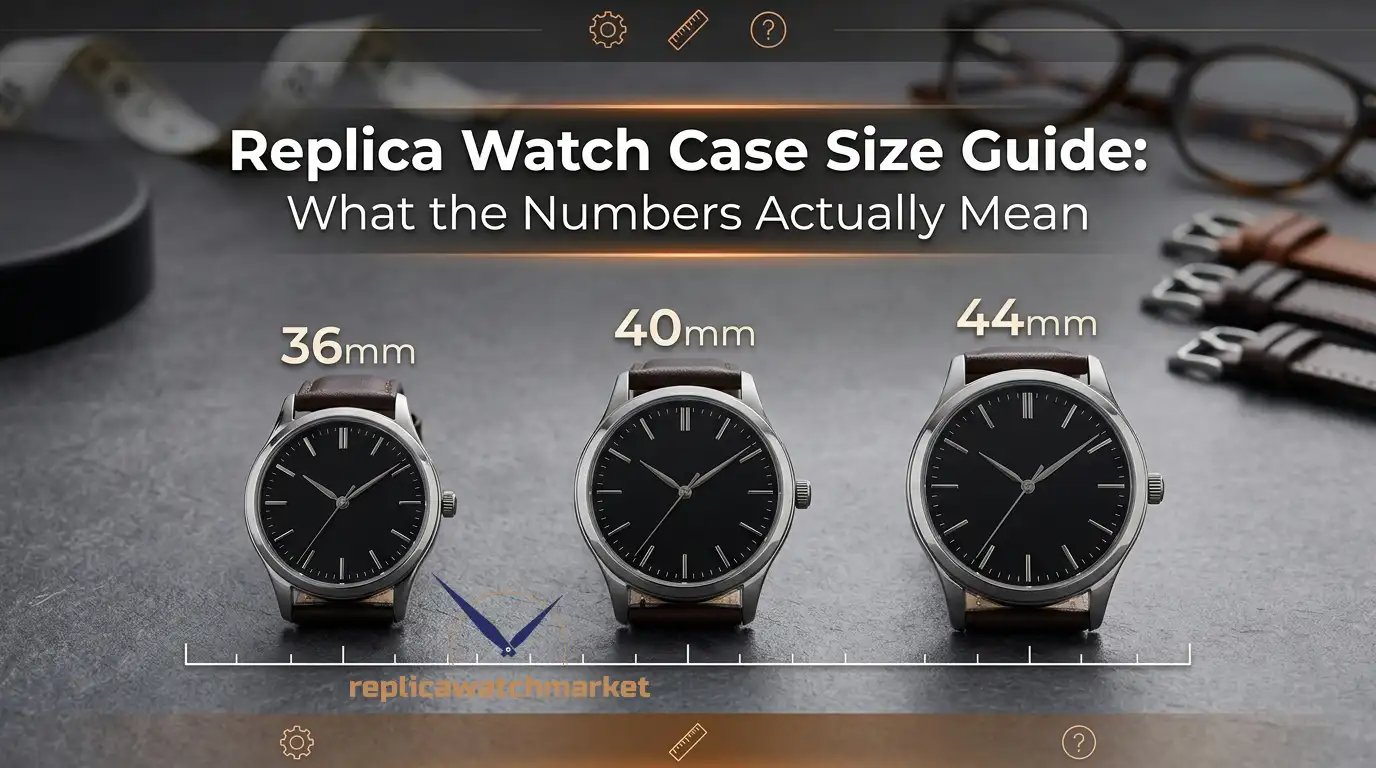
Case size is the diameter of the watch case measured in millimetres across the widest point of the case body, excluding the crown. It is measured from the 9 o'clock side to the 3 o'clock side — the horizontal axis. This is the number listed in every product specification, and it is a useful starting point — but only a starting point.
Two watches at 40mm can wear very differently depending on lug geometry, case thickness, and how the case sits on the wrist. A 40mm watch with long, flat lugs and a thick case can feel larger than a 42mm watch with short, curved lugs and a slim profile. The diameter number is a reference point, not a complete description of how the watch will feel in daily use.
There Is No Universal Rule
The idea that a specific wrist size requires a specific case diameter is one of the most repeated and least useful pieces of advice in watch buying. It treats wrist size as the only variable — when in reality, case size is a style and context decision as much as a fit decision.
A person with a 16cm wrist can wear a 44mm Panerai Luminor intentionally — because the oversized presence is the point of the watch. The same person can wear a 36mm Datejust in a formal setting — because a refined, understated watch suits the context better than a larger sports reference. Neither choice is wrong. They are different choices for different purposes.
Wrist size is one input. It is not the deciding factor. The questions that actually matter are: What is the occasion? What look am I going for? How does this reference read at the size I am considering? These questions produce a more useful answer than any wrist-to-diameter formula.
Size by Context — Not by Wrist
A more useful framework than wrist size is context. The same buyer may own multiple watches at different sizes for different occasions — and this is exactly how the market works at every level, from entry replica to genuine luxury.
Formal and Dress Context
Formal wear typically calls for a smaller, thinner case that sits comfortably under a shirt cuff — 36mm to 40mm is the conventional range. A Datejust 36mm or 40mm, a Patek Nautilus 40mm, or an AP Royal Oak 41mm read as refined and intentional in business or formal settings. The watch complements the outfit rather than competing with it. That said, some buyers deliberately choose a larger sport watch in formal contexts as a personal statement — and that is an equally valid choice if it reflects who they are.
Daily Wear and Sport Context
For daily wear and active use, 40mm to 44mm covers the most versatile range. A Submariner at 41mm, a GMT-Master II at 40mm, or a Breitling Chronomat at 43mm work across casual and semi-formal contexts without demanding attention in the way a larger piece does. These sizes wear comfortably across extended periods and suit most daily activities without compromise.
Statement and Bold Context
Some references are designed to make a statement — and wearing them at their full intended size is part of the point. A Panerai Luminor at 44mm or 47mm, a Hublot Big Bang at 44mm or 45mm, an AP Royal Oak Offshore at 44mm — these are not watches that try to be discreet. The large case is a design intention, not a sizing mistake. Buyers who are drawn to these references should not second-guess the case size. The watch is meant to be present on the wrist.
Building a Collection
Many buyers eventually own more than one watch — a smaller dress piece and a larger sport reference, or a versatile mid-size daily wearer and a bold weekend watch. In a collection context, case size diversity is intentional. Each piece serves a different role, and the sizes chosen reflect those different roles rather than a single preference for one diameter.
Case Size Reference Guide: 31mm to 46mm
The following covers every case size available in our catalog — what the size looks like in practice, which references use it, and what context it suits.
36mm
36mm is a classic dress size — refined, understated, and historically accurate for references produced before the industry shift toward larger diameters in the 2000s. On most wrists it sits as a clean, compact presence. On smaller wrists it wears proportionally. On larger wrists it reads as a deliberate style choice — a slim, elegant watch against a broader wrist has its own visual logic. References: Rolex Datejust 36, Rolex Oyster Perpetual 36.
38mm
38mm sits between the traditional dress size and the modern sport reference — versatile enough for both contexts without fully committing to either. It suits daily wear across formal and casual settings and works on a wide range of wrist sizes without the presence that 40mm+ delivers. References: Select Longines and TAG Heuer models.
40mm
40mm is the most versatile size in the replica market — large enough to read as a serious sport watch, small enough to wear under a cuff without forcing the issue. The GMT-Master II, Explorer II, and many Omega Seamaster references use 40mm as their standard diameter. It is the default choice for buyers who want one watch that works across the broadest range of contexts.
41mm
41mm is the current standard for Rolex sport references — Submariner, Datejust 41, Oyster Perpetual 41. The 1mm difference from 40mm is not dramatic in isolation but produces a slightly more substantial presence on the wrist. These references wear as modern sport watches — comfortable for daily use, versatile across contexts, and proportionally correct for the current design language of the references that use this size.
42mm
42mm is used on select Omega, Breitling, and TAG Heuer references — notably the Omega Seamaster 300M and certain Breitling Navitimer variants. It reads as a full-size sport watch without crossing into oversized territory. Suitable for daily wear across most contexts, and well-proportioned on medium to large wrists without being exclusive to them.
43mm
43mm is the territory of serious sport and pilot references — Breitling Chronomat, IWC Pilot, and select AP Royal Oak Offshore variants. At this size, the watch has a clear presence on the wrist and reads as a deliberate choice rather than a neutral daily driver. It suits buyers who want a watch that is noticed and wears well in active and casual contexts.
44mm
44mm is the entry point for bold, statement-oriented references — Panerai Luminor 44mm, AP Royal Oak Offshore 44mm, Hublot Classic Fusion 45mm. At this size, the watch is the focal point on the wrist. It does not try to be discreet. Buyers who choose 44mm know what they are buying: presence, weight, and a strong visual statement. This is a size where wrist fit matters less than intention — wear it because you want it, not because a formula approves it.
45mm and 46mm
45mm and 46mm are the largest sizes in the catalog — Panerai Luminor 1950 47mm-inspired references, select Hublot Big Bang variants, and Richard Mille pieces where the case geometry produces an equivalent presence. These are watches for buyers who specifically want a large, bold piece. The size is part of the design intention — not a compromise, not an accident. They work on large wrists with room to spare and on smaller wrists as an intentional oversize statement. The only question worth asking at this size is: do you want this presence on your wrist?
| Size | Character | Typical Context | Key References |
|---|---|---|---|
| 31mm | Compact, elegant | Dress, formal, ladies | Datejust 31, OP 31 |
| 36mm | Classic, refined | Formal, dress | Datejust 36, OP 36 |
| 38mm | Versatile, understated | Daily, formal | Select Longines, TAG Heuer |
| 40mm | Versatile sport | Daily, all contexts | GMT-Master II, Explorer II |
| 41mm | Modern sport standard | Daily, sport, casual | Submariner, Datejust 41 |
| 42mm | Full sport | Daily, sport | Seamaster 300M, Navitimer |
| 43mm | Sport presence | Sport, casual, active | Chronomat, IWC Pilot |
| 44mm | Bold, statement | Casual, weekend, active | Luminor 44, RO Offshore 44 |
| 45–46mm | Oversized, intentional | Statement, weekend | Luminor 1950, Big Bang |
Why Lug-to-Lug Matters More Than Diameter
Lug-to-lug distance is the measurement from the tip of one lug to the tip of the opposite lug — along the vertical axis of the watch. It determines how far the watch extends across the wrist from top to bottom, and it is a more reliable predictor of wrist fit than case diameter.
A 40mm watch with a 48mm lug-to-lug will overhang a narrow wrist regardless of the stated diameter. A 44mm watch with a 50mm lug-to-lug and curved lugs may actually sit more comfortably than a 41mm watch with a 47mm lug-to-lug and flat, straight lugs. The relationship between diameter and lug-to-lug varies significantly between references — a Submariner at 41mm has a different lug-to-lug geometry than a Datejust 41mm, and both wear differently despite sharing the same diameter.
For buyers where wrist fit is the primary concern, lug-to-lug is the number to check — not just the case diameter.
Other Case Specifications
Case Thickness
Case thickness is the measurement from the caseback to the top of the crystal. It determines how much the watch protrudes above the wrist and whether it clears a shirt cuff comfortably. Thickness is driven primarily by movement height. Clone movements typically produce thinner cases than the same reference fitted with a standard Japanese automatic — a relevant consideration for buyers where under-cuff fit matters.
Lug Width
Lug width is the distance between the two lugs on the same side — the measurement that determines strap and bracelet compatibility. A watch with 20mm lug width accepts any strap or bracelet made to 20mm. Confirm lug width before ordering aftermarket straps — replica lug widths occasionally differ from the genuine reference specification at lower production grades.
Crown
The crown is the winding and setting stem — the primary mechanical interface with the movement and the most water-resistance-critical point on the case. A correctly fitted crown sits flush against the case in the locked position, winds with defined resistance, and on screw-down references engages the case tube cleanly. At high-end grade, crown tolerances produce a mechanism that functions correctly across its full range. At lower grades, loose tubes and soft engraving are common failures. For full guidance on crown handling and water resistance, see our Water Resistance Guide.
Case Material
Case material determines weight, scratch resistance, corrosion resistance, and long-term surface appearance. Every reference in our catalog is built on a 904L stainless steel base — with additional material treatments (gold plating, PVD, rose gold) applied where the reference specifies. For a complete breakdown of every case material used across the catalog — including 904L steel, gold plating, black PVD, rose gold, carbon fiber, ceramic, and titanium — see our Replica Watch Materials Guide.
Grade Comparison
For a full breakdown of quality tiers and what separates mid-tier from high-end grade production, see Replica Watch Quality Levels.
| Quality Point | Mid-tier Grade | High-end Grade |
|---|---|---|
| Case diameter accuracy | ±1–2mm from reference | Within specification |
| Lug-to-lug accuracy | Often overstated | Matches reference geometry |
| Case thickness | Frequently 1–2mm over | Reference specification |
| Lug width | May vary, affects bracelet fit | Correct dimension |
| Crown fit | Loose tube, soft engraving | Flush, firm, correctly engraved |
| Rehaut engraving | Shallow, uneven spacing | Crisp, correctly aligned |
| Case finishing | Inconsistent brush/polish | Clean boundary, correct direction |
QC Checklist: Case
Use this checklist when reviewing QC photos of any replica watch case. For a broader list of common issues to look for across the full watch, see Common Replica Watch Problems New Buyers Face.
Case Dimensions
- Case diameter matches the reference specification — assess proportions in straight-on QC photo
- Lug proportions match the reference in side-profile shot — lug tips taper correctly
- Case thickness assessed from side-profile shot — request ruler if thickness is critical
- Lug width confirmed before ordering aftermarket straps or bracelets
Crown
- Crown sits flush against case in locked position — not canted, not proud
- Logo engraving on crown face sharp and correctly proportioned
- Crown guard geometry matches reference on sport models
- Request video to verify winding resistance and screw-down engagement
Case Finishing
- Brushed surfaces show consistent grain direction — no cross-hatching, no polished bleed
- Polished surfaces reflect cleanly — no haze, no micro-scratches under direct light
- Brushed/polished boundary sharp and defined — no bleed between finishing zones
Related Glossary Terms
Case Size · Case Thickness · Lug Width · Lug-to-Lug Distance · Crown · Rehaut · 904L Steel · Ceramic Case · Titanium · Carbon Fiber
Frequently Asked Questions
Is there a rule for which case size suits my wrist?
No — and any formula that claims otherwise oversimplifies the decision. Case size is a style and context choice as much as a fit choice. Wrist size is one input among several. The more useful questions are: what context will I wear this in, what look am I going for, and does this reference make sense at this size for my purpose? Those questions produce a better answer than a wrist-to-diameter ratio.
Can I wear a 44mm watch on a small wrist?
Yes — if that is the look you want. Many buyers with smaller wrists choose large cases intentionally as a statement. The watch will overhang the wrist, which is part of the oversized aesthetic. If that presence is what you are looking for, wrist size is not a disqualifier. If you want a watch that sits within the wrist boundary, a smaller case will serve that preference better.
Why does case diameter not tell me how a watch will fit?
Because diameter is only one dimension. Lug-to-lug distance, case thickness, and lug angle all affect how the watch sits on the wrist. Two 40mm watches can feel completely different depending on these other dimensions. Lug-to-lug is the most reliable single predictor of wrist fit — check it alongside diameter before deciding.
What is the most versatile case size?
40mm and 41mm cover the broadest range of contexts — formal enough to wear under a cuff, substantial enough to read as a sport watch in casual settings. For buyers who want one size that works across the most situations, this range is the most practical starting point. That said, the "most versatile" size is ultimately the one that suits how you actually live and what you plan to wear it for.
How do I verify case thickness before ordering?
Ask the seller for a side-profile QC photo with a ruler visible alongside the case. Sellers commonly quote the genuine reference thickness in listings — the actual replica measurement can differ by 1–2mm, particularly on references where the genuine uses a proprietary slim movement that the replica substitutes with a standard Japanese automatic.
Does lug width affect which straps I can use?
Yes — directly. Lug width determines strap and bracelet compatibility. Confirm the lug width of your specific piece before ordering aftermarket straps — replica lug widths occasionally differ from the genuine reference specification, particularly at lower production grades.