On this page 11 sections
Article at a glance
- Reading time
- 19 minutes
- Article length
- 4,101 words
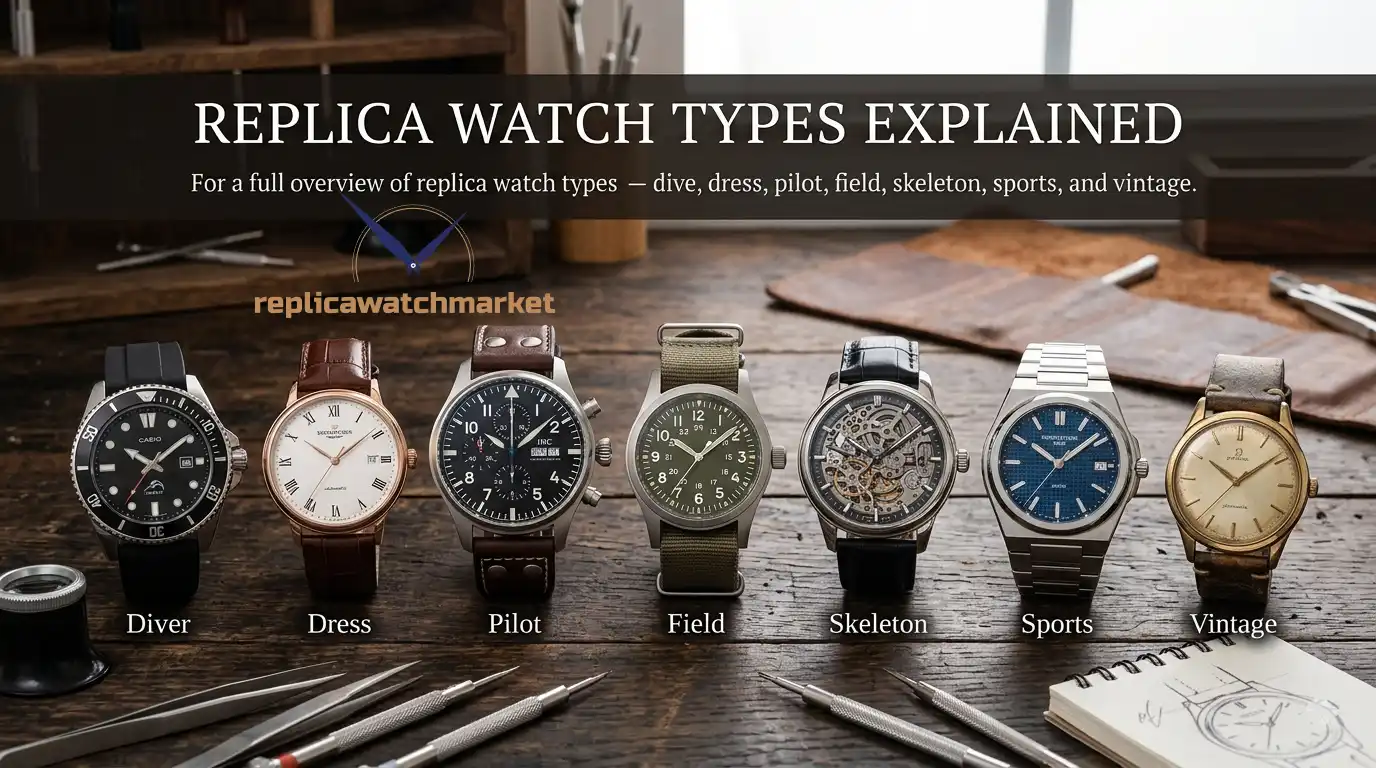
Not all watches are built for the same purpose — and understanding the difference between a dive watch and a dress watch, or a pilot watch and a field watch, is one of the most practical things a replica watch buyer can know before making a purchase. Each watch type has its own design logic, its own set of quality checkpoints, and its own movement requirements. This guide covers all seven main replica watch categories in detail: what defines them, how they're built, and what separates a well-executed replica from a poor one in each category. For a broader introduction to the replica watch world, see our Replica Watch Guide: Quality, Movements & Expectations.
Replica Watch Types at a Glance
| Watch Type | Typical Case Size | Water Resistance | Movement | Best For |
|---|---|---|---|---|
| Dive Watch | 40–44mm | 200m+ | Automatic | Everyday versatility |
| Dress Watch | 36–40mm | Splash only | Auto / Manual | Formal & office |
| Pilot Watch | 42–46mm | 100m | Automatic | Statement & aviation fans |
| Field Watch | 36–42mm | 100m | Auto / Manual | Understated utility |
| Skeleton Watch | 40–44mm | Limited | Auto / Manual | Movement display |
| Sports Watch | 40–44mm | 100–300m | Automatic | Active & prestige |
| Vintage Watch | 36–39mm | Splash only | Auto / Manual | Collectors |
1. Dive Watch
The dive watch is the dominant category in the replica market — and for good reason. The design language is iconic, the references are universally recognised, and the combination of a rotating bezel, bold dial, and robust case architecture produces a watch that works equally well underwater, in the office, or at a dinner table. No other watch category has the same versatility.
A dive watch is defined by a specific set of functional requirements: water resistance of at least 200 metres, a unidirectional rotating bezel for tracking elapsed dive time, luminescent indices and hands for low-light legibility, a screw-down crown to prevent water ingress, and a secure bracelet or strap. The ISO 6425 standard formalises these requirements — a watch meeting this standard is a genuine diver's instrument, not just a water-resistant sports watch.
In the replica market, dive watches dominate production. The most replicated references draw from Rolex Submariner, Sea-Dweller, and Deepsea designs, alongside Omega Seamaster Planet Ocean, Blancpain Fifty Fathoms, Tudor Black Bay, and Panerai Submersible inspired pieces. Each reference has distinct proportions, bezel insert materials, and dial layouts — a Submariner-inspired replica and a Seamaster-inspired replica are very different watches despite sharing the same functional category.
Quality evaluation for replica dive watches centres on four areas. First, bezel execution — the insert material, click count, rotation resistance, and alignment of the pip marker at 12 o'clock. Second, lume quality — brightness, colour consistency, and even application across all indices and hands. Third, crown sealing — whether the screw-down crown engages fully and the crown tube shows no gaps or misalignment. Fourth, case and bracelet finishing — the transition between brushed and polished surfaces, end link fit, and overall dimensional accuracy against the genuine reference.
Water resistance claims on replica dive watches should be approached carefully. High-grade references use proper gasket systems and screw-down crowns that provide genuine water resistance in daily use — swimming and showering are generally safe. However, no replica dive watch should be assumed to meet the full ISO 6425 specification without independent pressure testing. The sealing design may be correct, but manufacturing tolerances vary, and a watch that passes a visual QC check may not hold its rated depth under actual pressure.
The ceramic bezel insert has become the standard on high-grade dive watch replicas, replacing the earlier aluminium inserts used on vintage-era references. Ceramic inserts are harder, more scratch-resistant, and hold their colour and gloss better than aluminium over time. The colour accuracy, surface finish, and pip alignment of the ceramic insert are primary QC checkpoints on modern dive watch replicas.
→ Replica Watch Water Resistance Guide: ATM Ratings, Sealing Systems & What They Mean in Practice
2. Dress Watch
The dress watch occupies the opposite end of the design spectrum from the dive watch. Where dive watches are built for performance and visual impact, dress watches are built for restraint — slim profiles, clean dials, minimal complications, and an aesthetic that disappears into a shirt cuff rather than demanding attention.
A dress watch is characterised by a case diameter typically between 36mm and 40mm, a case thickness under 10mm, a leather strap rather than a metal bracelet, and a dial that carries only the functions needed — time only, or time with date. The movement is typically automatic or manual, reflecting the dress watch's heritage as an object of craft rather than function. Quartz movements are uncommon in genuine dress watches above entry level, and rare in replica dress references that draw from prestigious genuine designs.
The most replicated dress watch references draw from Patek Philippe Calatrava, Jaeger-LeCoultre Master Ultra Thin, A. Lange & Söhne Saxonia, and Rolex Datejust designs. Each represents a different expression of the dress watch philosophy — the Calatrava in its purest, most architectural form; the Datejust as a versatile dress-sport hybrid; the Saxonia as a showcase of German precision finishing.
Quality evaluation for replica dress watches is more demanding than for sport watches in one specific way: there is nowhere to hide. Without a rotating bezel, heavy lume application, or complex case architecture to draw the eye, every detail of the dial is directly visible — printing sharpness, hand finishing, index alignment, surface texture. Dial quality is the primary visual criterion for dress watch replicas, and imperfections that would be less visible on a sport dial are immediately apparent on a clean dress watch layout.
Case thickness is the most critical dimensional specification for dress watch replicas. Genuine dress watches achieve their slim profiles through carefully engineered ultra-thin movements. Replica dress watches using standard automatic movements may have slightly thicker cases than the genuine references they draw from — buyers should verify case thickness specifications before purchasing and compare them to the genuine reference.
Exhibition casebacks are common on dress watch replicas, displaying the movement as a secondary aesthetic feature. Movement finishing quality — bridge layout, rotor engraving, jewel colour — is more visible and more relevant on a dress watch than on a sport watch. Leather strap quality also carries more weight here than on a sport reference — the strap is the dominant material on the wrist, and its texture, stitching, and lining quality contribute directly to the impression the watch makes.
→ The Ultimate Guide to Replica Rolex Datejust Models: Style, Quality, and Value
3. Pilot Watch
The pilot watch — also called an aviator watch — carries one of the clearest functional design briefs in watchmaking: be readable in a moving cockpit, operable with gloved hands, and reliable under the demanding conditions of aviation. Every design element of a genuine pilot watch follows from these requirements, and that functional clarity is what gives pilot watches their distinctive, purposeful aesthetic.
A pilot watch is defined by a large case diameter — typically 42mm to 46mm — for easy dial reading, a highly legible dial with large Arabic numerals and high-contrast colour scheme, luminescent hands and markers, and an oversized crown for operation with aviation gloves. Many pilot watch references include additional complications relevant to aviation: slide rule bezels for navigation calculations, GMT hands for multi-timezone tracking, or chronograph functions for elapsed time measurement.
The most replicated pilot watch references draw from IWC Pilot's Watch Big Pilot and Mark series, Breitling Navitimer, Longines Heritage Pilot, and Hamilton Khaki Pilot designs. Each occupies a different position within the pilot watch category — the Big Pilot as the most dramatic expression of the oversized aviator aesthetic, the Navitimer as the quintessential tool watch with its functional slide rule bezel, the Mark series as a more understated, wearable interpretation of the same design language.
Quality evaluation for replica pilot watches centres on dial legibility and bezel function. Dial printing quality — sharpness and consistency of Arabic numerals, hand proportions, lume application — is the primary visual criterion. For Navitimer-inspired references, the slide rule bezel must rotate smoothly and the scale markings must be clearly printed and correctly aligned — this is a frequently flagged issue on lower-grade replicas where the slide rule graduations are poorly reproduced or misaligned.
Case size is a practical consideration for pilot watch buyers. The combination of large diameter and extended lug-to-lug distance that defines the pilot watch silhouette can result in significant wrist overhang on smaller wrists. Buyers should check the lug-to-lug measurement of the specific reference they're considering and compare it to their wrist circumference before purchasing.
Canvas straps — particularly olive or black NATO-style configurations — are strongly associated with the pilot watch aesthetic and give a more utilitarian character to the watch. The strap choice significantly affects how the watch reads on the wrist — a canvas strap emphasises the aviation tool heritage while a metal bracelet gives a more contemporary, versatile presentation.
→ The History of Breitling Watches: Aviation, Chronographs, and the Navitimer · Complete Replica Breitling Buyer Guide
4. Field Watch
The field watch is perhaps the most honest category in watchmaking — a design defined entirely by what it needs to do rather than what it needs to look like. Legible under stress. Durable in the field. Simple enough to use without thinking. These three requirements produce a design language that is immediately recognisable: clean, purposeful, and entirely without decoration for its own sake.
A field watch originated as a military-issue timepiece designed for ground-based operational use. The defining characteristics are a medium case diameter — typically 36mm to 42mm — with a slim profile, a highly legible dial with large Arabic numerals or bold indices, luminescent hands and markers, a canvas or leather strap, and a simple automatic or manual movement without unnecessary complications. Case finishing is typically brushed or matte throughout — polished surfaces have no place on a field watch reference, and their presence is a design inconsistency that undermines the military specification aesthetic.
The field watch category overlaps significantly with the pilot watch — both share legibility-focused dial design and utilitarian case construction, and both draw from military specification heritage. The primary differentiator is context: field watches reference ground-based military use, pilot watches reference aviation. References inspired by British MOD-specification watches, Hamilton Khaki Field, and similar ground-forces tool watches are field watches. References inspired by IWC Pilot or Breitling Navitimer are pilot watches.
In the replica market, field watches represent a smaller share of production than dive or sport references but attract a dedicated audience of buyers who prefer understated, historically-grounded designs. The field watch aesthetic translates well into replica production — the design requirements are straightforward, the case architecture is clean, and the absence of complex complications simplifies the movement specification. Miyota-based automatic calibres are standard in most field watch replicas and represent an appropriate movement specification for the category.
Quality evaluation for replica field watches centres on dial legibility and finishing consistency. Numerals and indices must be sharply printed and correctly sized for immediate readability. Lume application on hands and indices must be even and consistent — uneven lume is more visible on a field watch dial than on a heavily decorated sport dial. Brushed finishing must be consistent in direction and depth across all case surfaces, with no polish bleeding into brushed areas.
Strap choice matters significantly on field watch references. A canvas NATO strap or simple leather strap with period-appropriate stitching is correct for the category — a metal bracelet undermines the utilitarian design language. Lug width on most field watch references is standard at 20mm or 22mm, making strap swapping straightforward without tools.
5. Skeleton Watch
The skeleton watch inverts the normal relationship between a watch and its movement. Where conventional watches conceal their mechanics behind a solid dial, the skeleton watch removes material from the dial, movement plates, and bridges to expose the mechanical architecture directly to view. The movement is no longer a hidden engine — it becomes the primary visual element of the watch.
Skeletonisation requires significant additional machining and finishing work on the movement, as every newly exposed surface must be finished to the same standard as the outer surfaces visible before skeletonisation. In genuine watchmaking, skeleton movements represent considerable additional cost and craftsmanship. In replica production, the approach varies: some skeleton references use genuinely open-worked movements, others use skeleton-style dials applied over conventional movements to simulate the effect. The distinction matters — a true skeleton replica has movement architecture visible through the dial apertures, while a skeleton-style dial is a cosmetic treatment applied to a conventional movement.
The most common movement in replica skeleton references is the Skeleton Miyota 9015 Clone — an open-worked automatic calibre that provides a reliable base movement with visible gear train architecture through the dial. Tourbillon-inspired skeleton references combine open-worked movement architecture with a rotating tourbillon cage as the centrepiece, producing the most visually complex references in the replica market.
Quality evaluation for skeleton replica watches is demanding because the movement is completely exposed to scrutiny. Every surface visible through the dial apertures — bridges, plates, wheels, balance cock, jewel settings — is a quality checkpoint. High-grade skeleton replicas show clean edge bevelling, consistent surface finishing, and correctly proportioned movement architecture. Lower-grade references may show rough machining marks, simplified bridge layouts, or inconsistent finishing that is immediately apparent through the open dial.
Exhibition casebacks are standard on skeleton watch references, displaying the movement from both front and back. QC evaluation should cover both dial-side and caseback-side movement views, as finishing quality on the caseback-facing surfaces may differ from the dial-facing surfaces on some references.
Skeleton watches require slightly more care in ownership than conventional references. The open movement architecture creates pathways for dust to enter through dial apertures — skeleton replica watches should be stored in a pouch or case when not being worn, and service intervals should account for potential dust contamination.
6. Sports Watch
The sports watch is the broadest and most commercially significant category in the replica market. It encompasses any timepiece designed for active, outdoor, or physically demanding use — defined not by a single functional specification but by a combination of durability, water resistance, functional features, and an aesthetic that communicates capability. The category includes dive watches, GMT watches, chronographs, and integrated bracelet designs — and the most prestigious and widely replicated references in the world fall within it.
The most replicated sports watch references include the Rolex GMT-Master II, Daytona, and Yacht-Master; the Audemars Piguet Royal Oak and Royal Oak Offshore; the Patek Philippe Nautilus and Aquanaut; the Richard Mille RM series; and the Hublot Big Bang. Each occupies a distinct position in the sports watch hierarchy — from the GMT-Master II's understated tool watch heritage to the Royal Oak's architectural integrated bracelet design to the Big Bang's aggressive contemporary aesthetic.
Quality evaluation for replica sports watches consistently focuses on case and bracelet finishing. Sports watches typically combine brushed and polished finishing across complex case geometries — and the transition between these surfaces is one of the primary quality differentiators between replica grades. High-grade sports watch replicas show clean, consistent finishing transitions with no bleeding between surface types. Lower-grade references may show inconsistent brush direction or simplified case geometries that reduce the complexity of the finishing work required.
Integrated bracelet references — Royal Oak, Nautilus, and similar — present the most demanding QC evaluation challenges in the replica market. The bracelet must flow visually from the case without gaps, misalignment, or finishing inconsistencies at the lug-to-bracelet interface. End link fit — how the first bracelet link seats against the lug — is the most consistently flagged issue on integrated bracelet replica references. A gap or misalignment at this junction undermines the entire design intent of the watch.
Sports watches with chronograph complications — Daytona and similar inspired references — require additional QC evaluation of pusher function, subdial alignment, and chronograph hand reset accuracy. These are the most mechanically complex replica references in the sports category and quality variation between grades is most apparent in chronograph function. The chronograph pushers should engage and release cleanly, the elapsed time hand should return precisely to zero on reset, and the subdial registers should be correctly calibrated.
The sports watch category spans the widest price range in the replica market. Movement quality, case material, bracelet construction, and finishing precision all scale significantly across grades. Buyers should define their priority — movement quality, visual accuracy, or bracelet construction — and allocate budget accordingly rather than defaulting to the highest-priced option without a clear evaluation framework.
→ Complete Replica Audemars Piguet Buyer Guide · Complete Replica Hublot Buyer Guide
7. Vintage Watch
The vintage watch category occupies a unique position in the replica market. In the genuine watch world, "vintage" means original examples from earlier production eras — watches valued for their historical provenance, material patina, and design authenticity. In the replica world, "vintage" means something different: modern productions inspired by the design language of historical references, intentionally recreating the aesthetic character of older watches rather than their current counterparts.
A vintage-inspired replica watch is characterised by smaller case diameters — typically 36mm to 39mm rather than modern 40mm to 42mm standards — aged or patinated dial treatments, warm-toned lume colours rather than the blue-white of modern compounds, domed crystals rather than flat sapphire, and period-correct case profiles that differ from their contemporary equivalents. These design elements collectively recreate the visual character of watches from the 1950s through the 1980s — an era that many collectors consider the aesthetic high point of modern watch design.
The most replicated vintage-inspired references draw from the Rolex Submariner lineage — particularly the 5512, 5513, and 1680 references — the Paul Newman Daytona dial variations, the Explorer reference 1016, and Tudor Black Bay-inspired designs that themselves reference the original Tudor dive watch heritage. Each of these references has a specific set of period-correct details — gilt printing, matte dials, chapter ring layouts, specific handset profiles — that distinguish it from both the modern version and other vintage references.
Quality evaluation for vintage-inspired replica watches centres on the accuracy of aged treatments and period-correct details. Dial patina simulation — cream or warm-toned lume plots, aged printing colour, tropical dial effects — must be applied consistently and convincingly. Poorly executed ageing looks obviously artificial and undermines the entire premise of the watch. High-grade vintage replica references apply aged treatments that closely resemble genuine patina under close examination; lower-grade references show obvious inconsistency that is immediately apparent in QC photos.
The domed crystal is one of the most important period-correct details on vintage-inspired replica references. The dome profile significantly affects how light interacts with the dial, producing the characteristic distortion at the edges that gives vintage watches their distinctive visual character. Crystal dome height and clarity are primary QC checkpoints for vintage-inspired references — an incorrect crystal profile immediately breaks the period-correct illusion regardless of how well the dial and case are executed.
Lume colour is a detail that separates buyers who know vintage references from those who don't. Pre-Superluminova era watches used Tritium lume compounds that aged to a characteristic warm cream colour over decades. Vintage-inspired replica references should replicate this aged colour — and on the best vintage replica references, the warmth of the lume plots and hands is a primary contributor to overall period authenticity. Buyers evaluating vintage-inspired replicas should specifically check lume colour in QC photos and compare it to reference images of the genuine vintage watch being replicated.
QC Checklist by Watch Type
| Watch Type | Primary QC Check | Secondary QC Check | Common Issue |
|---|---|---|---|
| Dive Watch | Bezel pip alignment | Lume consistency | Crown tube gap |
| Dress Watch | Dial printing quality | Case thickness | Movement finishing |
| Pilot Watch | Dial legibility | Slide rule bezel alignment | Crown proportions |
| Field Watch | Brushed finishing | Lume evenness | Polish bleeding |
| Skeleton Watch | Movement finishing | Caseback view | Rough machining |
| Sports Watch | Brushed/polished transition | End link fit | Bracelet gaps |
| Vintage Watch | Patina consistency | Lume colour | Crystal dome height |
Which Watch Type Is Right for You?
The right watch type depends on how you intend to wear it and what you value in a watch. If versatility is the priority — a watch that works for daily wear, weekend activities, and occasional formal occasions — the sports watch or dive watch covers the most ground. If you want something with a specific aesthetic purpose, the dress watch for formal contexts or the vintage-inspired reference for a collector-oriented sensibility may be more appropriate. Pilot and field watches suit buyers drawn to functional, legible design with military heritage. Skeleton watches are for buyers who want to display mechanical craft as the primary visual feature.
Understanding the category you're buying into also sharpens your QC evaluation. Each watch type has its own quality checkpoints — and knowing what matters for a dive watch is different from knowing what matters for a dress watch or a skeleton reference. The glossary entries linked below provide detailed definitions of the specific features and terms relevant to each category.
Related Glossary Terms
Dive Watch · Dress Watch · Pilot Watch · Field Watch · Skeleton Watch · Sports Watch · Vintage Watch · Unidirectional Bezel · Chronograph · Exhibition Caseback · Integrated Bracelet · Tourbillon Inspired · Skeleton Miyota 9015 Clone · ISO 6425 · Tritium
Frequently Asked Questions
What is the most versatile replica watch type for everyday wear?
The dive watch is the most versatile replica watch type for everyday wear. Its combination of water resistance, robust case construction, and legible dial makes it appropriate for a wide range of contexts — from casual daily wear to office environments to social occasions. Submariner and Seamaster-inspired references in particular transition well between settings without looking out of place in any of them.
What is the difference between a pilot watch and a field watch?
Both pilot watches and field watches are legibility-focused military-heritage designs, but they reference different contexts. Pilot watches originate from aviation specification requirements — they typically have larger cases, oversized crowns for gloved operation, and often aviation-specific complications like slide rule bezels or GMT functions. Field watches originate from ground-based military use and tend to be slightly smaller, simpler, and more stripped-back in their design. References inspired by IWC Pilot or Breitling Navitimer are pilot watches; references inspired by Hamilton Khaki Field or British MOD-spec watches are field watches.
Are replica skeleton watches reliable for daily wear?
Replica skeleton watches using established calibres like the Skeleton Miyota 9015 Clone are mechanically reliable for daily wear. The reliability concern specific to skeleton watches is dust ingress through the open dial apertures — skeleton watches should be stored in a pouch or case when not worn and may require more frequent servicing than conventional references. They are not appropriate for dusty or dirty environments. For buyers who prioritise mechanical reliability above all else, a conventional closed-dial automatic reference is a safer choice.
What should I look for when evaluating a replica dive watch in QC photos?
The four primary checkpoints for replica dive watch QC photos are: bezel insert quality and pip alignment at 12 o'clock; lume application consistency and colour across all indices and hands; crown engagement and crown tube fit; and case and bracelet finishing — particularly the transition between brushed and polished surfaces and end link fit. Lume shots taken in darkness are an essential part of any dive watch QC review, as lume quality is a defining feature of the category and not visible in standard daylight photos.
Is a replica dress watch suitable for swimming or daily water exposure?
Generally no. Replica dress watches use push-pull crowns rather than screw-down crowns, and their slim case profiles leave less room for the gasket systems that provide meaningful water resistance. Light splashes and handwashing are typically fine, but swimming, showering, or any sustained water exposure is not recommended for most dress watch replicas. If water resistance is important to you, a sports or dive watch reference is the correct category.
What makes vintage-inspired replica watches different from standard replicas?
Vintage-inspired replica watches are modern productions built to replicate the design language of historical references rather than current production models. The key differences are smaller case diameters (typically 36mm to 39mm), domed crystals rather than flat sapphire, aged dial treatments with warm cream lume tones rather than modern blue-white compounds, and period-correct case profiles and printing styles. They are not aged original watches — they are new watches made to look like old ones. The quality of the ageing treatment and the accuracy of the period-correct details are the primary evaluation criteria.
Which replica watch type holds up best over time?
Sports and dive watch replicas generally hold up best over time due to their robust case construction, screw-down crowns, and metal bracelets. The same features that make them durable in use — thick cases, proper sealing systems, solid bracelet links — also make them more resistant to the effects of daily wear. Dress watches with leather straps require strap replacement over time, and vintage-inspired references with aged dial treatments may show accelerated wear of the patina simulation under heavy use. Skeleton watches are the most maintenance-intensive category due to the dust exposure risk from open dials.