On this page 14 sections
Article at a glance
- Reading time
- 14 minutes
- Article length
- 2,973 words
Water resistance is one of the most misunderstood specifications in the replica watch market. Buyers see "5 ATM" or "10 ATM" in a product listing and assume it means the watch can handle swimming, showering, or daily water exposure without issue. In most cases, that assumption leads directly to water damage — and water damage is not covered under any buyer protection policy.
This guide explains what water resistance actually means in replica watches, how ATM ratings translate to real-world use, why replica water resistance differs from genuine luxury watch specifications, and what daily habits protect your watch from moisture damage. For a broader foundation on replica watch quality and materials, see our Replica Watch Guide.
What ATM Actually Means
ATM stands for atmospheres — a unit of pressure. One ATM equals approximately 10 meters of static water pressure. A watch rated at 5 ATM is theoretically tested to withstand pressure equivalent to 50 meters of water depth under controlled laboratory conditions.
The critical word is static. Laboratory testing applies steady, controlled pressure to a watch in a dry environment. Real-world water exposure — hand washing, rain, swimming — creates dynamic pressure that is significantly higher than static ratings suggest. A hand entering water at normal speed generates pressure spikes well above static equivalents. This is why a 5 ATM rating does not translate to safe swimming, and why even a 10 ATM rating does not make a replica watch suitable for water sports.
ATM ratings in replica watches reflect design inspiration from the original model — not independently verified pressure testing of the replica piece itself. This distinction matters significantly when setting expectations.
ATM Ratings vs Real-World Use
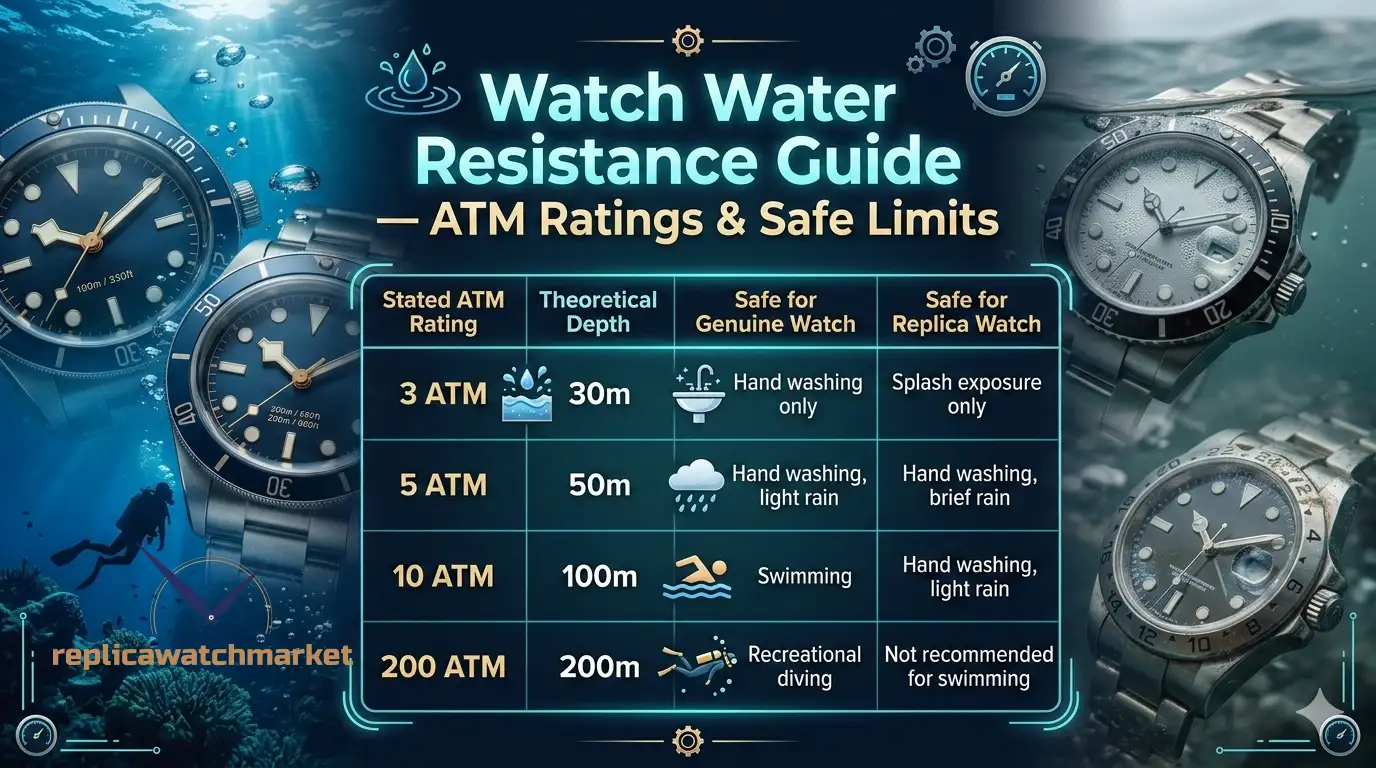
| Stated ATM Rating | Theoretical Depth | Safe for Genuine Watch | Safe for Replica Watch |
|---|---|---|---|
| 3 ATM | 30m | Hand washing only | Splash exposure only |
| 5 ATM | 50m | Hand washing, light rain | Hand washing, brief rain |
| 10 ATM | 100m | Swimming | Hand washing, light rain |
| 20 ATM | 200m | Recreational diving | Not recommended for swimming |
The replica column is consistently more conservative than the genuine column. This reflects the reality that gasket quality, case tolerances, and seal integrity in replica watches are not equivalent to genuine luxury watch manufacturing standards — regardless of the ATM number listed.
5 ATM — What It Means for Your Replica Watch
Every replica watch in the ReplicaWatchMarket catalog is rated at 5 ATM. This rating is consistent across all references — from Rolex Submariner-inspired pieces to dress references — and reflects the design specification of the original models rather than independently tested pressure performance of the replica pieces themselves.
5 ATM corresponds to 50 meters of static water pressure under controlled laboratory conditions. In practice, for a replica watch, this translates to a specific set of safe and unsafe activities that every owner should understand before wearing the watch near water.
What 5 ATM Is Safe For
Hand washing is safe under 5 ATM — brief contact with running water at normal temperature with the crown fully closed presents no meaningful risk. Light rain is safe under the same conditions: brief exposure, crown closed, dried off afterwards with a soft cloth. Sweat from normal daily activity and light exercise is safe — wipe the watch down after extended wear in warm conditions.
What 5 ATM Is Not Safe For
Hot showers are not safe at 5 ATM — the combination of heat, steam, and direct water pressure degrades gaskets faster than any other common exposure. Swimming is not safe — dynamic water pressure during swimming generates force well above what 5 ATM static testing covers. Saunas and steam rooms are the most damaging environment for any replica watch regardless of ATM rating — thermal expansion cycles and steam penetration degrade gasket integrity rapidly. High-pressure water — taps at full pressure, hoses, pressure washing — is not safe at any ATM rating.
Why All Our Watches Share the Same 5 ATM Rating
The 5 ATM rating across all references reflects an honest statement of practical water resistance for replica watches at AAAA+ grade — regardless of what the original genuine reference claims. A genuine Rolex Submariner is rated to 300 meters. A replica Submariner is rated to 5 ATM. This is not a compromise on quality — it is an accurate statement of the sealing standard achievable in replica production without individual pressure certification. Listing a higher ATM number would be misleading about real-world performance.
The practical implication is the same across all references in the catalog: hand washing and brief rain are safe, showers and swimming are not, and the crown should never be operated when wet. This applies equally to a replica dive watch and a replica dress watch — the case design of the original does not change the gasket and sealing reality of the replica piece.
| Activity | 5 ATM Replica Watch |
|---|---|
| Hand washing (brief, normal temp) | ✅ Safe |
| Light rain (brief exposure) | ✅ Safe |
| Sweat from normal daily activity | ✅ Safe |
| Splashes during cooking or cleaning | ✅ Generally safe — dry off quickly |
| Hot shower or bath | ❌ Not safe — heat + steam damages gaskets |
| Swimming — pool or open water | ❌ Not safe — dynamic pressure exceeds rating |
| Sauna or steam room | ❌ Not safe — most damaging environment |
| High-pressure water | ❌ Not safe — forces moisture through seals |
| Snorkelling or diving | ❌ Not safe — regardless of reference design |
For the complete guide to daily habits that protect your watch from water damage over time, see the sections below on crown handling, how water damage accumulates, and what to do after unexpected water exposure.
Why Replica Water Resistance Differs from Genuine Watches
Genuine luxury watches undergo individual pressure testing before leaving the factory. Each watch is tested in a pressure chamber, with results recorded and certified. The gaskets used are precision-engineered to specific tolerances and replaced on a defined service schedule.
Replica watches do not undergo this process. Factory quality control exists — and higher-grade replicas use better sealing components than low-tier alternatives — but individual pressure certification does not occur. Gasket material quality, crown thread tolerances, and caseback seal consistency vary between production batches and individual units.
This does not mean replica watches cannot handle any water exposure. It means the stated ATM rating should be treated as a design reference rather than a verified performance specification. Understanding this distinction is the foundation of realistic water resistance expectations. For a broader discussion of how material quality affects replica watch performance, see our replica watch materials guide.
Gaskets, Seals, and Where Moisture Enters
A watch has three primary sealing points: the crown, the caseback, and the crystal. Each relies on a gasket — a rubber or synthetic ring — to prevent moisture entry. When any of these gaskets degrade, compress unevenly, or are not seated correctly during assembly, the watch becomes vulnerable to moisture infiltration even under light exposure.
Gasket degradation happens gradually. Heat accelerates it — hot showers and saunas are particularly damaging because thermal expansion and contraction cycles compress and deform gasket material faster than cold water exposure. Steam is worse than liquid water because it penetrates gaps that liquid surface tension would normally bridge.
In replica watches, gasket replacement is not part of standard pre-sale preparation. A watch may leave the facility with adequate sealing and lose that sealing over months of normal use — particularly if exposed to temperature fluctuations or steam environments repeatedly.
The Crown: The Most Vulnerable Point
The crown is the single most common moisture entry point on any watch — genuine or replica. This is because the crown must allow rotational movement while maintaining a watertight seal, which is mechanically more complex than a static seal at the caseback or crystal.
Two crown types appear across replica watches. Push-pull crowns are simpler and more common — they rely entirely on crown seal compression when pushed in. Screw-down crowns add a threaded locking mechanism for additional security — but only when fully screwed in. A screw-down crown that is not fully engaged provides no meaningful water resistance advantage over a push-pull crown.
Never operate the crown — pulling out, adjusting, or pushing in — when the watch is wet or submerged. Water entering through the crown during adjustment is one of the most common causes of internal moisture damage in replica watches. Always ensure the crown is fully returned to its closed position after any time or date adjustment.
What Is Safe for Daily Use
| Activity | Safe for Replica Watch? | Notes |
|---|---|---|
| Hand washing | ✔️ Generally safe | Avoid direct crown pressure, brief exposure |
| Light rain | ✔️ Generally safe | Brief exposure, not prolonged |
| Sweat during normal activity | ✔️ Generally safe | Wipe down after wear |
| Hot shower | ❌ Not recommended | Heat degrades gaskets, steam penetrates seals |
| Swimming — pool | ❌ Not recommended | Dynamic pressure exceeds static ATM rating |
| Swimming — open water | ❌ Not recommended | Additional pressure variance, salt exposure |
| Sauna or steam room | ❌ Not recommended | Most damaging environment for gaskets |
| High-pressure water | ❌ Not recommended | Forces moisture through any gap |
Strap and bracelet type also affects how water exposure impacts the watch in practice. Leather straps degrade quickly under repeated moisture contact and should be treated as dry-wear only — regardless of the case's ATM rating. For a full breakdown of which strap and bracelet types are suitable for which conditions, see our Replica Watch Strap & Bracelet Guide.
How Water Damage Happens in Practice
Water damage in replica watches rarely happens from a single dramatic submersion. More commonly it accumulates — repeated shower exposure over weeks, steam from a bathroom environment, or condensation from temperature changes between warm and cold environments. Each exposure may seem insignificant, but cumulative moisture infiltration gradually reaches the movement.
The first signs of internal moisture damage are often subtle: slight fogging under the crystal, irregular timekeeping, or intermittent crown resistance. By the time these signs appear, moisture has already reached internal components. At this stage, the damage is typically irreversible without professional disassembly and drying — and even then, corrosion on movement components may have already occurred.
This pattern — gradual accumulation rather than single event — is why water damage claims are difficult to assess after the fact and why water damage falls outside buyer protection coverage universally. For a full overview of common damage patterns and what is and is not covered, see our common replica watch problems guide.
Chronograph Watches and Water Exposure
Chronograph replica watches carry additional water resistance risk beyond standard time-only models. The pusher buttons — used to start, stop, and reset the chronograph — are additional case penetration points, each with its own gasket. This means chronograph watches have more potential moisture entry points than time-only models.
Never operate chronograph pushers when the watch is wet or near water. Pressing a pusher momentarily breaks the seal contact at that point, creating a brief gap through which moisture or steam can enter. Even a watch that has handled light rain exposure safely can be compromised by pusher operation immediately afterward.
If a chronograph replica watch gets wet, allow it to dry completely in a room-temperature environment before operating any pusher or the crown.
What to Do After Water Exposure
If a replica watch is exposed to more water than intended — caught in heavy rain, briefly submerged, or exposed to steam — take the following steps immediately.
First, do not operate the crown or any pushers while the watch is still wet. Second, dry the exterior gently with a soft microfiber cloth, paying particular attention to the crown area and any pusher gaps. Third, place the watch in a dry, room-temperature environment — not near a heat source, as heat accelerates gasket degradation further. Fourth, monitor the watch over the following 24 hours for fogging under the crystal, timekeeping irregularities, or any change in crown resistance.
If fogging appears under the crystal, the watch has moisture inside the case. At this point, continued use accelerates internal corrosion. Contact our support team before taking any further action. For a full overview of how to handle watch problems after delivery, see our replica watch care guide.
Water Damage and Buyer Protection
Water damage is excluded from buyer protection coverage at ReplicaWatchMarket under all circumstances. This is not an unusual policy — it reflects the universal position across the replica watch market and is consistent with how genuine watch manufacturers handle water damage claims outside of certified dive watch specifications.
The exclusion exists because water damage is cumulative, difficult to attribute to a single event, and directly related to owner handling decisions after delivery. A watch that arrives in correct condition and develops moisture damage during use falls outside the scope of seller responsibility by any reasonable standard.
Any water resistance ratings referenced in our product listings reflect the design inspiration of the original model — not a verified specification of the replica piece. Full buyer protection terms, including what is and is not covered, are documented on our Guarantee & Quality Policy page.
Final Thoughts
Water resistance in replica watches is a design reference, not a performance guarantee. ATM ratings reflect the original model's specification — not independent pressure testing of the replica piece. Gasket quality, crown sealing, and case tolerances in replica production vary in ways that make conservative water exposure habits not just recommended, but necessary.
The practical rules are simple: hand washing and brief rain exposure are generally safe. Showers, swimming, saunas, and steam environments are not. The crown should never be operated when the watch is wet. Chronograph pushers should never be pressed near or after water exposure. These habits cost nothing and prevent the most common form of irreversible replica watch damage.
For a complete guide to daily care habits that protect both movement and case over time, see our Replica Watch Problems & Care: Complete Owner Guide. For guidance on what to look for when choosing a replica watch with the best build quality for daily use, see our how to choose a high-quality replica watch guide.
Related Glossary Terms
ATM Rating · Caseback Seal · Crown Seal · Dynamic Pressure · Gasket · ISO 6425 · Pressure Testing · Push-pull Crown · Screw-down Crown · Static Pressure · Water Resistance
Frequently Asked Questions About Replica Watch Water Resistance
What does ATM mean on a replica watch?
ATM stands for atmospheres — a unit of static water pressure. A 5 ATM rating means the watch was designed to reference a model tested to 50 meters of static pressure under controlled laboratory conditions. In replica watches, this rating reflects design inspiration from the original model, not independently verified pressure testing. Real-world water exposure generates dynamic pressure significantly higher than static ATM ratings suggest.
Can I swim with a replica watch rated at 10 ATM?
No. Even a 10 ATM replica watch is not recommended for swimming. The ATM rating reflects the original model's design specification — not the replica's actual tested water resistance. Gasket quality and seal integrity in replica watches are not equivalent to genuine luxury watch manufacturing standards, making the real-world water resistance lower than the stated rating suggests.
Can I shower with a replica watch?
No. Hot showers combine steam, heat, and direct water pressure — all of which damage gaskets and seals faster than cold water exposure. Heat causes gasket material to expand and deform, reducing seal integrity over time. Steam penetrates gaps that liquid water surface tension would normally bridge. Repeated shower exposure is one of the most common causes of gradual moisture damage in replica watches.
Is light rain safe for a replica watch?
Brief light rain exposure is generally safe for most replica watches. The key factors are duration and crown position — ensure the crown is fully closed and avoid prolonged exposure. After rain contact, dry the watch gently with a microfiber cloth, paying particular attention to the crown area.
What does fogging under the crystal mean?
Fogging under the crystal indicates moisture has entered the case. This is an early warning sign of internal moisture damage. If fogging appears, stop wearing the watch immediately and do not operate the crown or any pushers. Place the watch in a dry environment and contact our support team before taking any further action. Continued use after fogging accelerates corrosion on internal movement components.
Why is the crown the most important part for water resistance?
The crown is a moving component that must maintain a watertight seal while allowing rotational adjustment — mechanically more complex than static seals at the caseback or crystal. Operating the crown while wet momentarily breaks seal contact, allowing moisture entry. This makes crown handling habits the single most important factor in preventing water damage during daily use.
Are chronograph replica watches more vulnerable to water damage?
Yes. Chronograph watches have pusher buttons as additional case penetration points, each requiring its own gasket. This creates more potential moisture entry points than time-only models. Never operate chronograph pushers when the watch is wet or immediately after water exposure.
Is water damage covered under buyer protection?
No. Water damage is excluded from buyer protection coverage at ReplicaWatchMarket under all circumstances. This reflects the universal position across the replica watch market. Full coverage terms are documented on our Guarantee & Quality Policy page.
Does a screw-down crown mean better water resistance?
Only when fully engaged. A screw-down crown that is not fully screwed in provides no meaningful water resistance advantage over a push-pull crown. Always fully screw down the crown after any adjustment, and verify it is fully closed before any potential water exposure.
Why is replica water resistance lower than genuine watches with the same ATM rating?
Genuine luxury watches undergo individual pressure testing before leaving the factory, with certified results. Replica watches do not undergo this process — ATM ratings reference the original model's design specification. Gasket material quality, crown thread tolerances, and caseback seal consistency in replica production vary between units and are not equivalent to genuine manufacturing standards.
What is the best way to protect a replica watch from water damage daily?
Four habits cover most situations: keep the crown fully closed at all times, remove the watch before showering or swimming, dry the watch with a microfiber cloth after any water contact, and never operate the crown or pushers when the watch is wet. For a complete daily care framework, see our daily wear guide.