On this page 9 sections
Article at a glance
- Reading time
- 6 minutes
- Article length
- 1,319 words
- Topic
- Replica Fundamentals
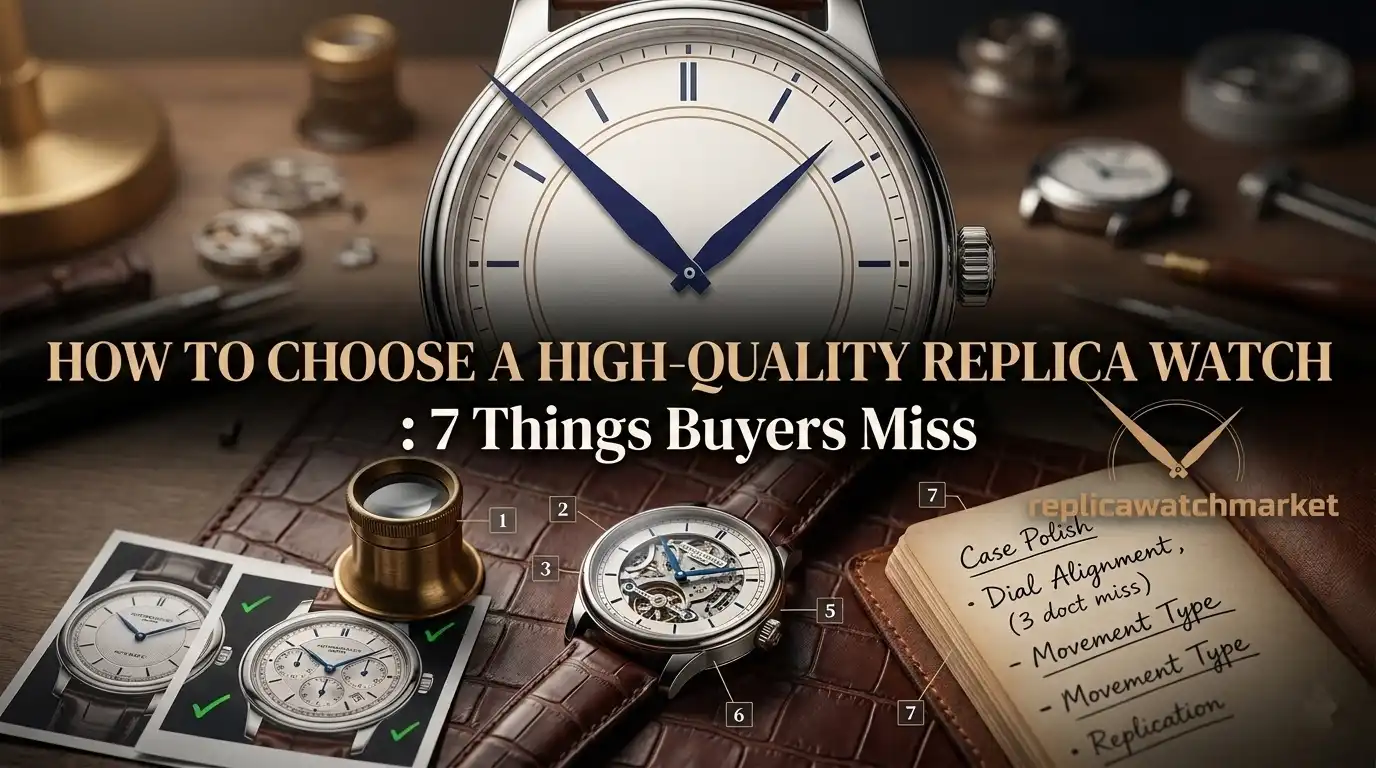
Before focusing on specific quality details, it's important to understand the overall buying process behind replica watches. Choosing a high-quality replica watch involves more than spotting individual features. It requires understanding how sellers operate, what trade-offs exist between quality tiers, and how to set realistic expectations when shopping online.
For a complete foundation on evaluating sellers, avoiding common risks, and making informed buying decisions, start with our guide on how to buy a replica watch online safely.
1. Movement Quality Matters More Than Brand Name
Most first-time buyers focus on the dial logo or bezel design. Experienced buyers look straight at the movement. A high-quality replica watch should use a reliable, serviceable movement — not a disposable one.
Automatic movements offer a traditional mechanical feel and a smooth sweeping seconds hand, making them appealing to buyers who value realism and classic watch behavior. Quartz movements provide higher accuracy, lower maintenance, and are often better suited for users who prioritize convenience and reliability.
What to look for: Japanese Miyota automatic or chronograph movements, smooth second-hand motion on automatic models, and consistent timekeeping over weeks — not days. If the movement type is not clearly listed by the seller, that is already a red flag.
For a deeper comparison of movement types and real-world performance differences, see our detailed guide on replica watch movements explained.
2. Case Material: Steel Type Is Not Just Marketing
Not all stainless steel is created equal. High-end replica watches use 904L stainless steel — the same alloy grade used by luxury Swiss manufacturers. Lower-quality replicas rely on generic 316L or unspecified steel mixes.
904L matters for four reasons: higher corrosion resistance, better polish and finishing, a heavier and more premium feel on the wrist, and a finish that maintains its shine significantly longer under daily wear. If a replica feels unusually light or dull, the case material is almost always the reason.
For a full breakdown of case construction, lug design, finishing quality, and what to check in QC photos, see the Replica Watch Case Guide.
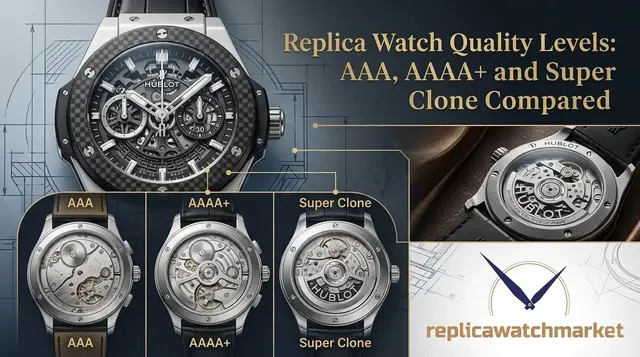
To understand how material grade affects quality tier classification, see our explanation of replica watch quality levels.
3. Crystal Quality: Sapphire vs Mineral Glass
Many buyers overlook the watch crystal — until scratches appear. The difference between sapphire and mineral glass is not subtle over time. Sapphire crystal is scratch-resistant, maintains optical clarity, and holds up under daily use for years. Mineral glass is cheaper, scratches easily, and dulls noticeably within months of regular wear.
A high-quality replica watch should always use sapphire crystal, particularly for daily wear. It directly affects long-term appearance and reduces visible wear far more than any other single component.
For a full technical breakdown of crystal types, anti-reflective coatings, and how crystal quality is assessed in QC photos, see the Replica Watch Crystal Guide.
4. Dial Details Reveal True Quality
Photos can hide flaws — but close inspection will not. A premium replica dial should have sharp and clean text printing, even lume application, correct spacing between markers, and no dust or alignment issues visible to the naked eye.
Common issues buyers miss include slightly crooked indices, inconsistent font thickness, and poor date window alignment. These details are easy to overlook in product photography but become obvious in person. Once noticed, they are difficult to ignore.
For a complete breakdown of every dial element — surface finish types, index evaluation, lume application, and a full QC checklist — see the Replica Watch Dial Guide.
5. Bracelet & Clasp: Comfort Is Quality
Many replicas fail not because of the case or dial — but because of the bracelet. A high-quality bracelet has solid links rather than hollow ones, smooth edges with no sharp cuts, a firm and precise clasp closure, and proper weight balance on the wrist.
A good replica should feel comfortable after hours of wear, not just minutes. Rubber straps should be flexible but firm — never sticky or excessively soft. Bracelet quality is one of the easiest indicators of overall production standard. For a full breakdown of every strap and bracelet type used in replica watches — including construction differences, daily use suitability, and what to check in QC photos — see our Replica Watch Strap & Bracelet Guide.
6. Water Resistance: Understand Realistic Limits
Most replica watches are not dive watches, even if they look like one. A 5 ATM rating — standard across most quality replica watches — is sufficient for light daily exposure such as rain or accidental splashes. Swimming, hot showers, saunas, and submersion are not recommended under any circumstances.
Any water resistance ratings referenced in product listings reflect the design inspiration of the original model — not a verified specification of the replica piece itself. Water damage is not covered under our buyer protection policy regardless of stated ATM rating. For a full technical explanation of what ATM ratings mean in practice and what daily exposure is genuinely safe, see our replica watch water resistance guide. For full buyer protection terms, see our Guarantee & Quality Policy.
7. Seller Transparency & After-Sales Support
Even the best replica watch needs proper handling — and a reliable seller should be part of that process. A trustworthy platform clearly lists movement type, provides real product photos, explains shipping timelines, offers responsive customer support, and shares care guidance after purchase.
If a seller avoids direct questions, uses vague descriptions, or cannot specify movement type and case material, that is a clear indicator of a low-quality operation. A professional store invests in long-term customer satisfaction — not just quick sales.
Final Thoughts: Buy Smart, Not Fast
Choosing a high-quality replica watch is not about luck — it is about knowing what to look for. A smart buying decision comes down to four things: a reliable movement, proper materials, realistic expectations, and a transparent seller. Focus on these and you will end up with a replica watch that looks impressive, feels premium, and performs reliably in everyday use.
For a complete conceptual framework covering quality tiers, terminology, and movement expectations, explore our Replica Watch Guide: Quality, Movements & Expectations.
Frequently Asked Questions About Choosing a High-Quality Replica Watch
Is a high-quality replica watch suitable for daily use?
Yes. With a reliable movement, proper materials, and reasonable care, a quality replica watch handles everyday wear comfortably. Mid-tier and higher models with Miyota or similar movements are specifically built for consistent daily performance. For detailed expectations, see our daily wear guide.
What is the best movement for replica watches?
Japanese Miyota movements are widely trusted for accuracy, durability, and serviceability. They are used across mid-tier and higher replica watches and offer consistent performance under daily use. For a full breakdown of movement types, see our movements explained guide.
Do replica watches scratch easily?
It depends on the crystal type. Mineral glass scratches easily and dulls within months of regular wear. Sapphire crystal — used in quality replica watches — is significantly more scratch-resistant and maintains clarity over years of daily use.
How long can a replica watch last?
With proper care — avoiding moisture exposure, protecting from strong shocks, and storing correctly — a high-quality replica watch can provide reliable performance for several years. The movement type and case material are the primary factors affecting longevity.
Is 904L steel really better than 316L?
Yes — meaningfully so. 904L offers better corrosion resistance, a deeper surface polish, and longer-lasting finish than standard 316L steel. The difference becomes most visible on brushed-to-polished surface transitions and during extended daily wear. It is also the alloy grade used by Rolex in genuine production.
How do I know if a replica watch seller is reliable?
A reliable seller clearly states movement type, case material, and crystal type for every product. They provide structured product descriptions, responsive communication, defined return terms, and buyer protection documentation. If specifications are vague or unavailable, that is a direct indicator of a low-quality operation. For a full evaluation framework, see our complete buying guide.
Related Technical Guides: Replica Watch Bezel Guide · Replica Watch Dial Guide · Replica Watch Case Guide · Replica Watch Crystal Guide