On this page 11 sections
Article at a glance
- Reading time
- 15 minutes
- Article length
- 3,230 words
The crystal is the most directly visible component on any watch — and one of the most consistently overlooked specifications when buyers evaluate replica watches. Most buyers check the dial, the bracelet, and the movement type. The crystal gets a passing glance at best. Yet crystal type, coating quality, and profile accuracy are among the clearest indicators of production grade, and their effects on long-term appearance and daily use are more consequential than most buyers realize before purchase.
This guide covers every crystal specification relevant to replica watch evaluation — material grade, hardness, anti-reflective coating, profile types, cyclops lens quality, and gasket integrity. Each section explains what the specification means, what it looks like in QC photos, and how it translates to daily ownership. For the broader quality and materials context that crystal specification sits within, see our replica watch materials guide and how to choose a high-quality replica watch.
Crystal Types: Sapphire, Mineral, and Acrylic
Three materials are used in watch crystal production across the full quality range — acrylic, mineral glass, and sapphire. Each occupies a distinct position in the market, and each produces a meaningfully different ownership experience. Understanding what each material is — not just what sellers claim about it — is the foundation of evaluating crystal specifications accurately.
Sapphire Crystal
Sapphire crystal is made from synthetic corundum — aluminium oxide grown into a single crystal structure and shaped to specification. It is the hardest material used in watch crystal production at Mohs 9, second only to diamond. Genuine luxury watches use sapphire as standard, and AAAA+ grade replica production follows the same specification. Sapphire is scratch-resistant under normal daily conditions, optically clear, and maintains its appearance over years of wear without visible degradation from the minor abrasion that daily contact produces.
Mineral Crystal
Mineral crystal is standard silica glass hardened through a tempering process. It rates approximately Mohs 5 — significantly softer than sapphire. Mineral crystal is the default at AAA grade and below. It is functional and optically clear at delivery, but its hardness deficit means it accumulates visible scratches from everyday contact within months of regular wear. For buyers who plan extended daily use, mineral crystal is a meaningful quality compromise. For occasional wear or frequent watch rotation, the practical impact is reduced.
Acrylic Crystal
Acrylic — also called hesalite or plexiglass — is a plastic material used on entry-level and vintage-style pieces. It rates Mohs 3, making it the softest of the three. Acrylic scratches easily but is highly impact-resistant due to its flexibility — it absorbs sharp impacts that would crack mineral or sapphire. Surface scratches on acrylic can be polished out with appropriate compounds, which is occasionally cited as an advantage. In practice, the need for regular polishing reflects the material's scratch vulnerability rather than a genuine benefit over harder alternatives.
| Material | Mohs Hardness | Replica Grade | Scratch Resistance | Impact Resistance | Daily Wear Suitability |
|---|---|---|---|---|---|
| Acrylic | 3 | Entry level | Poor | High | Occasional use only |
| Mineral Glass | 5 | AAA | Moderate | Moderate | Suitable with care |
| Sapphire | 9 | AAAA+ | Excellent | Low — brittle | Recommended for daily wear |
Crystal material is one of several specifications that determine replica grade — alongside steel grade, movement type, and finishing quality. For a complete introduction to how these specifications work together across the quality range, see our replica watch guide.
Crystal Hardness and Daily Wear Impact
Crystal hardness is not an abstract specification — it is what determines how a watch looks after six months of daily wear versus how it looked when it arrived. The Mohs scale is a relative hardness ranking: a material at any given value will be scratched by anything harder and will scratch anything softer. Common everyday materials that contact watch crystals — desk surfaces, sleeve cuffs, keys, quartz dust in the environment — sit at Mohs 6 to 7. A mineral crystal at Mohs 5 is softer than all of them. A sapphire crystal at Mohs 9 is harder than all of them.
The practical consequence is direct. Mineral crystal accumulates visible fine scratches within months of normal daily wear. These scratches are most visible under direct light at an angle and become progressively more noticeable over time. Sapphire crystal resists the same contact over years without visible degradation under normal conditions. For a buyer choosing between AAA and AAAA+ grade, this difference is the most visible durability gap over a multi-year ownership period — more visible than bracelet wear, more visible than case finish degradation, and more immediate than movement performance differences.
One important caveat: hardness and impact resistance are inversely related across crystal materials. Sapphire is hard but brittle — a sharp direct impact at the crystal edge can crack or chip sapphire in a way that more flexible mineral glass would survive. This is a property of the material, not a defect. Buyers who work in environments involving frequent physical impact should factor this into their crystal specification preference. Crystal damage from impact is one of several ownership realities covered in our Replica Watch Problems & Care guide.
Anti-Reflective Coating: Single vs Double-Sided
Anti-reflective coating — AR coating — is a thin optical layer applied to crystal surfaces to reduce light reflection and improve dial visibility. Without AR coating, a watch crystal reflects ambient light back toward the viewer, obscuring the dial in bright or angled lighting conditions. With correctly applied AR coating, the crystal becomes effectively transparent — the dial reads clearly regardless of light direction.
AR coating can be applied to the outer surface only, the inner surface only, or both surfaces. Single-sided outer coating reduces the most obvious source of glare — light reflecting off the top of the crystal — but leaves inner surface reflection, which can still obscure dial detail under certain lighting. Double-sided coating eliminates reflection from both surfaces, producing the maximum clarity associated with correctly executed AAAA+ production. At AAAA+ grade, double-sided AR coating on sapphire crystal is the specification.
The visual signature of correctly applied AR coating is a faint blue or green tint visible when the crystal is viewed under angled light. This tint is not a flaw — it is the optical byproduct of the coating's interference layer. A crystal that shows no tint under angled light is either uncoated or coated with a very thin single layer. Inconsistent tint across the crystal surface — stronger at the center, fading toward the edges — indicates uneven coating application, which affects both appearance and durability.
AR coating is more susceptible to damage than the sapphire beneath it. Harsh cleaning agents, abrasive cloths, and ultrasonic cleaners can strip or damage the coating layer without affecting the crystal itself. Cleaning with a soft microfiber cloth and avoiding chemical contact preserves coating integrity over time.
Crystal Profiles: Flat, Single-Dome, Double-Dome, and Box
Crystal profile — the shape of the glass — is a reference-specific specification. The same reference must use the same profile to read correctly. A flat crystal on a reference that specifies a double-dome produces a watch that looks visually wrong even if every other detail is accurate. Profile accuracy is part of what distinguishes AAAA+ production from lower-grade alternatives that substitute simpler profiles to reduce manufacturing cost.
Flat Crystal
A flat crystal has no curvature on either surface. It is the simplest profile to produce, the easiest to coat evenly with AR treatment, and the most consistent in QC photos. Flat crystals are correct on dress watches, field watches, and certain sport references where a flush low-profile crystal is part of the original design. On references that specify a flat profile, a flat crystal is the accurate specification — not a compromise.
Single-Domed Crystal
A single-domed crystal curves outward on its top surface while the inner surface remains flat. This produces a modest visual depth effect and a slightly raised profile above the case edge. Single-dome profiles appear on a range of sport and casual references and are more demanding to coat evenly than flat crystals due to the curved outer surface.
Double-Domed Crystal
A double-domed crystal curves on both its outer and inner surfaces. The outward curve raises the profile above the case, while the inward curve creates visual depth between the crystal surface and the dial beneath. The result is a sense of distance and dimension when looking through the crystal that flat or single-dome profiles do not produce. Double-dome execution requires precise reference-specific geometry — too flat and the depth effect is lost; too pronounced and the crystal sits incorrectly in the case.
Box Crystal
A box crystal has a strongly pronounced convex outer curve — more dramatic than a standard dome — producing a high, rounded profile that rises significantly above the case bezel. Box crystals are associated with vintage and vintage-inspired references where the high-dome profile is a defining visual element of the original design. The pronounced height makes box crystals more vulnerable to edge impact than lower-profile alternatives, and more technically demanding to coat evenly.
| Profile | Outer Surface | Inner Surface | Visual Effect | Typical References |
|---|---|---|---|---|
| Flat | Flat | Flat | Flush, no depth | Dress, field watches |
| Single-dome | Curved | Flat | Slight elevation | Sport, casual |
| Double-dome | Curved | Curved | Depth, dimension | Sport, dress references |
| Box | Strongly curved | Flat or curved | High vintage dome | Vintage-inspired references |
Cyclops Lens: Magnification and Quality Indicators
A cyclops lens is a small convex magnification lens mounted on the crystal above the date window. Its function is to magnify the date display — typically 2.5x on correctly executed pieces — for easier reading at a glance. The cyclops is a reference-specific detail associated with certain date and day-date models, and its presence, positioning, and magnification quality are among the most scrutinized details in replica watch evaluation.
Three quality indicators matter on a cyclops lens. First, magnification level — the date numeral should fill the lens clearly and be immediately readable at approximately 2.5x. A lens that magnifies less, or produces a blurred rather than sharp result, is off-specification. Second, centering — the lens must sit directly above the date aperture with no lateral or rotational offset. Even minor misalignment is immediately visible and cannot be corrected after fitting. Third, lens integration — the edge where the cyclops meets the surrounding crystal surface should be smooth and consistent, with no visible bubbling, irregular seam, or adhesive gap.
At lower replica grades, cyclops lenses are frequently applied as separate adhesive elements rather than formed as part of the crystal. Adhesive cyclops lenses lift, shift, and develop moisture ingress at the bond edge over time — failure modes not present on correctly manufactured integrated lens crystals. Reference accuracy also matters: not all date references use a cyclops, and applying one to a reference that does not specify it — or omitting it from one that does — is a specification error regardless of lens quality.
Crystal Gasket and Water Resistance
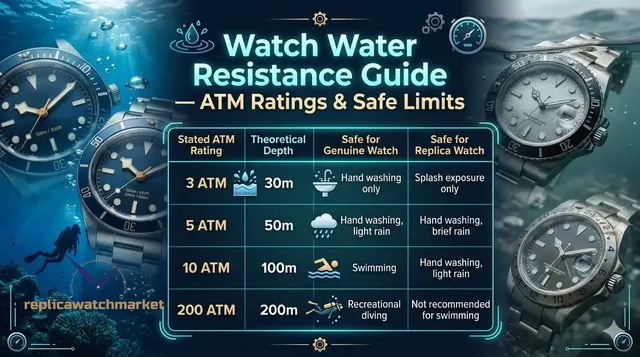
The crystal gasket is a rubber or synthetic sealing ring seated between the watch crystal and the case. It holds the crystal in place and provides the primary water resistance seal at the crystal-to-case junction. Along with the crown seal and caseback seal, it is one of three gasket points that determine a watch's real-world moisture resistance.
Crystal gasket quality is not visible in QC photos — it sits concealed within the case groove. Its condition is inferred from how the crystal seats against the case edge: a crystal that sits flush and even around its full circumference indicates a correctly fitted gasket. An uneven gap or a crystal that appears proud on one side indicates seating issues that affect both appearance and seal integrity.
Heat is the most damaging environmental factor for crystal gaskets — more damaging than cold water exposure. Hot showers, saunas, and steam environments cause gasket material to expand, compress, and deform over repeated cycles, reducing seal integrity progressively. This is one of several reasons why shower and steam exposure is not recommended for replica watches regardless of stated ATM rating. Fogging under the crystal — the first visible sign of moisture ingress — frequently originates at the crystal gasket after cumulative heat exposure rather than from a single dramatic water event. For a full technical explanation of how moisture damage occurs across all sealing points, see our replica watch water resistance guide.
How to Evaluate Crystal Quality in QC Photos
Crystal quality is one of the specifications most reliably assessable from QC photos — if you know what to look for and what photo conditions reveal each detail. The following checklist covers the key evaluation points.
QC Crystal Evaluation Checklist
- AR coating tint: View the crystal under angled light. Correct AR coating produces a consistent blue or green tint across the full surface. No tint indicates uncoated crystal. Patchy or fading tint indicates uneven application.
- Crystal profile: Request a side-angle shot. The crystal edge should show the correct profile for the reference — visible curve on domed references, dramatic elevation on box crystal references, straight edge on flat references.
- Crystal seating: Check the crystal-to-case junction around the full circumference. The crystal should sit flush and even. Any gap, unevenness, or proud edge indicates gasket seating issues.
- Cyclops centering: On date references with a cyclops, verify the lens sits directly above the date aperture. Request a top-down shot with the date set to confirm magnification level and alignment.
- Cyclops edge integration: The lens edge should be smooth and consistent against the surrounding crystal surface — no visible seam, bubbling, or adhesive gap.
- Dial clarity through crystal: Under the lighting conditions of the QC photo, the dial should read clearly without significant glare obscuring detail. Persistent glare on a claimed AR-coated crystal indicates insufficient or absent coating.
- Crystal surface condition: Check for dust, lint, or particles under the crystal — visible in top-down photos under direct light. These indicate assembly quality issues rather than crystal quality, but are worth flagging before approval.
Crystal Quality Across Replica Grades
Crystal specification follows replica grade closely — more closely than some other quality variables. At each tier, crystal type, coating, and profile accuracy are relatively consistent with the grade's overall production standard.
| Grade | Crystal Material | AR Coating | Profile Accuracy | Cyclops Quality |
|---|---|---|---|---|
| Entry / AAA | Mineral glass | None or single-sided | Often substituted flat | Adhesive, variable centering |
| AAAA | Sapphire | Single-sided | Generally correct | Integrated, mostly centered |
| AAAA+ | Sapphire | Double-sided | Reference-specific geometry | Integrated, correctly centered |
The grade gap that matters most for daily wear is between AAA and AAAA — the transition from mineral to sapphire crystal. This is where the long-term appearance difference becomes most visible over an ownership period measured in years. The gap between AAAA and AAAA+ is real but more subtle — double-sided AR coating and reference-specific profile geometry are meaningful improvements that experienced buyers will notice, particularly in QC photos and under direct comparison. For a complete breakdown of what each quality tier delivers across all specifications, see our replica watch quality levels guide.
Care and Maintenance by Crystal Type
Crystal care requirements vary by material. The habits that protect sapphire can damage acrylic, and vice versa. Understanding the correct approach for each material prevents accelerating the wear that the material is already most vulnerable to.
| Crystal Type | Cleaning Method | Avoid | Special Consideration |
|---|---|---|---|
| Sapphire with AR coating | Soft microfiber cloth, dry or lightly damp | Harsh chemicals, abrasive cloths, ultrasonic cleaners | AR coating is softer than sapphire — protect the coating |
| Sapphire without AR coating | Soft microfiber cloth | Abrasive materials | More tolerant of cleaning agents than coated sapphire |
| Mineral glass | Soft microfiber cloth | Abrasive materials | Surface scratches accumulate — avoid contact with hard surfaces |
| Acrylic | Soft cloth, plastic-safe polish for scratches | Solvents, alcohol-based cleaners | Solvents dissolve acrylic — use only plastic-safe products |
Across all crystal types, avoid exposing the watch to prolonged heat and steam — these degrade the crystal gasket beneath the glass rather than the crystal itself, but the resulting moisture ingress damages the dial and movement. For a complete daily care framework covering all watch components, see our replica watch care guide.
Related Glossary Terms
Anti-Reflective Coating · Box Crystal · Crystal Gasket · Crystal Hardness · Cyclops Lens · Double-Domed Crystal · Flat Crystal · Mineral Crystal · Sapphire Crystal
Frequently Asked Questions About Replica Watch Crystals
What crystal do most replica watches use?
AAA grade replica watches typically use mineral glass. AAAA and AAAA+ grade production uses sapphire crystal, with double-sided anti-reflective coating at AAAA+ grade. Entry-level pieces occasionally use acrylic. If a seller does not specify crystal type, asking directly is the most reliable way to confirm the specification before ordering.
How can I tell if a replica watch has sapphire crystal?
The most reliable method in QC photos is the AR coating tint check — correctly coated sapphire shows a faint blue or green tint under angled light. Uncoated sapphire and mineral glass both reflect white light without this tint, making them harder to distinguish without direct comparison. Asking the seller to confirm the crystal specification and cross-referencing with community reviews of the same piece provides additional verification.
Does anti-reflective coating make a visible difference?
Yes — significantly. An uncoated crystal on a dark dial produces noticeable glare under indoor lighting that partially obscures dial detail. Double-sided AR-coated sapphire eliminates this under most lighting conditions, allowing the dial to read clearly at all angles. The difference is most apparent in direct overhead light and when photographing the watch — coated crystals produce far better QC photos for exactly this reason.
What is the difference between single-dome and double-dome crystal?
A single-dome crystal curves outward on its top surface only. A double-dome curves on both surfaces — outer and inner. The inner curve creates visual depth between the crystal and the dial, producing a sense of dimension that single-dome and flat crystals do not replicate. The double-dome profile is reference-specific and most visible when viewing the watch at a slight angle rather than directly from above.
Can a scratched crystal be replaced?
Yes. Crystal replacement is a standard watchmaker service. A damaged sapphire or mineral crystal can be replaced with a correctly specified new crystal, with a new gasket fitted simultaneously. Local watchmakers can source replacement crystals for most common case dimensions. The cost is typically modest relative to the improvement in appearance — particularly on a watch where the movement and case remain in good condition.
Why does my crystal show fogging inside?
Fogging under the crystal indicates moisture has entered the case — typically through the crystal gasket, crown seal, or caseback seal after heat or steam exposure. This is not a crystal defect — it is a sealing failure caused by environmental exposure. If fogging appears, stop wearing the watch immediately and do not operate the crown or any pushers. Place the watch in a dry environment and contact support before taking further action. Continued wear after fogging accelerates internal corrosion.
Is sapphire crystal worth the upgrade from mineral at AAA grade?
For daily wear over an extended period, yes — it is the most consequential single specification upgrade between AAA and AAAA grade. The scratch resistance difference between Mohs 5 and Mohs 9 becomes visible within months of normal daily wear and compounds over time. Buyers who plan to wear a watch regularly for more than a year will notice the crystal material difference more than almost any other quality variable.
How do I check cyclops lens quality in QC photos?
Request a top-down shot with the date set to a single-digit number if possible — this makes magnification level immediately assessable. The date numeral should fill the lens clearly at approximately 2.5x. Check centering by verifying the lens sits directly above the date aperture with no lateral offset. Check edge integration by looking for a smooth, consistent boundary between the cyclops and the surrounding crystal surface — visible bubbling, an irregular seam, or an adhesive gap all indicate lower-grade construction.