On this page 12 sections
Article at a glance
- Reading time
- 16 minutes
- Article length
- 3,413 words
Choose what you want to solve first
Most issues are preventable with realistic expectations and simple habits. Pick the topic you need, then continue with the full owner guide.
Care & maintenance basics
Daily habits, cleaning, water caution, and what to avoid to reduce failure risk.
Open: Care guide →Common problems (new buyers)
What's normal vs a real fault — and how to interpret issues calmly.
Open: Common problems →Daily wear & durability
What's realistic for everyday use, and habits that protect long-term reliability.
Open: Daily wear →Water resistance explained
What ATM ratings actually mean for replica watches, safe limits, and how to avoid moisture damage.
Open: Water resistance guide →Before you decide (risk control)
Buying framework (full process)
The complete step-by-step flow: expectations, tiers, movements, pricing, seller checks, and timelines.
Open: Full buying framework →Buyer protection rules
Valid issues, required proof, and realistic outcomes if a real fault happens.
Open: Buyer protection →Movements & reliability
Movement type affects durability and what "normal behavior" looks like in daily use.
Open: Movements guide →Quality tiers & durability
What higher tiers really improve — and what they don't — for long-term use.
Open: Quality levels →Prefer browsing this topic like a library? Open Problems & Care Library →
Most replica watch disappointments have nothing to do with the watch itself. They come from a mismatch between what the buyer expected and what a replica watch actually is. Understanding that gap — before and after purchase — is what separates owners who enjoy their watches from those who regret them.
This guide covers what actually happens after you buy a replica watch. Not what marketing says, not what forum posts claim — what real ownership looks like. That includes common problems, why some watches fail early, what daily use realistically involves, how care habits affect lifespan, and how to tell the difference between a normal imperfection and a genuine defect that requires action.
Replica watches are not perfect. But informed owners rarely regret them — because they know what to expect before problems arise.
Understanding Replica Watch Ownership Reality
Replica watches sit between two worlds. They borrow the design language of luxury watches, but they are built under very different production constraints — different materials, different quality control standards, different tolerance levels. Accepting this gap is the foundation of a positive ownership experience. Owners who treat replicas as luxury watches are setting themselves up for frustration. Owners who treat them as what they are — well-designed consumer products with known limitations — rarely have regrets.
Expectations vs Reality
Many first-time owners subconsciously expect replica watches to behave like authentic luxury watches. This expectation usually comes from marketing photos, forum comparisons, or seller descriptions that focus exclusively on appearance. In reality, replicas are consumer products built to balance cost, visual appeal, and basic functionality — not lifelong heirlooms engineered to tolerances measured in microns. The finishing may vary between units. The movement may run slightly fast or slow. The bracelet may feel less solid than photos suggest. These are not failures — they are the reality of what replica watches are.
| Expectation | Reality |
|---|---|
| Perfect finishing on every unit | Minor imperfections are common |
| Luxury-level quality control | Factory-level QC with wider tolerances |
| Waterproof for swimming and showering | Limited splash resistance at best |
| Zero maintenance required | Basic care habits are necessary |
| Long-term investment value | Personal enjoyment item only |
Once this reality is genuinely accepted — not just intellectually acknowledged — most ownership frustration disappears permanently.
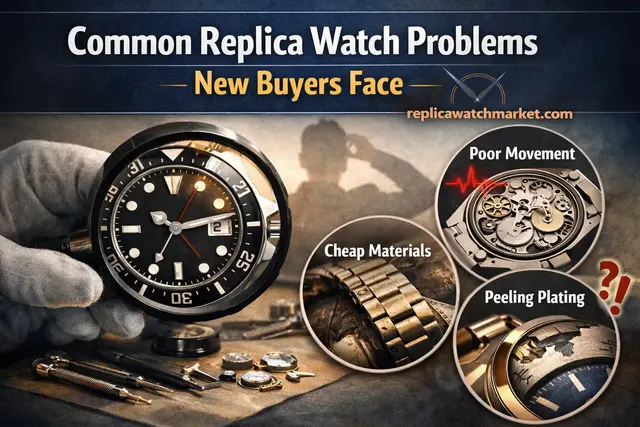
Common Replica Watch Problems New Owners Face
Problems do not affect every replica watch, but certain issues appear consistently enough across quality tiers and brands that every owner should understand them before they occur — not after.
Quality Mismatch
The most common concern among new buyers is that the watch received looks slightly different from product photos. This happens because replica watches are assembled with wider tolerances than luxury originals — dial printing alignment, bracelet finishing, and bezel fit can vary between units from the same batch. In most cases these differences are cosmetic and do not affect function. They are a known characteristic of replica production, not evidence of fraud or defect.
Movement-Related Issues
Replica movements vary widely in performance. Some keep time within a few seconds per day; others drift more noticeably. Common movement complaints include time running faster or slower than expected, a shorter power reserve than listed, and audible noise from the rotor or movement. None of these are automatically defects — they reflect the reality of movements that are not individually regulated to the standard of Swiss chronometer certification. For a detailed breakdown of how different movement types compare in practice, see our movements guide.
Water Resistance Myths
Water resistance is one of the most consistently misunderstood aspects of replica watch ownership. Many replicas are marketed as "water resistant" or reference the original model's water resistance rating — but this does not mean the replica has been individually pressure-tested to that standard. Gaskets vary in quality, case back seals are not always airtight, and crown seals on replica watches are rarely as robust as genuine luxury watches. In practice, most replica watches tolerate brief splash exposure but should not be submerged, worn in the shower, or taken into a pool. For a full technical breakdown of what ATM ratings mean in practice and how moisture damage actually occurs, see our replica watch water resistance guide.
| Problem | How Common | Typical Cause |
|---|---|---|
| Dial or bezel misalignment | Medium | Assembly tolerance |
| Bracelet noise or looseness | Common | Finishing level |
| Time accuracy drift | Common | Movement variance |
| Moisture ingress under crystal | Low–Medium | Water exposure |
| Short power reserve | Medium | Infrequent wear or movement quality |
Why Some Replica Watches Stop Working After a Few Months
When a replica watch stops working within the first few months of ownership, the cause is rarely a manufacturing defect in the traditional sense. In most cases, early failure is directly linked to usage habits or environmental exposure that the movement was not designed to withstand.
Usage Habits That Accelerate Wear
Replica movements are less forgiving than their authentic counterparts, and certain behaviors dramatically shorten their operational life. Setting the date during restricted hours — typically between 9 PM and 2 AM — stresses the date-change mechanism and can cause it to fail prematurely. Forcing the crown through winding or time-setting, operating chronograph pushers aggressively, or resetting a chronograph while the seconds hand is still moving all place strain on components that have narrower tolerances than genuine movements. These behaviors damage authentic watches too — they just damage replica movements faster.
Storage and Environmental Factors
Environmental factors contribute to early failure in ways that are easy to overlook. High humidity accelerates corrosion of internal components and seals. Strong magnetic fields — from speakers, laptop bags, or magnetic closures — can magnetize the movement's balance wheel and hairspring, causing erratic timekeeping or complete stoppage. Leaving automatic watches completely unworn for extended periods allows lubricants to settle and can cause the movement to seize. Repeated exposure to temperature extremes expands and contracts gaskets, eventually compromising what little water resistance exists. None of these factors alone guarantee failure, but most cases of unexplained early stoppage trace back to one or more of them.
Daily Use: Can Replica Watches Be Worn Every Day?
Yes — replica watches can be worn daily, but the answer depends entirely on what "daily use" means in practice. In low-impact environments, most mid-tier and higher-tier replicas perform reliably for extended periods. In high-impact environments, even the best replicas will fail faster than their genuine counterparts.
What Daily Use Actually Means
For replica watches, daily use that causes minimal long-term wear includes office work, driving, casual social settings, dining, and normal household activity. In these environments, a well-made replica worn consistently will keep time, maintain its appearance, and remain functional for years with basic care. The movement benefits from regular winding through normal wrist motion, and low-impact environments keep stress on the case, bracelet, and seals within acceptable limits.
What Daily Use Does Not Mean
Replica watches are not designed for sports, gym use, swimming, showering, heavy manual labor, or any activity involving significant impact or vibration. These activities accelerate wear on gaskets and seals, stress the movement through shock, and expose bracelets and cases to damage that reduces lifespan regardless of the watch's quality tier. Owners who want a watch for these activities should consider a genuine tool watch rather than a replica — not because replicas are inherently fragile, but because they are not built to those functional specifications.
| Activity | Risk Level | Recommendation |
|---|---|---|
| Office work | Low | Safe for daily wear |
| Driving | Low | Safe for daily wear |
| Casual outings and dining | Low | Safe for daily wear |
| Light household activity | Low–Medium | Generally safe |
| Gym and sports | High | Avoid |
| Swimming and showering | High | Avoid |
| Heavy impact or manual labor | Very High | Avoid |
Comfort, Case Size, and Wearability
Comfort is one of the most underrated factors in replica watch ownership — and one of the most directly connected to how long a watch lasts. A watch that fits well gets worn. A watch that is uncomfortable gets left on a shelf, forgotten, and eventually damaged by improper storage. Getting the size and fit right before ordering matters more than most buyers realize.
Case Size, Weight, and Wrist Fit
Large, heavy cases place mechanical stress on bracelets, lugs, and clasps over time. A 47mm AP Offshore replica on a 6.5-inch wrist will experience more movement, more leverage, and more stress on its connecting points than the same watch on a larger wrist. Beyond mechanical wear, oversized watches are simply worn less — which paradoxically can accelerate internal deterioration through extended periods of inactivity. Choosing a case size proportionate to your wrist is not just an aesthetic decision — it is a durability decision.
Bracelet vs Strap Comfort
Metal bracelets offer the classic integrated look that many buyers want — but they transmit shock more directly to the case and movement than rubber or leather straps. In high-activity environments, a rubber strap absorbs impact that a metal bracelet passes straight through. Many experienced owners rotate between the original bracelet for formal or casual wear and a rubber strap for anything involving physical activity. This simple habit extends both bracelet life and movement life simultaneously. For a full breakdown of every strap and bracelet type used in replica watches — including construction differences, daily use suitability, and what to check in QC photos — see our Replica Watch Strap & Bracelet Guide.
Replica Watch Care: How Owners Extend Lifespan
Extending a replica watch's lifespan does not require professional tools, expensive servicing, or significant effort. The habits that make the largest difference are small, consistent, and take seconds. The owners who get the most out of replica watches are almost always the ones who understand these basics from the beginning rather than learning them after something goes wrong.
Daily Care Habits
Wiping the watch after wear removes sweat, moisture, and debris that accumulate on the case, bracelet, and between links. This takes ten seconds and prevents the slow corrosion and discoloration that affects metal surfaces over time. Keeping the crown pushed in and properly screwed down — where applicable — maintains the limited water resistance that exists and prevents dust from entering the movement. Avoiding magnetic environments where practical prevents the magnetization that causes erratic timekeeping in most replica movements. Storing the watch in a dry, stable location when not worn prevents humidity damage and lubricant settling in automatic movements.
Long-Term Maintenance Expectations
Replica watches are not built for decades of service, but they can provide years of reliable use with periodic attention. Checking crown tightness every few months ensures the seal remains intact. Replacing worn rubber or leather straps before they fail prevents the strap breaking at an inconvenient moment. Monitoring timekeeping behavior — if a watch that normally runs accurately begins gaining or losing significant time — provides early warning of movement issues that can sometimes be addressed before they become complete failures. Owners who treat replicas as consumable mechanical devices that benefit from basic periodic attention experience far fewer surprises than those who treat them as set-and-forget objects.
Chronograph-Specific Problems and Care
Chronograph replica watches deserve special attention because they fail more often than simple time-only models — not because they are made worse, but because they are mechanically more complex. A standard automatic movement contains perhaps 130-150 components. A chronograph movement adds another 100-150 on top of that. Each additional component is an additional point of failure, and replica chronograph movements operate with the same wider tolerances as all replica movements, applied to a significantly more complex mechanism.
Why Chronographs Fail More Often
The most common chronograph failures in replica watches are directly caused by usage patterns rather than manufacturing defects. Frequent start-stop operation wears the column wheel and coupling levers faster than occasional use. Resetting the chronograph while the seconds hand is still in motion — rather than stopping it first — creates mechanical shock that damages the reset mechanism over time. Operating the pushers underwater, even briefly, introduces moisture through the pusher seals, which are consistently the weakest point in a replica chronograph's water resistance. For a detailed guide specifically on chronograph replica watch problems, see our chronograph problems guide.
Proper Chronograph Usage Habits
Using a replica chronograph correctly is straightforward: start and stop it infrequently rather than continuously running it throughout the day, always stop the seconds hand fully before resetting, and never operate the pushers near water or under water. Owners who follow these three rules consistently find that their replica chronographs last significantly longer than those who use them casually without awareness of these mechanics. Chronographs can be enjoyable and reliable when used with the awareness that their complexity demands slightly more care than a simple three-hand automatic.
When Problems Are Normal — and When They Are Not
One of the most useful skills a replica watch owner can develop is the ability to distinguish between imperfections that are normal characteristics of replica production and genuine defects that indicate a real problem requiring action. Treating every imperfection as a defect leads to unnecessary frustration and disputes. Treating every defect as a normal imperfection leads to watches being worn in states that worsen over time. The distinction matters.
Acceptable Imperfections
Minor dial or bezel alignment variations that are only visible under close inspection are normal. Light noise from the rotor during wrist movement is normal — automatic movements make noise, and replica rotors are not individually balanced to luxury standards. Small time variance — gaining or losing a few seconds per day — is normal for non-COSC-certified movements and affects authentic watches in this category as well. Slight variation between the watch received and product photos is normal given the batch-production nature of replica manufacturing. None of these require action or justify a buyer protection claim.
Red Flags That Require Action
Complete stoppage of the movement is not normal and requires action — either contacting the seller under buyer protection terms or finding a local watchmaker who can assess the movement. Severe time deviation — losing or gaining minutes per day rather than seconds — indicates a movement problem that will not self-correct. Visible moisture or condensation under the crystal indicates water ingress that will cause corrosion if not addressed. A crown or pusher that becomes stuck or requires force to operate indicates an internal issue that will worsen with continued use. For guidance on what qualifies as a valid buyer protection claim and what proof is required, see our buyer protection guide.
Who Replica Watches Are — and Are Not — For
Replica watches are not the right choice for every buyer, and being honest about this serves everyone better than overselling their suitability. The buyers who consistently report positive ownership experiences share a common profile: they value the design and aesthetic of luxury watches, they understand and accept the mechanical and quality limitations involved, and they approach replica watches as personal enjoyment items rather than investments, status symbols, or functional tools for demanding environments.
Replica Watches Suit You If...
Replica watches are a good fit if you appreciate luxury watch design and want to wear interesting timepieces without the financial commitment of authentic ownership. They suit buyers who enjoy rotating between multiple watches, who are comfortable with the idea that mechanical objects require occasional attention, and who can accept that some variation between units and some performance limitations are part of what makes these products possible at their price point. The most satisfied replica watch owners are typically those who have thought carefully about what they want before purchasing — not those who bought impulsively based on photos.
Replica Watches Are Not Ideal If...
Replica watches are not a good fit for buyers who expect perfection in finishing and function, who want a watch that will hold or increase in value, who need a timepiece that can withstand heavy physical activity or water exposure, or who are uncomfortable with the maintenance awareness that mechanical objects require. Buyers in these categories will consistently be disappointed by replica watches regardless of the quality tier — not because replicas are bad products, but because they are the wrong product for those specific needs. Recognizing this before purchase saves money, time, and frustration.
Frequently Asked Questions
Are replica watch problems common?
Minor issues are relatively common — cosmetic imperfections, small time accuracy variations, and light bracelet noise affect a meaningful proportion of replica watches across all quality tiers. Serious functional failures are less common but not rare. Most problems are manageable and predictable when expectations are realistic and basic care habits are followed from the beginning.
Why do some replica watches stop working after a few months?
Most early failures trace back to usage habits or environmental exposure rather than sudden defects. Setting the date during restricted hours, operating chronograph pushers while the hands are in motion, exposing the watch to water, or storing it near magnetic sources are the most common contributors. Replica movements are less forgiving than authentic luxury movements and fail faster when subjected to the same stresses.
Can replica watches be worn every day?
Yes, in low-impact environments. Office work, casual outings, driving, and normal daily activity are all suitable for daily replica watch wear. Sports, gym use, swimming, showering, and any activity involving significant impact or vibration are not. The distinction is not about the watch's quality — it is about what replica watch movements and seals are actually engineered to withstand.
Are replica watches really water resistant?
In most cases, only minimally. Marketing that references a water resistance rating is referencing the original model's specification — not a tested rating for the replica itself. Gasket quality varies, case back seals are inconsistent, and crown seals on replica watches are rarely as robust as genuine luxury watches. Most replica watches tolerate brief accidental splash exposure but should not be submerged, worn in the shower, or taken swimming.
Do replica watches require regular maintenance?
Not in the sense of professional servicing — but basic care habits make a significant difference to lifespan. Wiping the watch after wear, keeping the crown properly closed, avoiding magnetic environments, and storing it in a dry location are the habits that matter most. Periodic monitoring of timekeeping behavior also provides early warning of movement issues before they become complete failures.
Are chronograph replica watches more fragile?
More complex, not necessarily more fragile — but the complexity means more can go wrong. Replica chronograph movements contain significantly more components than simple automatics, and each additional component operates with the same wider tolerances as the rest of the movement. Chronographs that are used sparingly and correctly last well. Chronographs that are run continuously, reset improperly, or exposed to water through the pushers fail faster than comparable time-only models.
What problems are considered normal in replica watches?
Minor alignment variations visible only under close inspection, light rotor noise, small time variance of a few seconds per day, and slight differences from product photos are all normal characteristics of replica production. Complete movement stoppage, severe time deviation measured in minutes, moisture under the crystal, and stuck or stiff crowns and pushers are not normal and indicate genuine issues requiring attention.
Who should avoid buying replica watches altogether?
Buyers who expect perfection in finishing and function, who want investment or resale value, who need a watch for high-impact or water-involved activities, or who are uncomfortable with the idea that mechanical objects occasionally require care and attention will consistently be disappointed by replica watches. This is not a judgment — it is a fit problem. The wrong product for a given need produces frustration regardless of quality.
Related guides: Care guide · Common problems · Daily wear guide · Why watches stop working · Chronograph problems · Buyer protection rules · Movements guide · Water resistance guide