On this page 9 sections
Article at a glance
- Reading time
- 8 minutes
- Article length
- 1,660 words
- Topic
- Technical Insights
The movement inside a replica watch determines how it performs, how long it lasts, and how much maintenance it requires. Case finishing and dial accuracy are visible at a glance — movement choice shapes the daily experience of owning and wearing the watch. This guide covers every movement type used in replica watches: what each one means in practice, how specific calibres compare, and how to match movement choice to your expectations and usage habits.
For a broader foundation before diving into movement specifics, our main replica watch guide covers quality tiers, movements, and realistic expectations in one structured overview.
What Is a Watch Movement?
A watch movement is the internal mechanism that powers the watch and drives the hands. It controls timekeeping accuracy, power reserve, second hand behaviour, maintenance requirements, and overall durability. In replica watches, movements are selected to balance reliability, cost efficiency, and visual compatibility with the reference being replicated. Understanding movement types helps set realistic expectations and makes model selection significantly easier.
Automatic Movements
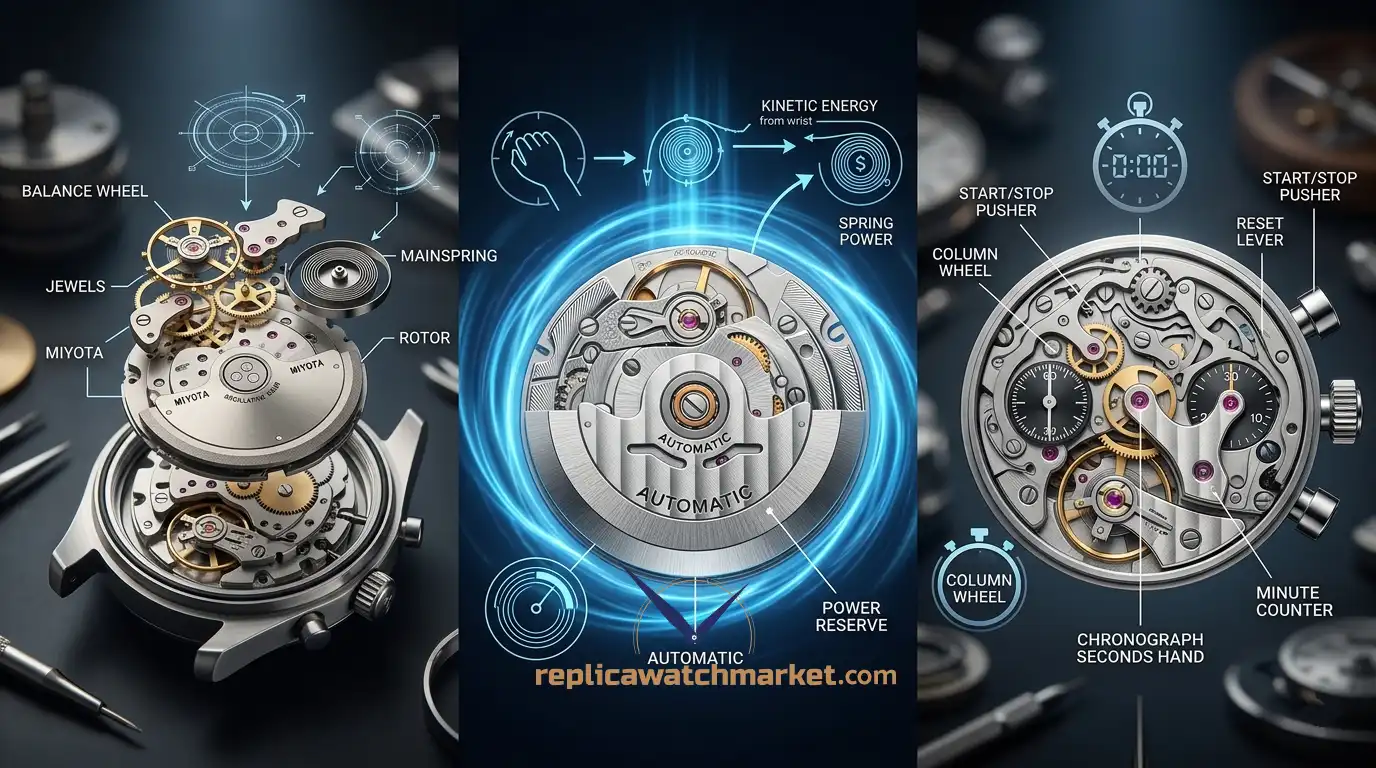
Automatic movements are mechanical calibres that wind themselves through wrist motion via a rotor. No battery is required — the watch maintains its power reserve during regular wear and produces the sweeping second hand associated with mechanical watches. Automatic movements are the most widely used type across replica watch production, spanning a range of calibres matched to specific references, price points, and case requirements.
The specific calibre matters more than the category label. Two automatic movements can differ substantially in architecture, complication set, and case geometry compatibility — understanding which calibre is inside a given reference is more useful than knowing it is simply "automatic."
Mingzhu Calibres
Mingzhu is a Chinese movement manufacturer producing a range of automatic calibres widely used across replica watch production. Mingzhu movements are specified for their practical reliability and broad compatibility across case types and reference architectures. The calibre designation — DG2813, DG3804, DG3836, and others — indicates the specific architecture, complication set, and case geometry compatibility of each version.
Learn more: Mingzhu DG2813 V4 · Mingzhu DG2813 V4 (Power Reserve) · Mingzhu DG3804 V4 · Mingzhu DG3836 V3 · Mingzhu DG2812 V3 · Mingzhu DG5833A V2 · Mingzhu DG5866PB V2
Miyota Calibres
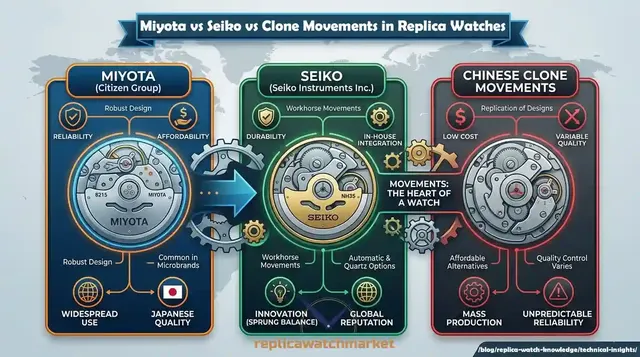
Miyota is produced by Citizen, one of Japan's largest watch manufacturers. Miyota calibres are specified in replica references where Japanese automatic architecture is matched to the requirements of the design — particularly models where the rotor geometry, beat rate, or power reserve specification aligns with a Miyota calibre over available alternatives.
Miyota movements are not visually identical to Swiss luxury calibres. If movement-level appearance matters — for example, in a watch with a display caseback — a Sea-Gull or clone movement may be more appropriate. For closed caseback models, this distinction is largely irrelevant.
Learn more: Miyota Movement · Miyota 8N24 V3 · Miyota 6P00 · Skeleton Miyota 9015 Clone
Sea-Gull Calibres
Sea-Gull is a Chinese movement manufacturer with an established production history, producing calibres used in higher-tier replica references — particularly models where movement architecture and finishing are visible through a display caseback. Sea-Gull movements offer a stronger visual presence than general-purpose automatic calibres and are specified accordingly.
Learn more: Sea-Gull ST1655 V3 · Seagull ST2500 V2
Other Automatic Calibres
Several additional automatic calibres appear in specific replica references — particularly vintage-style and dress watch models where movement architecture is tailored to the reference rather than drawn from a general-purpose calibre range.
Learn more: Hangzhou 7530 · Shanghai LB20
Manual Wind Movements
Manual wind movements are mechanical calibres with no automatic winding rotor. The watch must be wound by hand via the crown to maintain its power reserve. In replica watches, manual wind movements appear primarily in open-dial tourbillon inspired references — models where an exposed rotor would obstruct the movement display through the dial aperture.
Manual wind movements require more active ownership than automatic calibres: regular winding is part of the daily wear routine. They are specified for references where the absence of a rotor is a visual design requirement, not as a general-purpose movement type.
Learn more: HUB6311 Tourbillon Inspired · HUB1400 Inspired Tourbillon
Quartz Movements
Quartz movements are battery-powered calibres regulated by a quartz oscillator. They require no winding — manual or automatic — and deliver consistent timekeeping accuracy with minimal maintenance. In replica watches, quartz movements appear in two contexts: standard time-only references where simplicity and accuracy are the priority, and tourbillon inspired references where a rotating cage display is powered independently from the quartz timekeeping circuit.
Quartz Tourbillon Inspired Calibres
These calibres combine quartz timekeeping with a decorative rotating cage assembly that replicates the appearance of a tourbillon. The cage rotates independently from the timekeeping circuit and provides no positional rate correction — its function is visual animation. Two calibres carry this designation in replica production, differentiated by whether the cage rotates on one axis or two.
Learn more: Tourbillon Inspired · HUB9005 Inspired (single-axis) · HUB9009 Inspired (bi-axis)
Chronograph Movements
Chronograph movements add stopwatch functionality to a watch — sub-dials that measure elapsed seconds, minutes, or hours independently from the main timekeeping function. In replica watches, chronograph calibres are specified for sporty and technically complex references: racing watches, aviation models, and multi-complication designs where the dial layout requires functional pushers and sub-dial architecture.
Chronograph functions in replica watches operate correctly for casual use. They are not calibrated for professional timing applications. The primary reason most buyers choose chronograph models is visual complexity and design similarity to the original — the functional stopwatch is secondary for the majority of wearers. Chronograph pushers are more sensitive to moisture than a standard crown; avoiding water exposure is especially important in these models.
Seiko Meca-Quartz Calibres
The Seiko VK series are meca-quartz calibres — a hybrid architecture combining a quartz timekeeping circuit with a mechanical chronograph module. The result is quartz accuracy for the main timekeeping function alongside a smooth sweeping chronograph hand, rather than the stepping motion of a pure quartz chronograph. The VK series is the standard chronograph movement specification across mid-tier and higher replica production.
Learn more: Seiko VK63 · Seiko VK64 · Seiko VK67
Movement Comparison Overview
| Feature | Mingzhu Automatic | Miyota Automatic | Sea-Gull | Meca-Quartz Chronograph | Quartz Tourbillon Inspired | Manual Wind |
|---|---|---|---|---|---|---|
| Power Source | Wrist motion | Wrist motion | Wrist motion | Battery | Battery | Hand winding |
| Reliability | Good | Good | Good | Very Good | Good | Good |
| Maintenance | Low to Moderate | Low | Moderate | Low (battery) | Low (battery) | Regular winding |
| Daily Use | Good | Good | Good | Good | Good | Moderate |
| Visual Appeal | Clean | Clean | High (display caseback) | Sporty / Technical | Tourbillon window | Tourbillon window |
| Ideal For | Wide reference range | Specific references | Display caseback models | Chronograph references | Open-dial tourbillon | Open-dial tourbillon |
How to Choose the Right Movement
Movement choice follows naturally from how you intend to wear the watch and what you want from it. Ask yourself these questions before deciding:
- Will I wear this watch daily or occasionally?
- Do I want low-maintenance ownership or am I comfortable with regular winding?
- Does the movement need to be visible through a display caseback?
- Do I want a clean time-only dial or a chronograph with sub-dial complexity?
- Is a tourbillon window display a required visual element of the reference I want?
For automatic daily wear: Mingzhu and Miyota calibres both cover this well — the right choice depends on the specific reference and its case requirements. For display caseback references where movement appearance matters: Sea-Gull. For chronograph references: Seiko VK meca-quartz. For open-dial tourbillon references with no winding requirement: HUB9005 or HUB9009. For open-dial tourbillon references with a mechanical calibre: HUB6311.
For a full buying framework that connects movement choice to brand and model selection, see How to Buy a Replica Watch Online. For a detailed comparison of Swiss-style and Japanese movements, see Swiss vs Japanese Movements in Replica Watches.
Related Glossary Terms
Miyota Movement · Mingzhu DG2813 V4 · Mingzhu DG3804 V4 · Mingzhu DG3836 V3 · Seagull ST2500 V2 · Miyota 8N24 V3 · Skeleton Miyota 9015 Clone · Seiko VK63 · Seiko VK64 · Seiko VK67 · Tourbillon Inspired · HUB6311 Tourbillon Inspired · HUB9005 Inspired · HUB9009 Inspired · Hangzhou 7530 · Shanghai LB20
Frequently Asked Questions About Replica Watch Movements
Which replica watch movement is best for daily use?
For automatic daily wear, both Mingzhu and Miyota calibres are practical choices — the right fit depends on the specific reference and its case architecture. Both are self-winding automatic movements that perform reliably under normal daily conditions. Sea-Gull calibres are better suited to display caseback references. Chronograph references use Seiko VK meca-quartz, and tourbillon inspired references use dedicated calibres for their rotating cage displays.
Are automatic replica watches reliable?
Yes, when handled with reasonable care. Automatic replica watches can provide reliable daily performance over time. Regular wearing, occasional winding when not worn, and protection from moisture and strong shocks are the key habits that maintain reliability. As with any mechanical watch, replica movements are more sensitive to impact and water exposure than their genuine counterparts.
What is the difference between Miyota and Mingzhu movements?
Miyota is a Japanese automatic movement produced by Citizen. Mingzhu is a Chinese automatic movement manufacturer. Both are self-winding automatic calibres used across replica production. The practical difference for most buyers is less about origin and more about which calibre is specified for the reference they are considering — movement choice in replica production is typically matched to case geometry, complication requirements, and reference architecture rather than being a free selection.
Do chronograph replica watches actually work?
Yes. The chronograph function — start, stop, and reset via pushers — operates correctly in most replica chronograph watches. Sub-dials track elapsed time as intended. They are not precision-tested for professional timing applications, but for casual use the function works as expected. The Seiko VK meca-quartz calibres used in many replica chronographs deliver a smooth sweeping chronograph hand rather than the stepping motion of a pure quartz chronograph.
What is a tourbillon inspired movement?
A tourbillon inspired movement incorporates a visible rotating cage that replicates the appearance of a genuine tourbillon without the escapement correction mechanism. The cage rotates — typically once per minute — as a decorative element driven independently from the timekeeping circuit. In replica watches, tourbillon inspired calibres appear in open-dial references where the rotating cage is a required visual element. See Tourbillon Inspired for a full explanation.