
On this page 10 sections
Article at a glance
- Reading time
- 9 minutes
- Article length
- 1,762 words
- Topic
- Technical Insights
When choosing a replica watch, most buyers focus on what they can immediately see: the dial, bezel, case size, or how closely it resembles the original luxury model. Yet the real experience of owning a replica watch is shaped by something hidden beneath the caseback — the movement.
In the replica watch world, one question keeps coming back: Swiss movement or Japanese movement — which one is actually better? The answer is not as simple as marketing makes it sound. This guide breaks down what really matters when comparing Swiss-style and Japanese movements in replica watches, especially for everyday use.
For a broader foundation on movement types before diving into this comparison, see our Replica Watch Movements Explained guide. For a complete overview of quality tiers and realistic expectations, see the main Replica Watch Guide. For terminology clarification, see our fake vs replica watch comparison.
Understanding Movements in Replica Watches
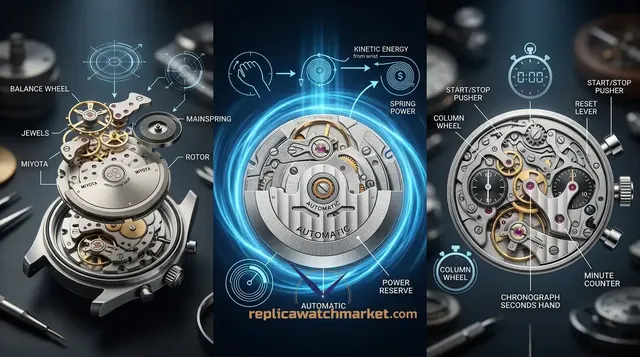
A watch movement is the internal mechanism responsible for timekeeping, power reserve, and overall reliability. In replica watches, movements are selected based on availability, cost, visual compatibility with the model, and performance expectations. Most replica movements fall into two broad categories: Swiss-style movements and Japanese movements.
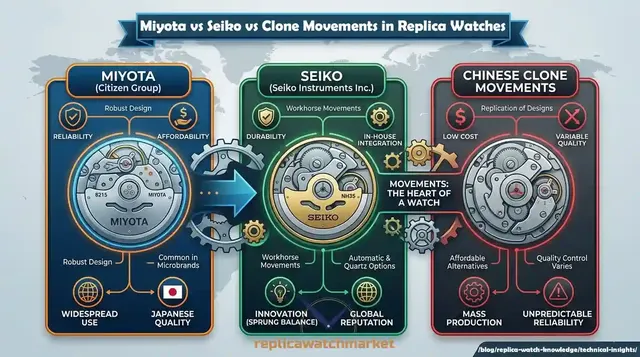
It is worth clarifying terminology before comparing them. "Swiss movement" in the replica context does not mean a genuine ETA or Rolex caliber. It refers to clone movements designed to replicate the architecture of specific Swiss calibers — including rotor layout, bridge design, and complication structure. "Japanese movement" most commonly refers to Miyota calibers produced by Citizen, though other Japanese automatic calibers exist. Both are independently produced — neither is manufactured by the original luxury brand.
Swiss-Style Movements in Replica Watches
What They Are
Swiss-style clone movements are engineered to replicate the visual and mechanical architecture of specific genuine Swiss calibers. They are typically found in super clone and higher-tier replica watches where movement-level accuracy is a priority alongside case and dial finishing. In models with display casebacks, the resemblance to the original caliber can be significant.
Strengths
Swiss-style clone movements offer smoother sweeping second hand motion in many models, movement layout closer to the original luxury caliber, and stronger visual accuracy for display caseback models. They are preferred by buyers who prioritize technical replication and collector-oriented detail.
Limitations
Quality varies significantly between factories and production batches. Clone movements are more sensitive to shock, magnetism, and irregular use than Japanese alternatives. Repairs may require specialized watchmakers, and service costs are generally higher. A well-assembled clone movement performs excellently — but consistency across units is less predictable than Miyota-based models.
Learn more: Mingzhu DG2813 V4 · Mingzhu DG3804 V4 · Mingzhu DG3836 V3 · Mingzhu DG2812 V3 · Mingzhu DG5833A V2 · Mingzhu DG5866PB V2 · Sea-Gull ST1655 V3 · Seagull ST2500 V2 · Hangzhou 7530 · Shanghai LB20
Japanese Movements: Reliability in Practice
What They Are
Japanese movements in the replica context most commonly refers to Miyota calibers, produced by Citizen — one of Japan's largest watch manufacturers. Miyota movements are automatic, self-winding, and designed for consistent daily performance across a wide range of conditions.
Strengths
Miyota movements are known for excellent durability in everyday wear, stable power reserve, lower failure rates compared to more complex clone calibers, and straightforward serviceability. Spare parts are widely available and most watchmakers are comfortable working with Miyota calibers, which keeps long-term maintenance costs predictable.
Limitations
Miyota movements do not visually replicate the architecture of specific Swiss calibers. In models with display casebacks, the movement layout will not match the original. The rotor sound is slightly audible in some models — this is a known characteristic of Miyota calibers, not a defect. For buyers who specifically want movement-level visual accuracy, a clone movement is more appropriate.
Learn more: Miyota Movement · Miyota 8N24 V3 · Miyota 6P00 · Skeleton Miyota 9015 Clone · Seiko VK63 · Seiko VK64 · Seiko VK67
Accuracy & Timekeeping: What Buyers Should Know
A common misconception is that Swiss movements are always more accurate than Japanese movements. In practice, accuracy in replica watches depends more on assembly quality and regulation than on movement origin.
A well-assembled and properly regulated Miyota movement can match or outperform a poorly assembled clone caliber. Both movement types, when well-regulated, typically perform within a few seconds per day — which is acceptable for daily mechanical watch use. Buyers who prioritize chronometer-level accuracy should understand that neither movement type is precision-tested to COSC standards in the replica context.
Daily Wear vs Occasional Use
For Daily Wear
Japanese Miyota movements are generally the more practical choice for consistent daily wear. They handle long hours of use well, are more forgiving of minor shocks and irregular habits, and require less maintenance attention. This is why many sports-oriented and everyday replica models are powered by Miyota calibers. For a full breakdown of daily wear expectations, see our daily wear guide.
For Occasional or Rotation Wear
Swiss-style clone movements may be more appealing for buyers who wear the watch occasionally, rotate between multiple pieces, or prioritize visual accuracy and collector detail. When handled with appropriate care, clone movements perform well in lower-intensity usage patterns.
Maintenance, Repairs & Long-Term Ownership
Over time, every mechanical movement needs servicing. This is where Japanese movements offer a practical advantage for most buyers.
Miyota calibers are widely serviced by watchmakers globally. Parts are readily available, service procedures are straightforward, and costs are predictable. For buyers who want a replica watch they can own and maintain for several years without specialized support, Miyota-based models are consistently more manageable.
Swiss-style clone movements can last equally long when handled carefully, but when service is needed, finding a watchmaker comfortable with specific clone calibers can be more difficult. Repair costs vary more widely, and parts availability depends on the specific caliber being replicated. For a full overview of maintenance habits and common issues, see our replica watch care guide and problems and care master guide.
Swiss vs Japanese: Side-by-Side Comparison
| Feature | Swiss-Style Clone | Japanese (Miyota) |
|---|---|---|
| Movement Origin | Clone of specific Swiss caliber | Miyota / Citizen (Japan) |
| Visual Accuracy | High (matches original layout) | Moderate (does not match original) |
| Daily Reliability | Good (varies by factory) | Very Good (consistent) |
| Shock Resistance | Moderate | Good |
| Maintenance Cost | Moderate to High | Low to Moderate |
| Serviceability | Moderate (specialist needed) | High (widely serviceable) |
| Display Caseback | Resembles original movement | Does not resemble original |
| Ideal For | Detail-focused / collector buyers | Daily wear / practical buyers |
| Price Impact | Higher | Mid-range |
Buyer Profile Guide
| Buyer Profile | More Suitable Movement | Reason |
|---|---|---|
| First-time replica buyer | Japanese (Miyota) | Reliable, low maintenance, forgiving |
| Daily wearer | Japanese (Miyota) | Consistent performance, manageable servicing |
| Low maintenance preference | Japanese (Miyota) | Widely serviceable, predictable costs |
| Display caseback model | Swiss-style clone | Visual resemblance to original caliber |
| Collector / rotation wearer | Swiss-style clone | Technical replication, movement detail |
| Super clone buyer | Swiss-style clone | Movement-level accuracy is defining feature |
What Really Matters When Choosing
The Swiss vs Japanese debate often distracts buyers from the factors that actually determine satisfaction. Instead of focusing on movement origin alone, consider these questions: How often will you wear this watch? Does the caseback show the movement? How important is long-term serviceability? What is your tolerance for maintenance complexity?
Assembly quality matters more than movement origin. A well-regulated Miyota in a quality replica will outperform a poorly assembled clone caliber in daily use. Factory standards, regulation, and quality control at the point of assembly shape real-world performance more than the movement label. For practical checks on evaluating quality before purchasing, see our guide on how to choose a high-quality replica watch.
Both movement types have their place. The right choice depends on how the watch fits into your daily life — not on which label carries more prestige. For the full buying decision framework that connects movement choice to brand and model selection, see How to Buy a Replica Watch Online.
Related Glossary Terms
Miyota Movement · Miyota 8N24 V3 · Miyota 6P00 · Skeleton Miyota 9015 Clone · Seiko VK63 · Seiko VK64 · Seiko VK67 · Mingzhu DG2813 V4 · Mingzhu DG2813 V4 (Power Reserve) · Mingzhu DG3804 V4 · Mingzhu DG3836 V3 · Mingzhu DG2812 V3 · Mingzhu DG5833A V2 · Mingzhu DG5866PB V2 · Sea-Gull ST1655 V3 · Seagull ST2500 V2 · Hangzhou 7530 · Shanghai LB20 · Tourbillon Inspired · HUB6311 Tourbillon Inspired · HUB9005 Inspired · HUB9009 Inspired
Frequently Asked Questions About Swiss and Japanese Movements
Are Swiss movements better than Japanese movements in replica watches?
Neither is universally better — they serve different priorities. Swiss-style clone movements offer greater technical replication and visual accuracy at the movement level, making them suited for display caseback models and collector-oriented buyers. Japanese Miyota movements offer more consistent daily reliability, easier serviceability, and lower maintenance costs. The right choice depends on how the watch will be used and what the buyer values most.
Which movement is more reliable for daily wear?
Japanese Miyota movements are generally more reliable for consistent daily wear. They are more forgiving of minor shocks, irregular habits, and long daily use. Swiss-style clone movements perform well when handled carefully, but their greater complexity makes them less resilient in high-frequency daily use compared to Miyota calibers.
Do Japanese movements keep accurate time in replica watches?
Yes. Well-assembled and properly regulated Miyota movements keep accurate time within a few seconds per day — comparable to many Swiss-style clone calibers. Accuracy depends more on assembly quality and regulation than on movement origin. A well-regulated Japanese movement can match or outperform a poorly assembled Swiss-style clone in daily timekeeping.
Are Swiss movements in replica watches real Swiss-made movements?
No. In the replica context, "Swiss movement" refers to clone movements designed to replicate the architecture of specific genuine Swiss calibers — they are not genuine ETA, Rolex, or other Swiss manufacturer calibers. They are independently produced replications of those movement designs, typically manufactured in China.
Which movement is easier to service or repair?
Japanese Miyota movements are significantly easier to service. They are widely recognized by watchmakers globally, spare parts are readily available, and service procedures are straightforward. Swiss-style clone movements may require a watchmaker familiar with specific clone calibers, and parts availability varies depending on which caliber is being replicated.
Which movement should beginners choose when buying a replica watch?
For first-time buyers, a Japanese Miyota-powered replica is the more practical starting point. It offers reliable daily performance, manageable maintenance, and a forgiving ownership experience. Once you have direct experience with replica watch ownership, you will be better positioned to evaluate whether a Swiss-style clone movement suits your priorities for future purchases.
Does movement choice affect the value of a replica watch?
Replica watches do not hold or appreciate in value regardless of movement type — they are not financial assets. Within the replica market, Swiss-style clone movements command higher prices due to production complexity. However, this higher price reflects manufacturing cost rather than investment value. Both movement types depreciate to zero from a resale perspective.