On this page 10 sections
Article at a glance
- Reading time
- 13 minutes
- Article length
- 2,661 words
- Topic
- Technical Insights
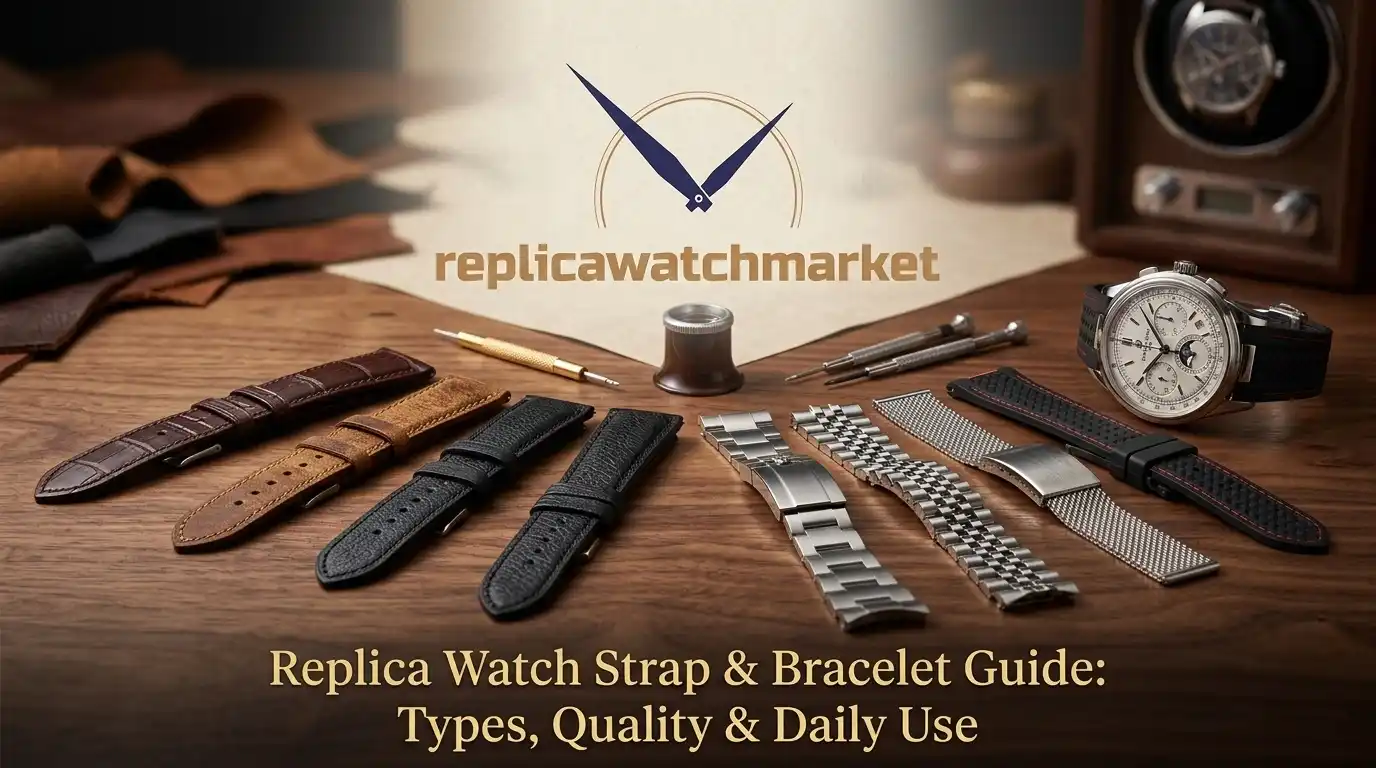
The strap or bracelet on a replica watch is not a secondary detail. It determines wrist feel, daily comfort, visual accuracy to the reference, and how the watch holds up over months of wear. A correctly executed bracelet on a AAAA+ grade replica reads as part of the watch — not an accessory attached to it. At lower grades, the bracelet is frequently where quality failures are most visible.
This guide covers every strap and bracelet type used across our catalog — what each construction involves, how quality varies across replica grades, what to look for in QC photos, and which types are best suited to different use cases. For a broader foundation on replica watch quality and build standards, see our Replica Watch Guide.
What Strap and Bracelet Type Actually Means
In replica watch listings, strap and bracelet descriptions are specifications — they describe what the original reference uses and what the replica is built to replicate. A listing that states "Oyster-style stainless steel bracelet" is telling you the link construction, the material, and the reference design language in three words.
Understanding what these terms mean in practice — and how execution quality varies between replica grades — is what separates an informed purchase from a disappointing one. The bracelet accounts for roughly 40% of a watch's total surface area. It is the component you feel most directly during wear, and the one most visible in wrist photos. It deserves the same evaluation attention as the dial or movement.
Strap and Bracelet Types Explained
Rubber Strap
Made from vulcanized rubber or synthetic elastomer. The most practical non-metal option — flexible, moisture-resistant, and comfortable in active conditions. Quality varies significantly: at AAAA+ grade, rubber straps are cut to correct taper profiles with consistent surface texture. At lower grades, straps are often stiff, generic in profile, and do not seat correctly against the case lugs.
Tropical Rubber Strap
A textured rubber strap with a warm brown coloration referencing the aged patina of vintage dive watch straps. Reference-specific — appropriate on vintage-inspired dive and sport models where the original used this strap type. Color consistency and texture definition are the primary quality indicators.
Oysterflex Strap
A hybrid construction with a flexible metal blade core encased in high-performance elastomer. Combines the comfort of rubber with the structural security of metal. One of the more technically demanding straps to reproduce correctly — the internal blade, surface texture, and integrated attachment method must all be executed to specification. At lower grades, standard rubber straps are frequently substituted.
Genuine Leather Strap
Constructed from calfskin, alligator-grain, or crocodile-grain leather with a lining, stitching, and buckle. Standard on dress watches and formal references. Quality range is wide — from correctly grained full leather to bonded composites. Grain consistency, stitching alignment, and lining quality are the primary indicators. Not water-resistant; not suitable for active wear.
Stainless Steel Bracelet
The most common metal bracelet type — linked steel segments with a combination of brushed and polished surfaces. Quality is determined by link tightness, finishing transition sharpness, end link fit, and clasp construction. At AAAA+ grade with 904L steel, polished center links show depth and dimension under light. At lower grades, transitions are soft and links are loose.
Two-tone Bracelet
Steel construction with gold-toned plating on center links, bezel, and case. Quality depends on plating evenness, color consistency, and boundary definition between steel and gold surfaces. More susceptible to visible wear than full steel — plating thickness at AAAA+ grade significantly delays high-contact wear compared to lower grades.
Steel Mesh Bracelet
Interwoven fine steel wire — flexible, continuously adjustable, and breathable against the wrist. Appears on dress, field, and vintage-inspired references. Weave density consistency, surface finish evenness, and sliding clasp quality are the primary indicators. More comfortable than solid link bracelets in warm conditions.
Integrated Bracelet
Designed as a structural continuation of the case — bracelet flows directly from the lug geometry without spring bar attachment. Associated with sport-luxury references where the case-to-bracelet transition is a central design element. Among the most demanding constructions to execute correctly. The transition joint is the primary quality checkpoint.
PVD-coated Bracelet
Steel bracelet with a hard black or dark grey coating applied via Physical Vapour Deposition under vacuum conditions. More durable than standard plating — but coating thickness, adhesion quality, and surface preparation before application determine how long the finish holds. At lower grades, coating lifts at high-contact points within months.
Oyster-style Bracelet
Three-piece link construction — one polished center link flanked by two brushed outer links. One of the most widely replicated bracelet designs in the market. Brushed-to-polished transition sharpness, center link polish depth, end link fit, and clasp construction are the primary quality indicators.
Jubilee-style Bracelet
Five-piece link construction — one center link flanked by two pairs of narrower outer links. Finer, more flexible, and dressier than the Oyster. More complex to execute correctly — more links means more tolerance points. Link consistency, drape quality, and end link fit are the primary indicators.
President-style Bracelet
Three-piece construction with semi-circular, rounded links — each link curved along its length to follow the wrist profile. Fully polished. Associated with high-end dress and day-date references, almost exclusively on gold-toned or two-tone models. Link curvature consistency and polish quality across curved surfaces are the defining indicators.
Pilot Bracelet
Stainless steel bracelet with exposed rivet detailing referencing early aviation instrument straps. Fully brushed. Appears on pilot and aviation-style references. Rivet execution, link width proportions relative to case diameter, and double-locking clasp construction are the primary quality indicators.
Ceramic Bracelet
Constructed from zirconium oxide ceramic — scratch-resistant, lighter than steel, and maintains consistent deep color without plating. Among the most demanding components to reproduce in replica production. Color depth, surface reflectivity, and weight are the primary in-hand quality indicators. Brittle under sharp impact — requires more careful handling than steel.
Comparison Table: All Types at a Glance
| Type | Material | Attachment | Water Resistance | Best For | Wear Sensitivity |
|---|---|---|---|---|---|
| Rubber Strap | Vulcanized rubber / elastomer | Spring bar | Good | Sport, dive, active daily wear | UV, oils — degrades over time |
| Tropical Rubber Strap | Textured rubber | Spring bar | Good | Vintage dive references | UV exposure accelerates fading |
| Oysterflex Strap | Metal blade + elastomer | Integrated | Good | Sport-luxury references | Low — most durable rubber option |
| Genuine Leather Strap | Calfskin / grain leather | Spring bar | Poor | Dress, formal references | High — moisture and sweat damage |
| Stainless Steel Bracelet | 316L or 904L steel | End links | Good | Sport, everyday wear | Low — scratches on polished surfaces |
| Two-tone Bracelet | Steel + gold plating | End links | Good | Dress-sport references | Medium — plating wears at contact points |
| Steel Mesh Bracelet | Fine steel wire | Sliding clasp | Good | Dress, field, vintage references | Low — wire ends can snag fabric |
| Integrated Bracelet | Steel / PVD / ceramic | Case-integrated | Good | Sport-luxury references | Low — not interchangeable |
| PVD-coated Bracelet | Steel + PVD coating | End links | Good | Sport, tactical references | Medium — coating wears at high-contact points |
| Oyster-style Bracelet | 316L or 904L steel | End links | Good | Sport, dive references | Low — scratches on polished centers |
| Jubilee-style Bracelet | 316L or 904L steel | End links | Good | Date, dress-sport references | Low — more links means more polish points |
| President-style Bracelet | Steel + gold plating | End links | Good | Dress, day-date references | Medium — polished curves show scratches |
| Pilot Bracelet | Stainless steel | End links | Good | Pilot, aviation references | Low — fully brushed, hides minor wear |
| Ceramic Bracelet | Zirconium oxide ceramic | End links / integrated | Good | Sport-luxury references | Low surface wear — brittle under impact |
Daily Use Suitability
| Use Case | Recommended Types | Avoid |
|---|---|---|
| Office / formal wear | Genuine Leather, Jubilee-style, President-style, Two-tone | Rubber, Pilot |
| Active daily wear | Rubber, Oysterflex, Stainless Steel, Oyster-style, Pilot | Genuine Leather |
| Sport and outdoor | Rubber, Tropical Rubber, Oysterflex, PVD-coated | Genuine Leather, President-style |
| Hot or humid conditions | Rubber, Steel Mesh, Oysterflex | Genuine Leather, Two-tone |
| Dress occasions | Genuine Leather, President-style, Jubilee-style | Rubber, Pilot, PVD-coated |
| Water exposure (light) | Rubber, Oysterflex, Stainless Steel, Oyster-style | Genuine Leather |
For a complete guide to daily wear habits that protect both strap and movement over time, see our daily wear guide.
What to Check in QC Photos
QC photos are the primary tool for evaluating strap and bracelet quality before a replica watch ships. The following checkpoints apply across all bracelet and strap types.
- End link fit: The point where the bracelet meets the case lug should be flush with no visible gap. A gap at the end link is the most common bracelet quality failure across all metal constructions.
- Finishing transitions: On bracelets with mixed brushed and polished surfaces, the boundary between the two should be sharp and defined — not soft or blurred. This is most relevant on Oyster-style, Jubilee-style, and stainless steel bracelets.
- Link tightness: Request a video if photos do not show bracelet movement clearly. Excessive lateral play between links is not visible in still photos but is immediately apparent when the bracelet moves.
- Clasp seating: The clasp should sit flush when closed with no visible gap or proud edge. Clasp quality is a reliable overall build indicator — it is often where cost reduction is most apparent at lower grades.
- Strap profile and taper: On rubber and leather straps, check that the strap narrows correctly from lug width to buckle width. A strap that tapers too quickly or sits proud at the lug indicates an off-spec profile.
- Surface consistency: Color, texture, and finish should be even across the full bracelet or strap length. Variation in tone, texture depth, or reflectivity between links or along a strap indicates manufacturing inconsistency.
For a complete framework on evaluating replica watch quality before purchase, see our guide to choosing a high-quality replica watch.
How Grade Affects Strap and Bracelet Quality
Strap and bracelet quality is one of the most visible differentiators between replica grades. The gap between AAAA+ and lower-grade execution is often more apparent on the bracelet than anywhere else on the watch.
- At AAAA+ grade, bracelets and straps are produced as matched components to the case — correct link geometry, tight tolerances, reference-specific profiles, and finishing that matches the case treatment. The bracelet reads as part of the watch.
- At AAAA grade, construction quality is close but finishing transitions are softer, link tolerances are slightly looser, and end link fit may show minor gaps. The bracelet is correct in form but not fully precise in execution.
- At AAA grade and below, bracelets are frequently sourced generically — correct construction type but incorrect proportions, loose links, soft finishing, and clasp mechanisms that do not match the reference specification.
Steel grade also affects bracelet quality directly. At AAAA+ grade, 904L steel produces a deeper, more layered polish on center links than the 316L used across most of the market. For a full explanation of how steel grade affects surface quality, see our replica watch materials guide.
Care and Maintenance
- Rubber straps: Wipe down with a damp cloth after sweat exposure. Avoid prolonged UV exposure and contact with oils or solvents. Replace when cracking appears along the underside near the buckle.
- Leather straps: Keep dry. Remove before showering, swimming, or any water exposure. Wipe with a dry cloth after contact with sweat. Leather straps have the shortest lifespan of any strap type under daily active wear.
- Steel bracelets: Clean with a soft brush and warm soapy water periodically to remove debris from between links. Dry thoroughly after cleaning. Avoid abrasive cloths on polished surfaces.
- Two-tone and PVD bracelets: Handle with care at high-contact points. Avoid hard surface contact on clasp inner surfaces. Two-tone plating and PVD coating both wear faster under mechanical abrasion than under normal use.
- Ceramic bracelets: Scratch-resistant but brittle. Avoid hard impacts. Clean with a soft damp cloth — ceramic does not require the same attention as steel but should be kept away from sharp edges that could chip link corners.
- Mesh bracelets: Clean periodically with a soft brush to remove debris from the weave. Avoid snagging on fabric — the open weave structure can catch on knit materials.
For a complete maintenance framework covering all watch components, see our replica watch care guide.
Final Thoughts
The strap or bracelet on a replica watch is not a finishing touch — it is a structural and aesthetic component that determines how the watch feels on the wrist, how it reads visually, and how long it holds up under daily use. At AAAA+ grade, bracelet and strap construction is executed to the tolerances required for the component to match the reference. At lower grades, it is frequently where the quality gap is most visible.
The practical guidance is straightforward: match strap type to use case, evaluate end link fit and finishing transitions in QC photos, and treat leather straps as a dry-wear component regardless of the watch's ATM rating. For a complete guide to identifying common quality failures before and after purchase, see our Replica Watch Problems & Care: Complete Owner Guide.
Related Glossary Terms
Ceramic Bracelet · Genuine Leather Strap · Integrated Bracelet · Jubilee-style Bracelet · Oysterflex Strap · Oyster-style Bracelet · Pilot Bracelet · President-style Bracelet · PVD-coated Bracelet · Rubber Strap · Stainless Steel Bracelet · Steel Mesh Bracelet · Tropical Rubber Strap · Two-tone Bracelet
Frequently Asked Questions About Replica Watch Straps & Bracelets
Which strap type is best for daily wear?
Rubber straps and stainless steel bracelets are the most practical for daily wear. Rubber handles moisture, sweat, and active conditions without degrading quickly. Stainless steel is durable and easy to clean. Leather straps are not recommended for daily active wear — moisture and sweat accelerate degradation significantly.
Can I wear a leather strap replica watch in the rain?
Brief light rain exposure is unlikely to cause immediate damage, but repeated moisture contact degrades leather straps quickly. Prolonged rain, swimming, or showering will stain and deform the strap over time. If your daily environment involves regular water exposure, a rubber or steel bracelet is the more practical choice.
Can an integrated bracelet be replaced?
Not with a standard strap alternative. Integrated bracelets attach directly to the case without spring bars — the lug design does not accommodate conventional strap attachment. Buyers should evaluate integrated bracelet quality carefully before purchase, as it is not a separately serviceable component in the same way a spring-bar-attached strap is.
How long does PVD coating last on a replica bracelet?
At AAAA+ grade, PVD coating is applied at sufficient thickness to maintain its appearance under normal daily wear for an extended period. At lower grades, thin or poorly adhered coating shows wear at high-contact points — clasp inner surfaces, bracelet underside, crown edges — within months. Avoiding hard surface contact and abrasive cleaning extends PVD lifespan regardless of grade.
What is an end link and why does it matter?
An end link is the connecting piece between the bracelet and the case lug. It should seat flush against the lug with no visible gap. A gap at the end link is one of the most common bracelet quality failures in replica watches at lower grades — and one of the most immediately visible in QC photos. At AAAA+ grade, end links are machined to fit the specific case geometry rather than adapted from generic components.
What is the difference between an Oyster-style and Jubilee-style bracelet?
The Oyster uses a three-piece link construction — one wider polished center link flanked by two brushed outer links. The Jubilee uses a five-piece construction — one center link flanked by two pairs of narrower outer links. The Jubilee is finer, more flexible, and dressier. The Oyster is more substantial and sporty. Both are reference-specific — the correct bracelet type is determined by the original design, not by preference.
Can a ceramic bracelet chip?
Yes. Ceramic is highly scratch-resistant but brittle under sharp impact — a property of the material itself, not a manufacturing defect. Link edges and corners are the most vulnerable points. Ceramic bracelets require more careful handling than steel alternatives, particularly in environments with hard surface contact risk.
What is the difference between an Oysterflex strap and a standard rubber strap?
An Oysterflex strap has a flexible metal blade core embedded within the elastomer outer layer — producing a strap that holds its shape and provides structural security while remaining flexible. A standard rubber strap has no internal structure and relies entirely on the rubber compound for its behavior. The Oysterflex also attaches via an integrated system rather than standard spring bars. At lower replica grades, standard rubber straps are frequently substituted for Oysterflex specifications.