On this page 11 sections
Article at a glance
- Reading time
- 12 minutes
- Article length
- 2,488 words
- Topic
- Technical Insights
This guide compares the main automatic movement types found in replica watches — Miyota, Mingzhu, Seiko, and Chinese clone movements — and explains what each one means for timekeeping accuracy, daily wear reliability, and long-term ownership. For a broader technical overview including chronograph and manual wind movement types, see our replica watch movements explained guide.
When shopping for a replica watch, most buyers focus on design, brand appearance, and price. These elements matter — but one specification more than any other determines whether a replica watch performs reliably over months and years of actual use: the movement. A watch that looks perfect in photographs but uses an unreliable movement will disappoint within weeks. A watch with a solid movement and acceptable finishing will deliver consistent satisfaction for years.
This guide covers the main automatic movement types found across the replica market — Miyota, Mingzhu, Seiko, and Chinese clone movements — and explains what each one means in practice. Not in terms of marketing descriptions, but in terms of timekeeping accuracy, daily wear durability, serviceability, and long-term ownership reality. By the end, you will know which movement type suits your specific use case, what to ask a seller before ordering, and what each option realistically delivers at the wrist.
What Is a Watch Movement?
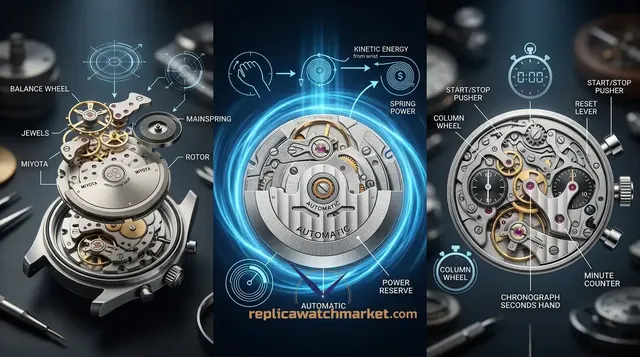
A watch movement — also called a caliber — is the internal mechanism that powers the hands and complications of a watch. It converts stored energy into precisely regulated motion, controlling everything from basic timekeeping to date changes, chronograph functions, and power reserve. In mechanical watches, this energy comes from a wound mainspring; in automatic movements, the mainspring is wound by a rotor that rotates with wrist movement.
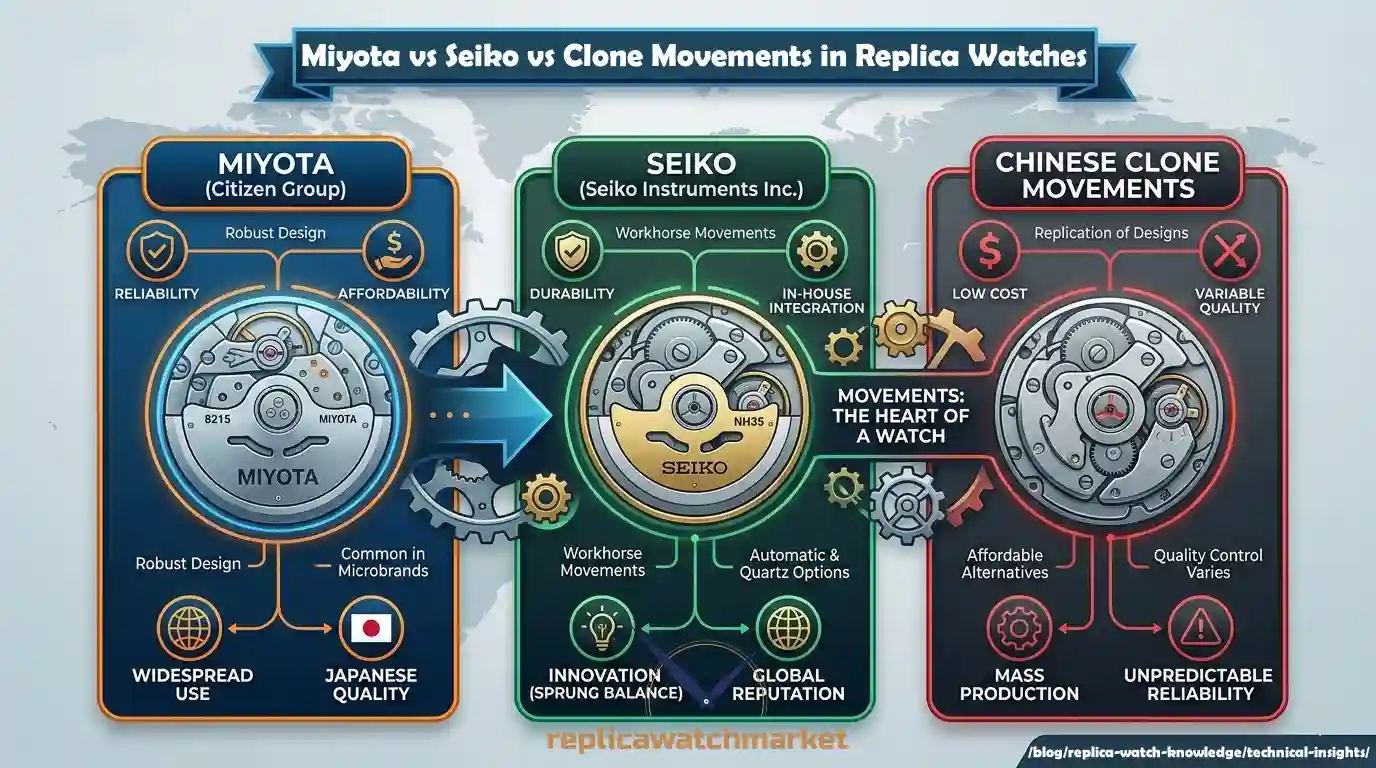
In replica watches, automatic movements fall into several categories: Chinese automatic movements produced by manufacturers such as Mingzhu, Japanese movements produced by Miyota and Seiko, and Chinese clone movements designed to replicate the architecture of specific Swiss calibers. Each represents a different balance of cost, performance, availability, and long-term reliability — and understanding that balance is what separates buyers who are satisfied with their purchase from those who are not.
Why Movement Type Matters
A replica watch may look perfect on the outside — correct dial, correct bezel, correct bracelet — but if the movement is unreliable, that appearance becomes irrelevant within weeks. Movement quality determines four things that a buyer will live with every day: timekeeping accuracy, durability under daily wear, serviceability when something eventually needs attention, and the overall longevity of the watch as a functional object.
Timekeeping accuracy is the most immediately noticeable. A poor movement loses or gains minutes per day — not seconds. Durability determines how the movement responds to the stresses of daily wear: shock, temperature changes, magnetic fields, and the accumulated effect of continuous mechanical operation. Serviceability determines whether a watchmaker can work on the movement when needed. And longevity is the cumulative result of all three.
For experienced buyers and sellers alike, movement type is the first specification to confirm — before price tier, before finishing quality, before brand or model. Everything else follows from it.
Mingzhu Movements
Mingzhu is a Chinese movement manufacturer producing a wide range of automatic calibres that are among the most widely used across replica watch production. Mingzhu movements are specified for their practical reliability and broad compatibility across case types, reference architectures, and complication requirements. The calibre designation — DG2813, DG3804, DG3836, and others — indicates the specific architecture, complication set, and case geometry compatibility of each version.
What Mingzhu Delivers in Practice
Mingzhu movements provide reliable daily timekeeping under normal wearing conditions. The calibre range covers a broad variety of complications — date, day-date, power reserve, and others — which makes Mingzhu the practical choice for references where a specific complication set is required alongside a particular case geometry. Serviceability is acceptable for experienced watchmakers familiar with Chinese automatic calibres, though less universally documented than Japanese alternatives.
The most important variable with Mingzhu movements is the specific calibre version — V3, V4, and so on indicate production generation, with later versions generally reflecting refinements in tolerances and finishing. Confirming the calibre version with the seller before purchase is always worthwhile.
Learn more: Mingzhu DG2813 V4 · Mingzhu DG2813 V4 (Power Reserve) · Mingzhu DG3804 V4 · Mingzhu DG3836 V3 · Mingzhu DG2812 V3 · Mingzhu DG5833A V2 · Mingzhu DG5866PB V2
Miyota Movements
Miyota movements are produced by Citizen's movement division in Japan. In replica watch production, Miyota calibres are specified for references where Japanese automatic architecture matches the case geometry, beat rate, or power reserve requirements of the design. They are a well-established option across replica production and are familiar to watchmakers in most markets.
What Miyota Delivers in Practice
Miyota movements keep time within a few seconds per day under normal wearing conditions. The calibres are well-documented and straightforward for experienced watchmakers to service, which is a practical advantage for buyers who want serviceability as a long-term option. Rotor noise is slightly more audible than in high-end Swiss calibres — this is normal for automatics at this price point.
Miyota movements are not visually identical to Swiss luxury calibres. In references with a display caseback where movement appearance matters, a Sea-Gull or clone movement may be more appropriate. For closed caseback models, this distinction is largely irrelevant.
Learn more: Miyota Movement · Miyota 8N24 V3 · Miyota 6P00 · Skeleton Miyota 9015 Clone
Seiko Movements
Seiko movements are produced in Japan to standards that have earned respect across both affordable and premium watch segments. In replica watch production, genuine Seiko movements appear less frequently than Miyota or Mingzhu — sourcing cost and availability limit their presence to premium or small-batch pieces at the upper end of the market.
Seiko in the Replica Market
In terms of daily performance, Seiko movements are comparable to Miyota — accurate, durable, and serviceable. The choice between them in the replica context comes down to availability and verified sourcing rather than meaningful performance differences for a daily wear buyer. Movement claims in the replica market are not always accurate — if a Seiko movement cannot be confirmed through seller documentation and QC photos, it should be treated as unverified.
Learn more: Seiko VK63 · Seiko VK64 · Seiko VK67
Chinese Clone Movements
Chinese clone movements are engineered to replicate the architecture, layout, and visual appearance of specific Swiss calibers — ETA, Rolex in-house movements, and others. They are not simple low-grade mechanisms. Better-produced clone movements are sophisticated pieces of engineering that fit cases designed for specific luxury references, support complications including date wheels and chronograph functions, and in some cases achieve visual accuracy through display casebacks that buyers focused on the complete aesthetic experience will value.
What Clone Movements Deliver in Practice
Quality varies significantly between factories and generations. Better-grade clone movements perform acceptably for daily use under normal conditions. Lower-grade versions fail faster and are harder to service. This variance is the central consideration: a buyer cannot reliably predict which end of the quality spectrum a given clone movement occupies without information from verified sources familiar with the specific piece.
Serviceability is the other significant factor. Clone movements that replicate proprietary Swiss calibers are harder for watchmakers to service — parts availability is inconsistent, and technical documentation is limited. When a clone movement develops a problem, replacement is often more practical than repair. For buyers who prioritize visual accuracy to a specific Swiss reference and understand these trade-offs, clone movements are a reasonable choice.
Learn more: Sea-Gull ST1655 V3 · Seagull ST2500 V2 · Hangzhou 7530 · Shanghai LB20
Side-by-Side Comparison
| Feature | Mingzhu | Miyota | Seiko | Chinese Clone |
|---|---|---|---|---|
| Reliability | Good | Good | Good | Varies by factory |
| Timekeeping accuracy | Good | Good | Good | Variable |
| Serviceability | Moderate | Good — widely known | Good — widely known | Difficult — limited parts |
| Availability in replicas | Very common | Common | Rare | Common |
| Complication range | Wide — date, day-date, PR | Moderate | Moderate | High — reference specific |
| Daily wear suitability | Good | Good | Good | Acceptable at higher grades |
| Visual accuracy to Swiss ref | Not a priority | Not a priority | Not a priority | High — designed to replicate |
| Ideal for | Wide reference range | Specific references | Premium verified pieces | Display caseback / visual accuracy |
Which Movement for Which Buyer
Movement type is not a ranking where more expensive is always better — it is a specification that should match the buyer's actual priorities and the reference they are considering.
Mingzhu — if:
The reference you want uses a Mingzhu calibre — which covers the majority of replica production across brands and models. Mingzhu movements are matched to specific case geometries and complication requirements, so the choice is often determined by the reference rather than being a free selection. They provide reliable daily performance across a wide range of references and price points.
Miyota — if:
The reference you want is specified with a Miyota calibre, or you want a movement with widely documented serviceability. Miyota is a practical choice for buyers who want long-term serviceability as an option and are comfortable with the movement architecture it provides.
Seiko — if:
You find a verified Seiko-powered replica at a price point that reflects the sourcing premium, and you can confirm the movement claim through seller documentation. Seiko movements are comparable to Miyota in daily performance — the choice between them comes down to availability and verified authenticity rather than meaningful wear differences.
Chinese Clone — if:
Visual accuracy to a specific Swiss reference is your primary priority — particularly for references with a display caseback where the movement architecture is part of the visual experience. Clone movements are also found in higher-tier Super Clone references where movement-level replication is the defining feature. Buyers who choose clone movements should do so with awareness of the serviceability trade-offs involved. For a complete overview of how movement type fits into the broader quality decision, see our replica watch quality levels guide.
Are Replica Watch Movements Suitable for Daily Use?
Yes — with the right movement choice and realistic usage expectations. Automatic replica watches worn daily in low-impact environments perform reliably for extended periods with basic care. The key distinction is between movement quality and usage environment. An automatic movement in an office, casual social, or driving context will perform well. The same movement subjected to sports, water exposure, or heavy impact will wear faster — not because of the movement itself, but because replica watch cases and seals are not built to the same standards as genuine tool watches designed for those environments.
Clone movements can also work for daily use at higher quality grades — but with less consistency than Mingzhu or Miyota alternatives. The variance between factory quality levels means that a well-made clone movement may perform comparably in normal daily use, while a lower-grade version may show problems within months. Buyers who choose clone movements for daily wear should do so with awareness of this variance. For a detailed breakdown of daily use reality across all replica watch types, see our daily wear guide.
Related Glossary Terms
Mingzhu Movement · Mingzhu DG2813 V4 · Mingzhu DG2813 V4 (Power Reserve) · Mingzhu DG3804 V4 · Mingzhu DG3836 V3 · Mingzhu DG2812 V3 · Mingzhu DG5833A V2 · Mingzhu DG5866PB V2 · Miyota Movement · Miyota 8N24 V3 · Miyota 6P00 · Skeleton Miyota 9015 Clone · Seiko VK63 · Seiko VK64 · Seiko VK67 · Sea-Gull ST1655 V3 · Seagull ST2500 V2 · Hangzhou 7530 · Shanghai LB20 · Tourbillon Inspired · HUB6311 Tourbillon Inspired · HUB9005 Inspired · HUB9009 Inspired
Frequently Asked Questions
What is the difference between Mingzhu and Miyota movements?
Mingzhu is a Chinese automatic movement manufacturer; Miyota is produced by Citizen in Japan. Both are self-winding automatic calibres used across replica production. The practical difference for most buyers is less about origin and more about which calibre is matched to the specific reference they are considering — movement choice in replica production is typically determined by case geometry and complication requirements rather than being a free selection. Serviceability is slightly more universally documented for Miyota, while Mingzhu covers a broader complication range across its calibre lineup.
Is a Seiko movement better than Miyota in replica watches?
In terms of daily performance, both are comparable. The practical difference in the replica market comes down to availability and price: Miyota movements are widely used and accessible; genuine Seiko movements are rare and found only in premium pieces at higher price points. For most buyers, the performance difference between verified Miyota and verified Seiko is not meaningful enough to justify the price premium.
What is a Chinese clone movement in replica watches?
A Chinese clone movement is engineered to replicate the architecture and visual appearance of a specific Swiss caliber — typically ETA or a proprietary brand movement. Better-grade clone movements perform acceptably for daily use; lower-grade versions fail faster and are harder to service. Quality varies significantly between factories, and the only reliable way to assess a specific clone movement is through verified experience with the same piece from the same seller.
Do replica watches with clone movements last long?
It depends on the factory quality and usage habits. Well-made clone movements from reputable factories can last for years with proper care. Lower-grade clone movements often fail within months under daily wear conditions. Serviceability is also more limited for clone movements compared to Mingzhu or Miyota — when something goes wrong, replacement is usually more practical than repair.
Which movement is best for daily use in a replica watch?
Both Mingzhu and Miyota calibres are practical choices for daily automatic wear — the right fit depends on which calibre is matched to the reference being considered. Both provide reliable daily performance under normal conditions. Clone movements can also work at higher quality grades, but carry more variance in consistency and are harder to service when issues arise.
Are replica watch movements serviceable?
Miyota and Seiko movements are serviceable by most experienced watchmakers — the calibres are well-documented and parts are generally available. Mingzhu movements are serviceable for watchmakers familiar with Chinese automatic calibres, though documentation is less universal. Chinese clone movements are generally the hardest to service — parts availability is inconsistent and many watchmakers are unfamiliar with specific clone calibres.
Do automatic replica watches need regular maintenance?
Basic care — keeping the crown closed, avoiding magnetic environments, storing properly when not worn — extends the life of any automatic replica movement significantly without professional servicing. Monitoring timekeeping behavior provides early warning of developing issues. If a replica watch that normally runs accurately begins gaining or losing significant time, that is a signal worth acting on before it becomes a complete failure.
How can I tell what movement a replica watch uses?
Ask the seller directly and expect a specific answer — not a vague description like "Japanese movement" or "high-quality automatic." Reputable sellers list movement specifications clearly in product descriptions and can confirm them through QC photos or documentation on request. If movement information is missing, vague, or the seller is unwilling to confirm it specifically, treat the movement claim as unverified and factor that uncertainty into your purchase decision.
Why does movement choice affect the price of a replica watch?
Higher-quality movements cost more to source, install, and test. Movement specification is almost always the variable that explains significant price differences between two otherwise similar replica watches. Buyers who cannot identify why two watches differ in price should check the movement specification first.