On this page 15 sections
Article at a glance
- Reading time
- 19 minutes
- Article length
- 4,068 words
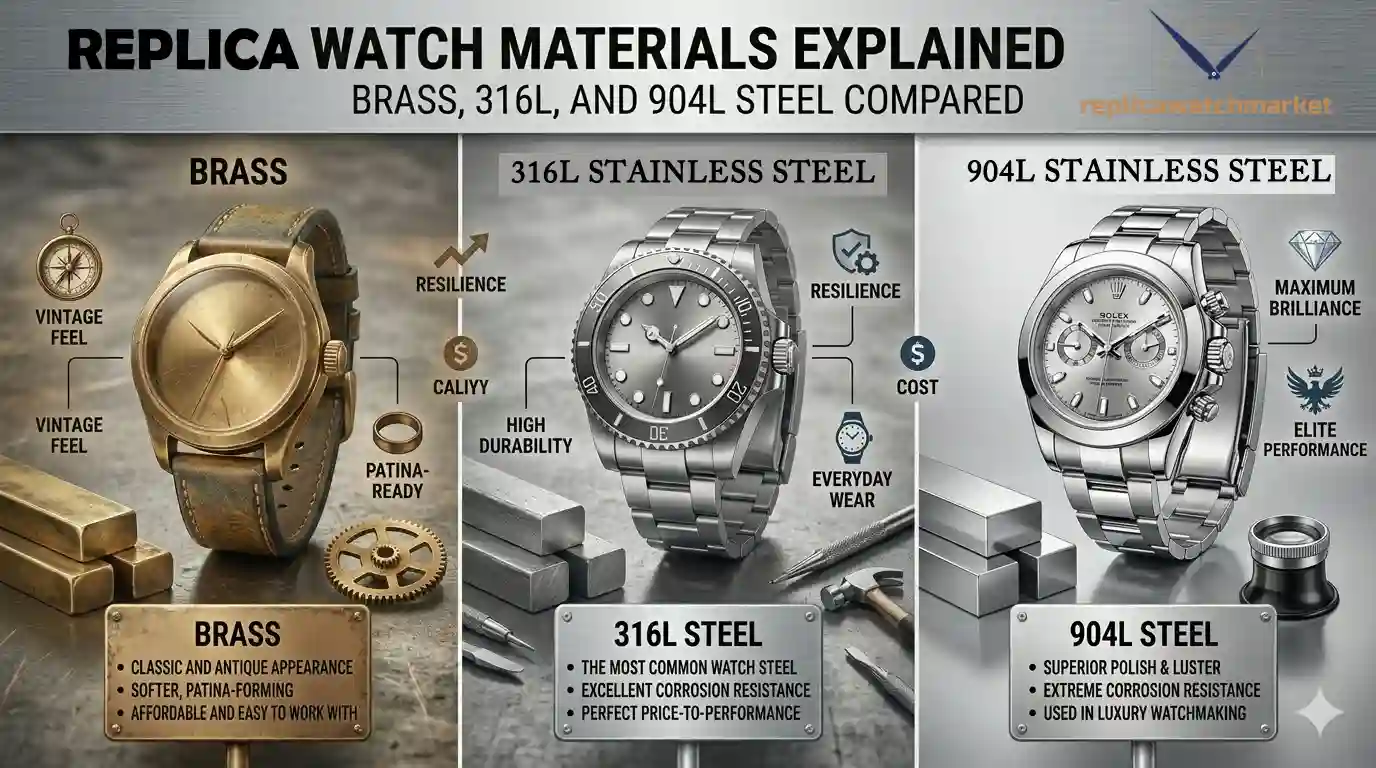
This guide covers the three main material grades found in replica watch production — brass alloys, 316L stainless steel, and 904L stainless steel — and explains what each one means in practice for finishing quality, durability, and daily wear. For the broader quality tier context, see our replica watch quality levels guide.
The material a replica watch is made from affects everything — how it feels in hand, how the surface holds up over time, how the polish reads under light, and how close the finished piece comes to the genuine reference it is based on. Yet most buyers never ask about material grade before placing an order. They focus on movement type, price tier, and seller reputation — all important — but skip the one specification that directly determines finishing quality and long-term durability.
This guide covers the three main material categories found across the replica market: brass and cheap alloys at the entry level, 316L stainless steel as the market standard, and 904L stainless steel at the top of the quality range. Each section explains what the material actually is, what it delivers in practice, where its limits are, and which buyer profile it suits. By the end, you will know exactly what to look for, what to ask a seller, and what each grade realistically delivers at the wrist.
Why Material Grade Matters
In replica watch production, material grade is the specification that most directly determines finishing quality — yet it is also the one most consistently obscured by vague seller descriptions. Terms like "stainless steel," "high-grade steel," or "premium materials" appear everywhere in replica listings without specifying the alloy. These descriptions are not useful. The grade is what matters, and the grade determines four things a buyer will notice from the moment the watch arrives.
Surface finishing quality is the most visible consequence of material grade. How deep the polish reads, how clean the transition between brushed and polished surfaces appears, and how well that finish holds over months of daily wear are all direct functions of the underlying material. A buyer comparing QC photos of a 316L piece and a 904L piece of the same reference will see the difference immediately on bracelet center links and case flanks — even if they cannot articulate exactly why one looks better than the other.
Weight and feel follow directly from material density. Brass-based watches feel noticeably lighter and less substantial than steel ones — a difference experienced buyers identify within seconds of picking up the watch. Corrosion and wear resistance determine how the material responds to sweat, humidity, and water exposure over years of ownership. And visual accuracy to the genuine reference — the degree to which the finished watch matches the original in surface depth, light reflection, and tactile feel — is ultimately bounded by material grade, regardless of how skilled the finishing work is. For a complete introduction to how quality specifications work across the replica market, see our replica watch guide.
Brass and Cheap Alloys — Entry Level
At the lowest tier of replica production, cases and bracelets are made from brass or zinc-based alloys rather than stainless steel. These materials are cheap to cast, easy to plate, and widely used in A and low AA grade pieces. Understanding what they are — and what they are not — prevents the most common entry-level disappointment in the replica market.
What Brass Alloy Means in Practice
Weight is the first thing experienced buyers notice on a brass piece. The density difference between brass and stainless steel is significant enough that a brass replica often feels hollow or toy-like compared to either the genuine reference or a steel replica of the same model. This weight gap alone is worth understanding before purchase — if the watch feels wrong in hand from the moment it arrives, material grade is almost always the explanation.
Brass pieces are typically chrome or silver-plated to simulate the appearance of steel. This plating serves the surface reasonably well in photographs and at initial inspection, but it fades, chips, and wears through at contact points — edges, lugs, bracelet links — within months of regular daily wear. Once the plating wears through, the underlying brass becomes visible and the watch deteriorates quickly under the combined effects of sweat, humidity, and continued friction.
Surface polish on brass alloys is shallow by nature. It looks acceptable in product photos under favorable lighting but does not hold the same depth, durability, or tactile quality as steel finishing — and it cannot, because the material beneath does not support it. Brass alloys are not inherently worthless. They serve a purpose at very low price points for occasional, low-commitment use. But they are not a long-term material and should never be confused with steel when sellers describe their products in vague terms.
316L Stainless Steel — The Market Standard
316L is an austenitic stainless steel alloy and the default material across AAA grade replica production. It is also used in a wide range of genuine mid-range watches, medical instruments, and industrial applications — a well-established, capable material with a documented track record across demanding environments. When a seller describes a watch as "stainless steel" without specifying the grade, 316L is almost always what they mean.
What 316L Delivers
Surface finishing on 316L is clean and durable. The material accepts both brushed and polished finishing well, and the results hold up over time with reasonable care. This is why 316L dominates mid-tier replica production — it delivers exactly what most buyers need at a price point that makes sense for the market. The machinability advantage over 904L also means that 316L pieces can be produced with tighter tolerances at lower cost, which translates directly into the price difference buyers see between AAA and AAAA+ grade pieces.
Where 316L Has Limits
316L is a capable material — but it has a ceiling. The surface polish it produces is good, but it does not reach the depth and layered quality that 904L delivers. On brushed-to-polished transitions, the difference between 316L and 904L is visible in side-by-side QC photos: 316L transitions read as clean but flat; 904L transitions read as sharp and three-dimensional. For most buyers at AAA grade, 316L is entirely sufficient and the limitation is academic. It becomes relevant only when the buyer's specific goal is the closest possible visual and tactile result to the genuine reference — at which point the material gap between 316L and 904L is meaningful.
904L Stainless Steel — AAAA+ Grade
904L is a high-alloy austenitic stainless steel with elevated chromium, nickel, and molybdenum content compared to 316L. It is harder to machine, more expensive to source, and used selectively — at AAAA+ grade — where material accuracy to the genuine reference is a stated priority. Understanding what 904L actually delivers — and what it does not — separates buyers who benefit from it from those who are paying for a specification they cannot use.
What 904L Delivers That 316L Does Not
The most visible difference between 904L and 316L is surface polish depth. 904L produces a more layered, three-dimensional polish on both brushed and polished surfaces — a quality that becomes most apparent on bracelet center links and case flanks, where the genuine reference achieves a distinctive visual depth that 316L approaches but does not fully replicate. The boundary between brushed and polished surfaces is also sharper and more defined on 904L — one of the finishing details that experienced buyers identify immediately in QC photos, and one that contributes significantly to how closely the finished piece reads to the genuine reference under direct inspection.
Corrosion resistance is also superior. The higher alloy content gives 904L better performance against salt water, prolonged humidity, and years of daily sweat exposure — a difference that matters more over a multi-year ownership period than it does in the first few months. For buyers who plan to wear a piece daily for years, the material advantage compounds over time in a way that justifies the price premium at AAAA+ grade.
How to Identify 904L in QC Photos
904L cannot be confirmed from a product listing photo alone. Verification requires QC photos taken under consistent lighting, with deliberate attention to the surfaces where the material difference is most visible: bracelet center link polish — does it read as deep and layered, or flat and reflective? Case flank transitions — are brushed and polished surfaces sharply defined, or blended together? Lug finishing — do the polished lug tops show depth and dimension, or a flat mirror reflection? A seller claiming 904L should be able to provide QC photos where these differences are clearly visible. If the photos are ambiguous or low resolution, request a short video before approving shipment — movement under light reveals surface depth and polish quality that a single static photo can obscure or misrepresent.
Side-by-Side Comparison
| Criteria | Brass / Cheap Alloy | 316L Steel | 904L Steel |
|---|---|---|---|
| Replica quality tier | A / low AA | AA / AAA | AAAA+ |
| Weight & feel | Light, hollow | Solid, substantial | Solid, substantial |
| Surface polish depth | Shallow, plated | Good, clean | Deep, layered |
| Brushed/polished transitions | Basic | Clean but flat | Sharp, defined |
| Corrosion resistance | Poor — plating wears | Good | Very good |
| Long-term durability | Low | High | High |
| Cost to produce | Very low | Moderate | High |
| Suitable for daily wear | Occasional only | Yes | Yes |
| Visual match to genuine | Distant | Good | Closest available |
Which Material for Which Buyer
Material grade is not a ranking where more is always better — it is a specification that should match the buyer's actual priorities and use case. The right material is the one that delivers what a specific buyer actually needs, at a price point that reflects the value they will get from it.
Brass / Cheap Alloy — if:
You need the lowest possible price point, plan occasional rather than daily use, and understand clearly that the watch has a limited lifespan tied to plating durability. Brass pieces are not recommended for daily wear or for buyers who expect the watch to maintain its appearance over time. They are entry points — useful for buyers exploring the market before committing to a higher grade piece.
316L Steel — if:
You want a reliable daily wear watch with solid construction, good finishing, and consistent durability at a mid-range price point. 316L delivers exactly what most buyers need from an AAA grade piece — no significant compromises for normal use, good long-term performance, and finishing quality that reads well at normal viewing distances. For the majority of replica watch buyers, 316L is the right choice and 904L is not a necessary upgrade.
904L Steel — if:
You want the closest practical result to the genuine reference in surface quality, finishing depth, and long-term corrosion resistance. You have owned replicas before, you understand what surface quality looks like at different grades, and you are buying at AAAA+ specifically because the material difference matters to you. 904L is not a marginal upgrade — for the buyer who can use it, it is a meaningful one. For a buyer who cannot tell the difference in QC photos, it is a price premium without a perceivable benefit.
How to Verify Material Grade Before Buying
Material grade cannot be confirmed from a product listing alone — and a seller's claim without supporting evidence is not verification. Before placing any order where material grade matters to you, the process should involve direct confirmation, photographic evidence, and cross-referencing with existing buyer experience on the same piece.
Ask the seller directly which steel grade is used and expect a specific answer — not a vague description like "high-grade stainless steel." Request QC photos before approving shipment, and examine bracelet center links, case flank transitions, and lug finishing under the lighting conditions the photos provide. If photos are ambiguous or shot under conditions that obscure surface quality, request a short video. Movement under light reveals polish depth and finishing transitions that a static photo can hide.
Cross-reference with community reviews of the same seller and reference. Buyers who have received the same piece can confirm whether the material claim matches the delivered product in a way that no seller description can. A seller who cannot or will not provide clear QC photos of material finishing is not in a position to substantiate their material claims — and that inability is itself a data point worth acting on before committing to an order. For a broader breakdown of technical specifications across all quality tiers, see our Technical Insights library.
Gold Plating and Rose Gold Plating
Gold-plated and rose gold-plated cases are found across AAAA+ grade replica production — most commonly on Rolex Day-Date, Datejust two-tone variants, and select AP Royal Oak and Patek Philippe references. The base material is 904L stainless steel; the plating is an electrochemical coating applied over the finished case and bracelet to replicate the appearance of solid gold. Understanding how this coating works — and where its limits are — sets realistic expectations before purchase.
What Gold Plating Actually Is
Electroplating deposits a thin layer of gold alloy — typically 18k or 14k equivalent — onto the steel surface through an electrochemical process. The result is a surface that reads as gold in appearance, color, and initial feel. Rose gold plating uses a copper-rich gold alloy to produce the warm pinkish tone associated with Rolex Everose references and AP Royal Oak rose gold models. The underlying 904L steel provides structural integrity; the plating provides the visual and tactile finish.
Durability and Long-Term Wear
Plating thickness determines longevity. On quality AAAA+ pieces, the plating is applied at sufficient thickness to resist wear at normal contact points — bracelet center links, case edges, and lug surfaces — under daily use conditions. Thinner plating, common at lower quality tiers, shows wear within months at high-friction points. At AAAA+ grade, the plating is durable for years of careful daily wear, but it is not permanent. Prolonged exposure to chemicals — perfumes, cleaning agents, chlorinated water — accelerates wear. Avoiding these conditions and cleaning the watch regularly with a soft cloth extends plating life significantly.
How to Identify Quality Plating in QC Photos
Quality plating reads as warm and even across all surfaces — no thin patches, no color variation between bracelet links, no visible steel bleeding through at edges. In QC photos, pay particular attention to the inner bracelet links, the case back edge, and the lug chamfers — these are the areas where thin plating shows first. On rose gold pieces, the color should be consistent and warm across the case and bracelet, without cold or grey patches that indicate insufficient plating thickness.
Black PVD Coating
PVD — Physical Vapour Deposition — is a vacuum coating process that bonds a thin layer of hard material to the steel surface at the atomic level. In replica production, black PVD is used on references where the genuine piece uses DLC (Diamond-Like Carbon) coating or blackened steel — most commonly on stealth variants of Rolex Submariner, Milgauss, and TAG Heuer Carrera, and on AP Royal Oak Offshore black case editions.
PVD vs Plating — Key Difference
Unlike electroplating, PVD coating does not sit on the surface — it bonds to it. This produces a significantly harder finish with better scratch and wear resistance than conventional plating. Black PVD on a quality replica can maintain its appearance through years of daily wear with none of the edge-wear or color fading that characterizes painted or plated black finishes. The coating is also chemically inert, making it more resistant to sweat, humidity, and water exposure than gold plating.
Appearance and Finish Quality
Quality black PVD reads as a deep, uniform matte-to-satin black across all surfaces. It should show no reflective patches, no thin spots, and no variation in tone between the case and bracelet. In QC photos, examine the bezel edge, case flank, and bracelet clasp — these are the areas where inferior PVD shows first. A well-applied PVD coating produces a surface that reads as intentionally designed rather than painted, with the same depth and consistency across all finished surfaces that the genuine reference achieves.
Carbon Fiber
Carbon fiber cases appear on high-end replica references — primarily Richard Mille RM series models — where the genuine piece uses forged or layered carbon composite construction. Carbon fiber is not a metal: it is a woven composite material made from carbon filament layers bonded with resin under heat and pressure. Its replica application focuses almost entirely on visual and tactile accuracy to the genuine reference, where carbon fiber is a defining design and material element rather than a functional upgrade over steel.
Properties in Practice
Carbon fiber is lighter than stainless steel for equivalent volume — a noticeable difference on wrist pieces, where the weight reduction is immediately apparent. The woven surface texture is distinctive and visually unique: each panel shows a pattern of interlocked carbon threads that reads entirely differently from polished or brushed metal. On quality replica pieces, this pattern is applied with the same directional consistency and surface depth as the genuine reference. The material does not corrode, is resistant to temperature variation, and maintains its surface appearance under normal wear conditions without the maintenance requirements of metal finishes.
What to Check in QC Photos
Carbon fiber quality is visible in the surface pattern consistency. The weave should be even, tight, and free from visible voids, surface bubbles, or resin pooling at edges. The pattern direction should be consistent across all panels — mismatched weave directions on adjacent case surfaces indicate lower quality layup. The finish over the carbon — typically a clear lacquer or resin coat — should be gloss-consistent with no clouding or orange-peel texture. On Richard Mille references, the skeletonized movement visible through the carbon case back should be examined separately from the case material itself.
Ceramic
Ceramic cases appear on select AAAA+ replica references — primarily Omega Speedmaster Dark Side of the Moon variants, AP Royal Oak Offshore ceramic editions, and Panerai Luminor Carbotech-inspired pieces. In genuine watchmaking, high-tech ceramic (zirconia oxide, ZrO₂) is valued for its hardness, scratch resistance, and color stability. In replica production, the material serves the same purpose: a case that reads visually and tactilely as ceramic, with the distinctive weight and surface properties that the genuine reference delivers.
Properties and Wear Characteristics
Ceramic is harder than stainless steel, which means conventional scratching from keys, surfaces, and daily contact has essentially no effect on the surface. It is also hypoallergenic and chemically stable — relevant for wearers with metal sensitivities. The material does not discolor over time; black ceramic stays black, and the color depth does not fade with UV exposure or daily wear in the way that PVD-coated steel can over extended periods. The limitation of ceramic is brittleness under impact: a sharp knock against a hard surface can chip or crack a ceramic case in a way that steel would only dent. This is a characteristic of the material itself, not a quality deficiency in the replica piece.
Surface Appearance
Quality ceramic on a replica piece reads as a deep, uniform color with a slightly different surface quality from PVD-coated steel — smoother, colder to the touch, and with a more even sheen rather than the directional quality of brushed metal. In QC photos, ceramic should show consistent color depth across all surfaces with no patches of lighter or darker tone. Edge finishing on ceramic cases should be clean and sharp — ceramic is difficult to machine, so quality of edge work is a reliable indicator of overall production standard.
Titanium
Titanium cases appear on a small number of AAAA+ replica references — primarily Panerai Luminor titanium editions and select AP Royal Oak Offshore titanium variants. Titanium is a lightweight, high-strength metal with a distinctive grey tone and surface quality that reads differently from stainless steel. In genuine watchmaking, titanium is used where weight reduction is a design priority and the material's natural grey tone is part of the intended aesthetic.
Properties in Practice
Titanium is approximately 45% lighter than stainless steel for equivalent volume — a significant weight reduction on large-diameter pieces like Panerai Luminor 44–47mm references, where the difference is immediately apparent on the wrist. The material is also significantly harder than stainless steel, providing superior scratch resistance, and is hypoallergenic — relevant for wearers who react to nickel content in conventional steel alloys. Titanium does not corrode and maintains its surface appearance under prolonged water exposure and daily wear without maintenance requirements beyond normal cleaning.
Surface Finish and Visual Character
Titanium has a distinctive natural grey tone — cooler and slightly darker than 904L stainless steel — and accepts brushed finishing that reads as finer and more even than steel brushing at the same grade. The material does not polish to the same mirror depth as 904L, which means titanium pieces rely on brushed finishing quality for their visual character rather than polished surface depth. In QC photos, examine brushed surfaces for consistency and fineness of the grain — coarser or uneven brushing indicates lower finishing quality regardless of the material claim. The case edges and lug chamfers on quality titanium pieces should show clean, defined transitions between brushed and any contrasting finished surfaces.
Complete Material Reference
| Material | Base | Typical replica tier | Key property | Main references |
|---|---|---|---|---|
| Brass / alloy | Zinc/copper | A / low AA | Lightweight, plated surface | Entry-level pieces |
| 316L stainless steel | Steel alloy | AA / AAA | Durable, good finishing | Most AAA pieces |
| 904L stainless steel | High-alloy steel | AAAA+ | Deep polish, superior finish | Rolex, AP, Patek, Omega |
| Gold plated (904L base) | 904L + gold coat | AAAA+ | Yellow gold appearance | Day-Date, Datejust two-tone |
| Rose gold plated (904L base) | 904L + rose gold coat | AAAA+ | Warm pink-gold tone | Day-Date Everose, AP Rose |
| Black PVD (904L base) | 904L + PVD coat | AAAA+ | Hard black finish, wear-resistant | Submariner PVD, Milgauss, Carrera |
| Carbon fiber | Carbon composite | AAAA+ | Lightweight, woven texture | Richard Mille RM series |
| Ceramic | Zirconia oxide | AAAA+ | Scratch-resistant, color-stable | Speedmaster Dark Side, AP Offshore |
| Titanium | Titanium alloy | AAAA+ | Lightweight, hypoallergenic | Panerai Luminor Ti, AP Offshore Ti |
Related Glossary Terms
316L Steel · 904L Steel · Brass Alloy · Brushed Finish · Carbon Fiber · Ceramic Case · DLC Coating · Gold Plating · PVD Coating · Rose Gold Plating · Titanium · Polished Finish · Superluminova
Frequently Asked Questions
What steel do most replica watches use?
Most AAA grade replica watches use 316L stainless steel. Entry-level pieces use brass or zinc-based alloys. 904L is used selectively at AAAA+ grade, where material accuracy to the genuine reference is a stated priority and the buyer is paying specifically for the finishing quality difference that 904L delivers.
Is 316L good enough for daily wear?
Yes. 316L is a capable, durable material that handles daily wear well under normal conditions. It is used in many genuine mid-range watches and performs reliably over years of regular use. Its limitations become relevant only when compared directly to 904L in terms of surface polish depth and finishing transitions — for most buyers, those limitations have no practical consequence.
Can I tell the difference between 316L and 904L by looking?
Not reliably from a product listing photo. The difference becomes visible in good QC photos — particularly on bracelet center links, case flank transitions, and lug finishing. Side by side under consistent lighting, 904L produces a noticeably deeper, more layered polish. In isolation, the difference requires a trained eye and good photographic conditions to assess reliably.
How do I know if a replica watch is brass or steel?
Weight is the most immediate indicator — brass pieces feel noticeably lighter than steel ones, and the difference is apparent in hand within seconds. Over time, plating wear at edges and bracelet links reveals the underlying material. Before purchase, ask the seller directly and request QC photos that show edge finishing and bracelet construction clearly. A seller who cannot provide these is not in a position to confirm their material claims.
Does material grade affect movement quality?
No — material grade and movement type are independent specifications. A watch can use 904L steel with a Japanese automatic movement, or 316L with a clone Swiss-style movement. The two variables do not determine each other and should both be confirmed separately before purchase. Paying for 904L steel does not mean the movement has been upgraded, and vice versa. For a full breakdown of how movement types compare in practice, see our Swiss vs Japanese movements guide and Miyota vs Seiko vs clone movement comparison.
Why do sellers not always specify material grade?
Most replica sellers do not volunteer material grade information because vague descriptions like "stainless steel" or "premium materials" are easier to use in product listings without inviting direct comparison. This is not necessarily deceptive — but it places the responsibility on the buyer to ask directly and request evidence before committing to an order. A seller who knows their product uses quality materials should have no difficulty providing a specific answer and supporting QC photos.