On this page 11 sections
Article at a glance
- Reading time
- 10 minutes
- Article length
- 2,097 words
- Topic
- Replica Fundamentals
In 2026, the Rolex name continues to represent precision, heritage, and timeless design. At the same time, the market around Rolex-inspired watches has become more complex than ever — ranging from obvious low-quality fakes to highly refined replica models. Knowing how to tell them apart is not just about authentication. It is about understanding what separates a poorly made imitation from a well-constructed replica, and how to evaluate any Rolex-inspired watch with realistic, informed expectations.
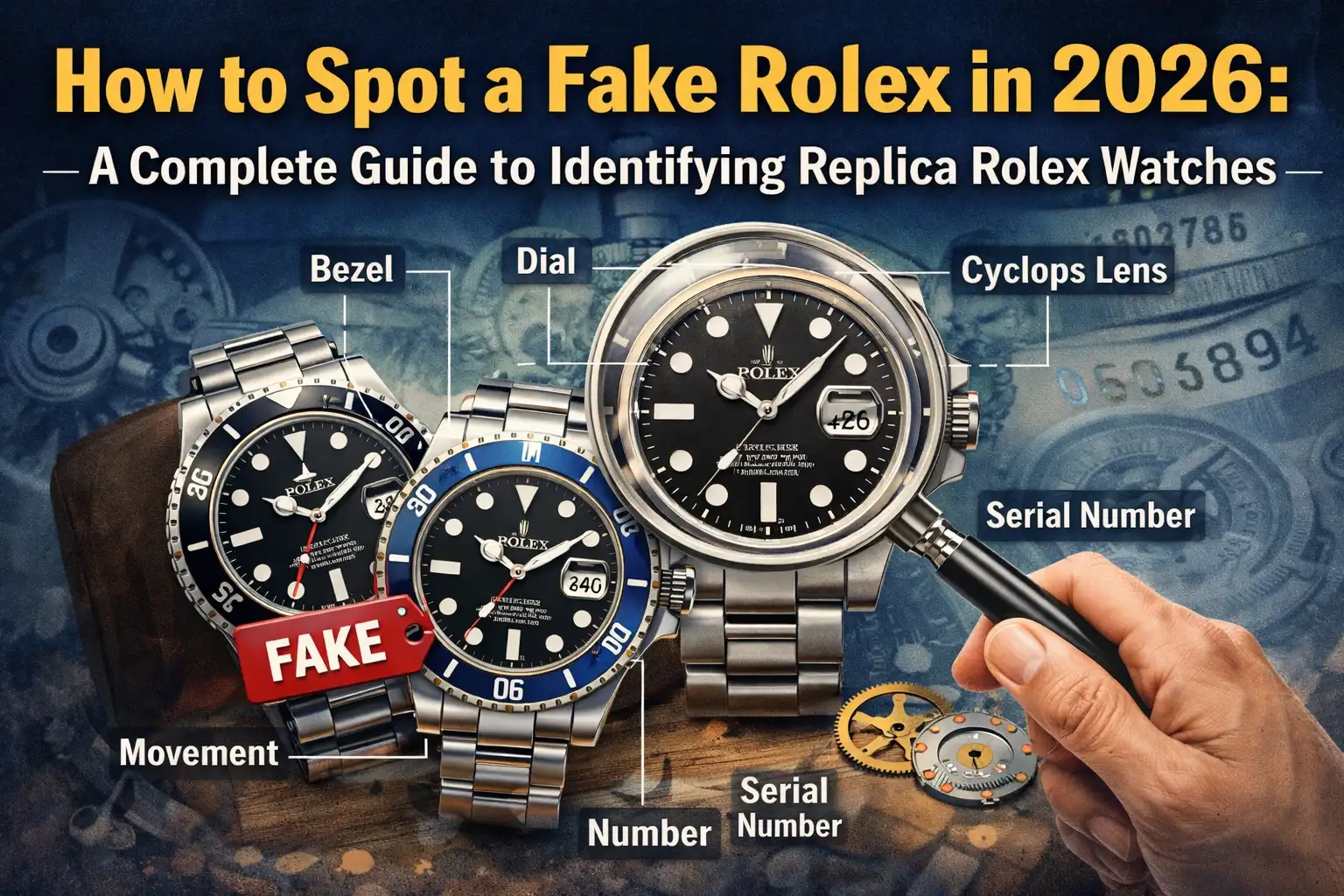
This guide focuses specifically on identifying low-quality fake Rolex watches by examining practical visual and functional warning signs — no specialist tools required. For a broader overview of replica watch quality and terminology, see our Replica Watch Guide. For a clear explanation of how fake watches and replica watches differ by definition, see our fake vs replica watch comparison.
What "Fake" Means in the Rolex Market
Before evaluating specific warning signs, it is important to clarify terminology. In the Rolex market, two very different types of non-genuine watches exist side by side.
A fake Rolex is a low-quality counterfeit produced deceptively — often sold as genuine or near-genuine, using cheap materials, unreliable movements, and poor finishing. These watches fail quickly and are designed to deceive rather than to deliver lasting value.
A replica Rolex is purchased knowingly as a non-original watch. Quality replica buyers understand they are not buying a genuine Rolex — they are buying a well-constructed alternative that follows the design language of the original. The intent, materials, and production standard are fundamentally different from a fake.
This guide focuses on helping buyers identify the warning signs of low-quality fakes — not on distinguishing replicas from genuine Rolex watches. For a full breakdown of quality tiers in the replica market, see our quality levels guide.
Materials and Case Construction
Genuine Rolex watches use 904L stainless steel — a corrosion-resistant alloy that is harder and more refined than the 316L steel used in most other watchmaking. Low-quality fakes typically use cheap brass alloys or low-grade steel with thin plating that chips or discolors quickly.
Red Flags — Fake Rolex Materials:
- Extremely light case — noticeably lighter than expected for a steel watch of that size
- Rough or uneven surface finish — brushed areas look scratched rather than satin
- Inconsistent polishing — polished lugs appear dull or uneven under light
- Visible discoloration or plating wear within weeks of use
- Sharp case edges that feel unfinished to the touch
- Crown that feels loose, wobbly, or gritty when turned
What Quality Replicas Aim For:
Higher-grade replica watches use solid stainless steel construction with consistent brushed and polished finishing. The case should feel substantial and balanced — not hollow or toy-like. Material quality is one of the most reliable first indicators of overall build standard.
Dial Printing and Finishing
The dial is where most fake Rolex watches reveal themselves most quickly. Rolex dials are produced with extreme precision — text is sharp, markers are perfectly aligned, and every element is positioned with consistency across thousands of units.
Red Flags — Fake Rolex Dial:
- Blurry or soft-edged text — "ROLEX" or "OYSTER PERPETUAL" printing lacks sharpness
- Incorrect font weight — letters too thin, too thick, or inconsistently spaced
- Misaligned hour markers — indices not perfectly symmetrical or evenly spaced
- Uneven lume application — lume plots look lumpy, uneven, or different sizes
- Wrong dial color tone — fakes often use slightly off shades (too blue, too green, too bright)
- Coronet logo errors — the Rolex crown logo is often poorly reproduced on fakes, with uneven points or blurry outlines
- Date font inconsistency — the date wheel font does not match the dial printing style
How to Check:
View the dial under good lighting at a slight angle. Genuine Rolex dials and quality replicas show clean, sharp printing with consistent depth. Fakes often look flat or slightly blurred even at arm's length. A loupe or smartphone macro lens reveals text quality differences very clearly.
Movement and Second Hand Behavior
Movement behavior is one of the most accessible ways to evaluate a Rolex-inspired watch without opening the caseback.
Red Flags — Fake Rolex Movement:
- Ticking second hand — genuine Rolex movements sweep smoothly. A clearly ticking second hand almost always indicates a cheap quartz movement
- Irregular sweep — the second hand stutters, jumps, or moves unevenly
- Loud audible ticking — a quality automatic movement is near-silent in normal conditions
- No winding sensation — when worn, an automatic movement should wind through wrist motion. No resistance at all when shaking suggests a non-functional or broken rotor
- Chronograph pushers that do nothing — on fake Daytona or chronograph models, the pushers are often purely decorative
What to Expect from Quality Replicas:
Quality replica Rolex watches use proven automatic movements — typically Miyota calibers or Asian automatics — that produce a smooth sweeping second hand and functional self-winding. Clone movements in super clone models additionally replicate the rotor architecture of genuine Rolex calibers. For a full explanation of movement types, see our movements guide.
Weight and Wrist Feel
Weight is one of the most immediate indicators of build quality. A genuine Rolex Submariner weighs approximately 155 grams on the bracelet. Quality replicas typically fall within a similar range. Fakes are often dramatically lighter due to hollow cases and cheap alloy construction.
Red Flags — Fake Rolex Weight:
- Watch feels noticeably light — almost plastic-like when lifted
- No wrist presence — does not settle naturally on the wrist
- Case feels hollow when tapped — a slight metallic resonance rather than solid feel
- Bracelet feels flimsy — individual links flex excessively or rattle
Practical Check:
Hold the watch in your palm before putting it on. A well-constructed watch — genuine or quality replica — should feel intentionally weighted. If it feels surprisingly light for its size, that is a reliable warning sign.
Bracelet and Clasp Quality
The bracelet is one of the most technically demanding components of a Rolex watch — and one of the most revealing on fakes.
Red Flags — Fake Rolex Bracelet:
- Hollow bracelet links — links that compress slightly under finger pressure
- Rough inner bracelet surface — the underside of the bracelet scratches the wrist
- Loose or rattling links — excessive play between links indicates poor tolerances
- Clasp that opens too easily — or feels thin and flimsy when closed
- Visible gaps between end links and case — poor fitment where bracelet meets lugs
- Incorrect brushing pattern — Rolex bracelets alternate brushed and polished surfaces with precision; fakes often get this wrong
Oyster vs Jubilee Bracelet:
The Oyster bracelet (three-link) and Jubilee bracelet (five-link) are the two main Rolex bracelet styles. Fakes frequently get the link count, proportions, or surface treatment wrong. On Jubilee fakes specifically, the center links are often too wide or the outer links too thin.
Bezel, Cyclops Lens, and Crown
Bezel Red Flags:
- Bezel that spins freely in both directions on a Submariner — genuine Submariners have unidirectional bezels that click only counterclockwise
- Soft or poorly defined bezel clicks — genuine Rolex bezels have 120 distinct click positions; fakes often have fewer or inconsistent clicks
- Ceramic bezel insert that looks slightly off-color or has uneven pip position
- Aluminum insert that shows thin printing rather than deep laser engraving
Cyclops Lens Red Flags:
- Weak magnification — the Cyclops lens on genuine Rolex watches magnifies the date 2.5x. Fakes often show 1x or barely perceptible magnification
- Cyclops not centered over the date window
- Distorted date — the date appears stretched or blurry through the lens
Crown Red Flags:
- Crown that screws down loosely or not at all
- No distinct positions when pulling the crown out — genuine Rolex movements have clearly defined crown positions for winding, date setting, and time setting
- Coronet logo on the crown tip that is poorly defined or absent
Caseback and Engravings
Genuine Rolex watches have solid, polished casebacks with no display windows — Rolex does not produce exhibition casebacks on any current production model. If a "Rolex" watch has a see-through caseback showing the movement, it is not genuine.
Red Flags — Caseback:
- Exhibition caseback on any model — Rolex does not make these
- Poorly engraved model reference or serial number on the caseback outer edge
- Laser etched Rolex crown on the caseback that looks blurry or off-center
- Caseback that opens easily by hand — genuine Rolex casebacks require a specialized tool
Boxes, Papers, and Serial Numbers
In 2026, packaging and paperwork are no longer reliable authenticity indicators. High-quality fake packaging has become increasingly sophisticated — green Rolex boxes, cards, and booklets can be reproduced convincingly. Informed buyers do not rely on accessories to assess quality.
Red Flags — Packaging:
- Seller emphasizing packaging over watch specifications
- "Comes with full set" claims used as primary selling point
- Serial number that does not correspond to the stated model year
- Hologram sticker on caseback — Rolex discontinued these in 2002
The Right Mindset:
Honest sellers of replica watches do not claim their products are genuine and do not rely on packaging to create false impressions. Transparency about what a watch is — and is not — is the most reliable indicator of a trustworthy seller. For payment safety and scam patterns, see our payment safety guide.
Final Thoughts: Knowledge Is the Best Filter
Spotting a fake Rolex in 2026 is less about specialized tools and more about understanding context. Low-quality fakes reveal themselves through incoherence — materials that do not match, movements that tick, dials that blur, bracelets that rattle. When multiple warning signs appear together, the picture becomes clear quickly.
Quality replica watches, by contrast, are evaluated differently — not as attempts to deceive, but as knowingly purchased alternatives with their own set of realistic expectations. Understanding this distinction removes the anxiety from the evaluation process and replaces it with informed judgment.
For buyers who want to go beyond identification and learn how to choose a high-quality Rolex replica specifically, see our complete Rolex replica buyer guide. For broader quality evaluation principles, see our guide on how to choose a high-quality replica watch.
Frequently Asked Questions About Spotting a Fake Rolex
How can you tell if a Rolex is fake?
The most reliable method is evaluating multiple factors together rather than relying on a single check. Look at second hand behavior — a ticking second hand almost always indicates a cheap quartz movement. Check dial printing sharpness, bezel click quality, Cyclops magnification, bracelet link construction, and overall case weight. Low-quality fakes typically fail on several of these checks simultaneously. A single imperfect detail is less meaningful than a pattern of inconsistencies across multiple areas.
Can you instantly tell if a Rolex is fake?
Often yes, for low-quality fakes. A dramatically light case, a clearly ticking second hand, or blurry dial printing are immediately visible without close inspection. Higher-effort fakes require more careful evaluation — particularly of bezel click quality, Cyclops magnification, bracelet finishing, and crown behavior. The more checks you apply, the clearer the picture becomes.
Do replica Rolex watches use real Rolex movements?
No. Replica watches do not contain genuine Rolex calibers. Quality replicas use proven automatic movements — most commonly Miyota calibers or Asian automatics — that produce smooth sweeping second hand motion and reliable daily performance. Super clone models use clone movements designed to replicate the architecture of genuine Rolex calibers visually and mechanically, without being genuine manufacturer pieces.
What is the biggest red flag in a fake Rolex?
For most buyers, second hand behavior is the most immediately accessible check. A ticking second hand reveals a cheap quartz movement — and no genuine Rolex or quality automatic replica uses a ticking quartz movement in a model that should be automatic. After movement behavior, dial printing quality and bracelet construction are the next most revealing indicators.
Are all replica Rolex watches low quality?
No. The replica market spans a wide quality range — from cheap fakes with obvious flaws to high-grade replicas with solid stainless steel construction, reliable automatic movements, and strong visual accuracy. The key distinction is production intent and material quality. Low-quality fakes prioritize cost above everything. Quality replicas prioritize visual accuracy and functional reliability within realistic limits. For a full breakdown of quality tiers, see our quality levels guide.
Is it easy to spot a fake Rolex Submariner specifically?
Yes, on low-quality fakes. The Submariner has several easily checkable features: the bezel should rotate unidirectionally with 120 distinct clicks, the Cyclops lens should magnify the date 2.5x, the bracelet should have solid Oyster links with alternating brushed and polished surfaces, and the second hand should sweep smoothly. Fakes frequently fail on bezel direction, magnification strength, and bracelet quality simultaneously.
What should I look for when buying a Rolex replica specifically?
Focus on movement type, case material, bracelet construction, and seller transparency. Look for clearly stated automatic movement, stainless steel construction, solid bracelet links, and a seller who describes the product honestly rather than using vague marketing language. For a full buying framework specific to Rolex replicas, see our Rolex replica buyer guide.