On this page 15 sections
Article at a glance
- Reading time
- 12 minutes
- Article length
- 2,428 words
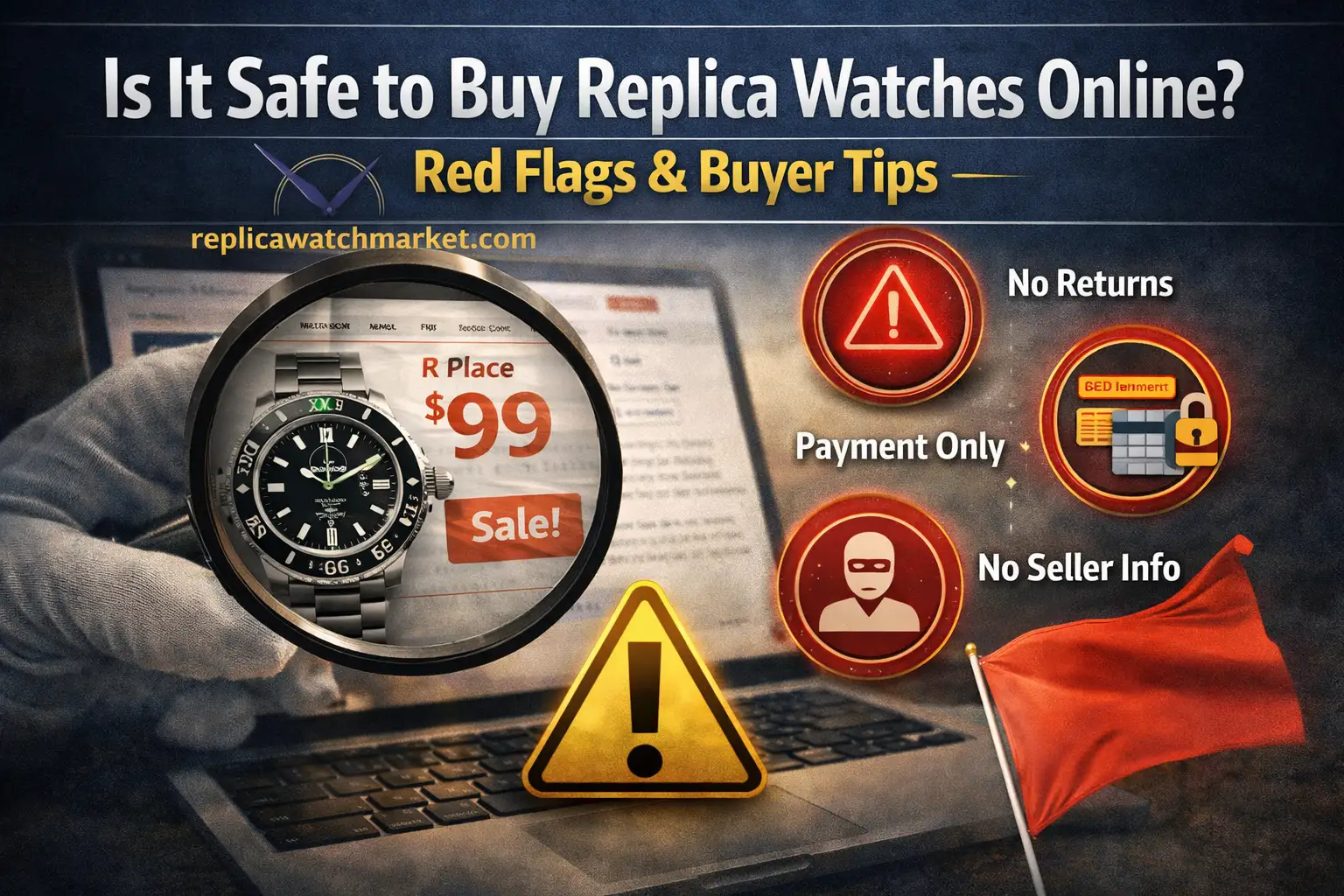
Is it safe to buy replica watches online? This is one of the most important — and most misunderstood — questions for anyone considering their first replica watch purchase. Delivery and buyer outcomes vary, and no seller can guarantee that every transaction will be trouble-free. The difference is rarely luck. It usually comes down to awareness, realistic expectations, and decision-making before payment is sent. This guide explains the real risks, the most common warning signs, and the practical habits experienced buyers use to reduce problems — without false guarantees or exaggerated fear.
Understanding the Real Risk Landscape
Buying replica watches online is not the same as shopping on a mainstream e-commerce platform. Transactions typically involve overseas sellers, informal communication channels, and payment methods that offer limited or no buyer protection. This does not make the process automatically unsafe, but it does mean the risk management responsibility falls almost entirely on the buyer rather than on platform infrastructure.
The risks that matter most in practice are not legal — the treatment of individual buyers and personal imports varies by jurisdiction and should be checked against current official guidance. The risks that actually affect buyers are practical: receiving a watch that does not match the product listing, losing payment to an unreliable seller, or having a shipment seized at customs without recourse. Understanding where these risks sit — and how controllable they are — is the first step toward managing them effectively.
Risk frequency cannot be ranked responsibly without a defined dataset. Assess product evidence, seller identity, payment recourse, destination rules and the amount you can afford to lose for the specific transaction.
The Four Red Flags to Know Before Buying
"100% Safe" or "Guaranteed Delivery" Claims
Absolute promises are one of the strongest warning signs in the replica watch market. No seller controls customs inspections, enforcement decisions, or shipping outcomes. Claims of "100% safe delivery" or "guaranteed to pass customs" reflect marketing language rather than operational reality. Trustworthy sellers explain the risks that exist — they do not deny them. A seller who acknowledges uncertainty upfront is operating more honestly than one who promises what cannot be guaranteed.
Prices That Seem Too Good to Be True
Extremely low prices in the replica watch market almost always signal a problem. Price reflects real decisions: component quality, movement selection, assembly standards, and quality control investment. A watch listed at a fraction of what comparable models cost elsewhere is typically built from lower-grade components, assembled with less care, or — in the worst cases — never delivered at all. Common outcomes of chasing the lowest price include receiving a lower-quality product than advertised, bait-and-switch substitutions, or old and defective stock. The buyers most likely to be disappointed are those who prioritized price above everything else.
Stock Photos Without Real QC Images
Many replica watch platforms use factory-provided or heavily edited images that look impressive but bear no relationship to what the buyer will actually receive. Warning signs include identical photos appearing across multiple unrelated sites, no close-ups of movement, clasp, or caseback, and no date-stamped quality control photos of real units. Sellers who show actual photos of the watches they handle and ship are demonstrating accountability — they are showing the real product, not a marketing render. Experienced buyers routinely request QC photos of the specific unit before approving shipment.
Poor or Rushed Communication
How a seller communicates before payment is a reliable predictor of how they will behave afterward. Sellers who apply pressure to order quickly, avoid answering specific technical questions, provide vague or copy-paste replies, or change their tone and responsiveness immediately after payment has been received are all demonstrating patterns associated with unreliable operations. Clear, patient, specific communication before a purchase decision is one of the strongest safety signals available.
What Actually Makes Buying Replica Watches Safer
The platforms that produce the fewest buyer complaints share a consistent set of characteristics: they explain clearly how they operate and what buyers should expect, they describe product limitations honestly rather than making exaggerated claims, and they maintain accessible communication before and after payment. None of this eliminates risk entirely — but it replaces the uncertainty that causes the most buyer problems with transparency that allows informed decisions.
Policy pages are among the most overlooked but most important safety indicators. A seller who clearly states shipping timelines, return and refund conditions, guarantee limitations, and customer responsibilities is operating with the kind of defined accountability that signals long-term seriousness. Sellers without any visible policies are not prepared for real customer interactions — they are optimized for transactions, not relationships. Accessible contact channels, reasonable response time expectations, and willingness to answer specific questions before payment are all signals that the seller expects repeat engagement, not one-time sales.
Why Real Product Photos and Reviews Matter
Photos are essential but can be deceptive. Factory images, heavily edited product shots, and renders are common across replica watch platforms — they show an aspirational version of the product rather than the actual unit a buyer will receive. The distinction that matters is whether a seller is showing what they actually handle. Real photos taken of real inventory — showing dial, case, bracelet, and caseback — signal that the seller has direct access to the product and is willing to be accountable for what it looks like. Photos alone are not proof of quality, but real photos signal accountability that stock images do not.
Customer reviews provide the layer of information that no product page will. Real buyer experiences after delivery reveal packaging quality, communication speed, accuracy relative to expectations, delivery reliability, and whether problems were handled well when they occurred. Reviews should be read critically — some are selective, outdated, or not independently verified — but consistent patterns across multiple reviews over time are a meaningful signal. Sellers with a long track record of positive post-delivery feedback are operating differently from those with a handful of recent positive reviews and no history.
Payment Methods: Understanding Risk Levels
Payment method is one of the few variables where buyers directly control their risk exposure. The replica watch market operates largely outside conventional buyer protection systems, which means the payment method chosen determines whether any recourse exists if something goes wrong.
| Payment Method | Buyer Protection Level | Risk Profile |
|---|---|---|
| Bank transfer (wire) | Very low | High |
| Cryptocurrency | Very low | High |
| Western Union / MoneyGram | Extremely low | Very high |
| Card via payment processor | Moderate | Medium |
| Escrow service | Higher | Lower |
Experienced buyers who use low-protection payment methods compensate by spending more time evaluating the seller before payment — not by assuming the payment method itself will provide safety. For payment verification checks, fake payment link patterns, and how chargebacks work in this context, see Replica Watch Payment Safety: Verification, Records & Disputes.
Customs Risk: What Buyers Should Expect
Customs may inspect, hold, release, return or seize a shipment according to destination rules. No universal outcome applies to a personal-use order; follow the carrier or authority notice and seek local advice when needed.
Customs priorities and outcomes vary, and no quantity or packaging method guarantees that a shipment will clear. Tracking statuses showing "held at customs" do not automatically indicate seizure — in many cases the delay resolves without any action from the buyer. For a full breakdown of what each scenario means and how to respond, see Customs Risks When Ordering Replica Watches Explained and Replica Watch Order Held at Customs: What Happens Next?
Common Buyer Mistakes That Increase Risk
Reduce avoidable risk by checking local import rules, using accurate shipment information, documenting the order and choosing only terms and payment methods you understand. No packaging or shipping method guarantees customs clearance.
Each of these decisions is individually minor but they compound. Buyers who consistently make conservative decisions across all of these variables face significantly fewer problems than those who optimise for speed, quantity, or appearance.
How Experienced Buyers Approach Online Purchases
Buyers with experience in the replica watch market approach purchases with a consistent set of habits that reduce both the frequency and impact of problems. They start with one watch rather than testing a new seller with a large order. They ask specific, technical questions before payment — about movement type, case material, QC process, and shipping method — and evaluate the quality and specificity of the answers as much as the answers themselves. They request QC photos of the actual unit before approving shipment, and they review those photos carefully rather than approving reflexively.
Experienced buyers also set honest expectations about what they are buying. They accept that minor cosmetic imperfections are common even in high-quality replica production, that delivery timelines can vary, and that some degree of uncertainty is inherent in this type of purchase. This acceptance reduces stress significantly — most buyer disappointment in the replica watch market comes from expecting an experience that the market is not structured to provide, rather than from systematic fraud.
Quality Expectations vs Reality
Even legitimate, well-sourced replica watches from reputable sellers carry inherent production variance that buyers should anticipate. Minor cosmetic flaws — a slightly uneven brushing transition, a dial element that sits marginally off-center, bracelet finishing that differs from the product photo — are manufacturing realities at this price and production tier, not evidence of fraud. Timekeeping accuracy can vary between units from the same batch. Packaging is often inconsistent and should not be treated as a quality signal for the watch itself.
The distinction that matters is between manufacturing variance — which is normal — and misrepresentation, where a seller describes a product materially differently from what they deliver. Buyers who understand this distinction are better positioned to evaluate whether a problem they encounter is the result of production reality or seller dishonesty, and to respond proportionately rather than reactively.
Legal and Ethical Awareness
Buying replica watches carries personal legal and ethical responsibilities that buyers should understand before purchasing. Presenting a replica watch as genuine — whether casually or in a transaction — crosses from personal use into deception. Reselling a replica watch, even one originally purchased for personal use, constitutes commercial activity with counterfeit goods and is illegal in most jurisdictions. These are not abstract concerns — the legal protection that covers personal-use buyers disappears at the point where the transaction becomes commercial.
Understanding and staying within these limits is both ethically appropriate and practically protective. For a broader overview of how replica watches are treated under different national legal frameworks, see Are Replica Watches Legal? A Global Buyer's Guide.
Pre-Purchase Checklist
Before placing an order, run through the following questions honestly. If any answer is "no" or "I'm not sure," pause and reassess before committing to payment.
- Do I understand the real risks — customs, quality variance, limited recourse?
- Are my expectations realistic for this price and product tier?
- Has the seller communicated clearly and specifically about the product?
- Have I seen real QC photos of the actual unit, not stock images?
- Do I understand the payment method I am using and its risk profile?
- Am I ordering a single unit rather than multiple watches?
- Am I prepared for possible delays or a customs hold?
For a full step-by-step ordering framework covering QC photo review, approval process, and delivery expectations, see How to Buy a Replica Watch Online: Complete Buying Framework.
Final Thoughts
Buying replica watches online is neither completely safe nor inherently dangerous. Outcomes depend on knowledge, expectations, and behavior — not luck. Buyers who understand where the real risks sit, recognise warning signs before payment, and approach sellers with appropriate skepticism face significantly fewer problems than those who rely on promises and optimism.
Safety in this market comes from awareness, not from guarantees. Any seller who tells you otherwise is the first red flag you should take seriously.
This article is for informational purposes only and does not constitute legal advice. Buying replica watches may involve legal, financial, and practical risks depending on jurisdiction and individual circumstances.
Related Glossary Terms
QC (Quality Check) · Trusted Dealer (TD) · Super Clone · Miyota Movement · Replica Watch Factory
Official sources and jurisdiction note
Online-shopping security guidance can reduce payment and impersonation risk, but it cannot guarantee delivery, product quality or customs clearance.
Frequently Asked Questions
Is it actually safe to buy replica watches online?
It can be, but it is never completely risk-free. Safety depends on seller transparency, realistic expectations, payment method, and shipping decisions. Informed buyers who evaluate sellers carefully before payment face significantly fewer problems than those who prioritise price or convenience above everything else.
What is the biggest risk when buying replica watches online?
The most common risks are receiving a watch that does not match what was advertised, losing payment to an unreliable seller, and customs seizure during shipping. Criminal prosecution of individual buyers for personal-use orders is extremely rare in most countries — the practical financial risks are more significant than the legal ones.
How can I tell if a replica watch seller is trustworthy?
Trustworthy sellers communicate clearly, answer specific technical questions before payment, provide real QC photos of actual units, explain limitations honestly, and have visible policies for shipping, returns, and guarantees. Sellers who promise absolute safety or rush buyers toward payment are demonstrating the opposite of trustworthiness.
Can I get my money back if something goes wrong?
Not reliably. Most replica watch sellers operate outside conventional buyer protection systems, and payment methods commonly used in this market (bank transfer, cryptocurrency) offer little or no recourse. This is why seller evaluation before payment is the primary risk management tool available. For guidance on what constitutes a valid issue and what outcomes are realistic, see our Buyer Protection Rules guide.
Is it safer to order one watch at a time?
Yes. Single-unit orders carry a lower customs profile, reduce financial exposure if the order fails, and better reflect genuine personal-use intent. Experienced buyers almost always start with one watch when testing a new seller, regardless of how confident they feel about the platform.
Does a higher price mean a safer or better purchase?
Not automatically. Higher prices in the replica watch market often reflect better components, movement quality, and assembly standards — but they do not eliminate risks related to shipping, customs, or seller reliability. Price is one quality signal among many, not a safety guarantee.
What should I do if my order is held at customs?
A customs hold does not automatically mean seizure. In many cases the delay resolves without any action from the buyer. Follow the carrier or customs authority's official notice, respond truthfully when information is requested and do not conceal or misdescribe the contents. A seller cannot override an authority's instructions. For a full breakdown, see Replica Watch Order Held at Customs: What Happens Next?