On this page 12 sections
Article at a glance
- Reading time
- 9 minutes
- Article length
- 1,861 words
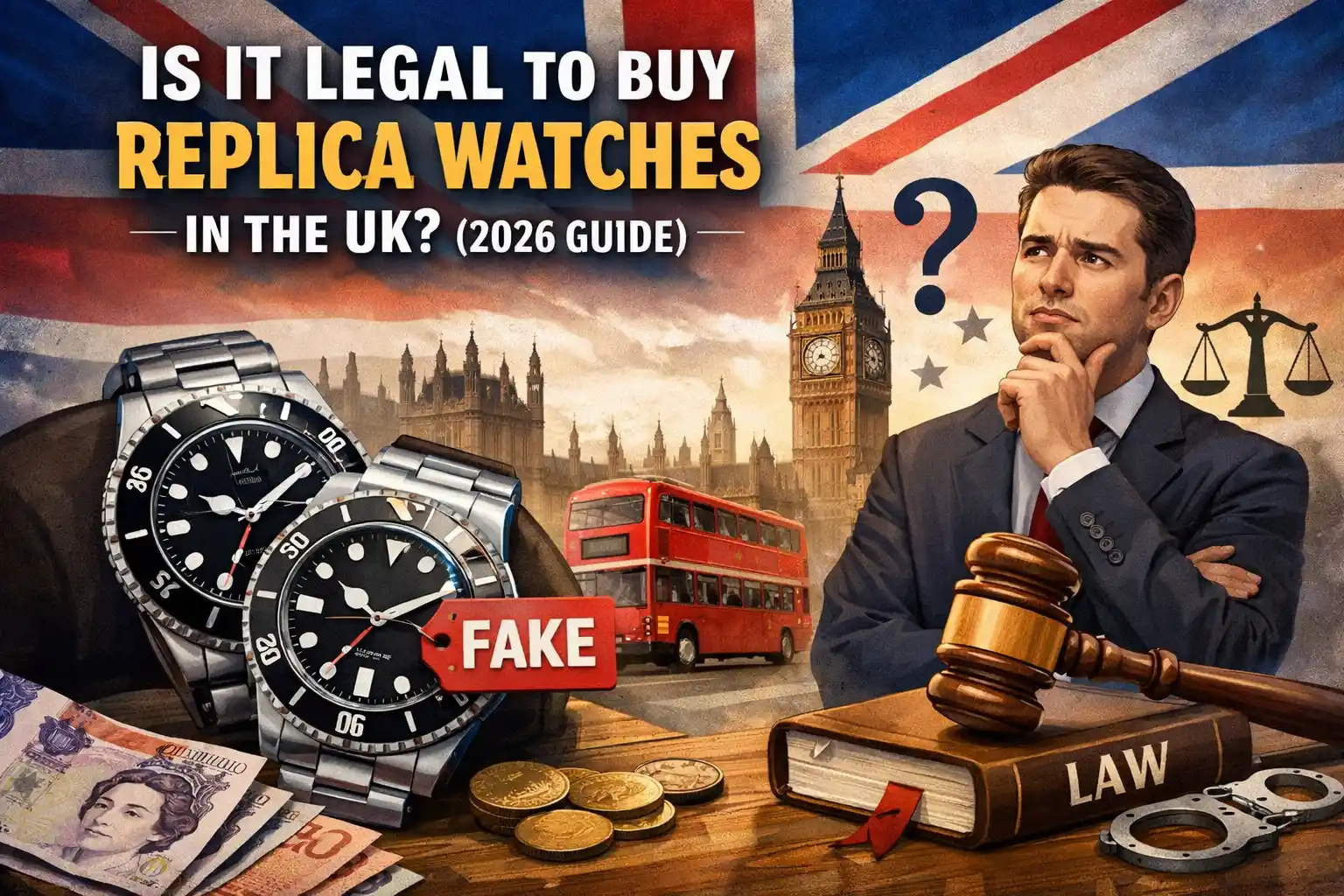
Replica watches attract consistent interest across the UK, particularly among buyers who appreciate luxury watch design without committing to five-figure prices. The question that consistently appears alongside that interest is a straightforward one: is it legal to buy replica watches in the UK? This guide answers that question clearly, outlines what UK buyers should realistically expect from customs, and explains where legal boundaries actually sit — without exaggeration, fear tactics, or misleading reassurance. For a broader legal perspective covering multiple jurisdictions, see our complete guide: Are Replica Watches Legal? A Global Buyer's Guide.
UK Law: What the Law Actually Says About Replica Watches
In the United Kingdom, the legal framework around counterfeit goods focuses almost entirely on commercial activity — not personal ownership. Selling or distributing counterfeit watches in the UK is illegal under the Trade Marks Act 1994 and related intellectual property legislation. Manufacturing goods that infringe registered trademarks is equally prohibited. These laws are designed to prevent commercial misuse, consumer deception, and fraudulent trade — not to criminalise individuals who purchase a single replica watch for private use.
This distinction is central to understanding the UK's legal position. Enforcement resources are directed at supply chains, distributors, and commercial operators — not at the individual buyer who receives a single package at home. The legal boundary is commercial intent, not possession.
Is Buying a Replica Watch for Personal Use Illegal in the UK?
UK law does not support a blanket answer for every personal import: liability depends on the facts and the provisions that apply. However, replica watches are still legally classified as counterfeit goods, which means customs rules apply regardless of the buyer's intent. The presence of customs oversight does not imply prosecution; it simply means that imported goods carrying trademark-protected branding can be assessed and potentially seized at the border.
The practical distinction that matters is between personal use and commercial activity. A buyer who orders one watch, wears it, and does not resell it is in a fundamentally different position from someone placing bulk orders or operating a resale business. UK enforcement practice reflects this distinction — personal-use buyers are not the target of trademark enforcement action.
UK Customs: What Buyers Should Realistically Expect
UK customs may inspect, detain or seize goods under the rules that apply to the shipment. No package size, description or packaging method guarantees clearance; consult official guidance and ensure declarations are accurate.
When a seizure does occur for a personal-use order, the most common outcome is straightforward: the item is confiscated, the buyer receives a standard notification letter, and no fine or criminal follow-up is issued. Criminal prosecution of an individual UK buyer for importing one replica watch for personal use is extremely rare — the resources and legal threshold required make it a disproportionate response to what amounts to a minor customs infringement. For a full breakdown of what happens during and after a seizure, including what your tracking status means, see Customs Risks When Ordering Replica Watches Explained and Replica Watch Order Held at Customs: What Happens Next?
Fake Watches vs Replica Watches: What UK Buyers Should Understand
Although legally both categories are classified as counterfeit goods, fake watches and replica watches are meaningfully different from a buyer's perspective. Low-grade fake watches — typically sold informally, at markets or through pop-up vendors — use poor materials, incorrect proportions, and disposable movements. They are often purchased by buyers who may not fully understand what they are getting, or who are being deceived about the product's nature.
Replica watches, by contrast, are purchased deliberately by buyers who understand the product is not genuine, value design similarity and construction quality, and approach the purchase with realistic expectations. This distinction matters for how buyers research, evaluate, and use their purchases — and it explains why the replica watch market has developed a more informed, quality-conscious buyer base than the low-grade fake market. For a full breakdown of how these categories differ in practice, see Fake Watch vs Replica Watch: Key Differences Explained.
Why Replica Watches Appeal to UK Buyers
The UK market has developed a distinct replica watch buyer profile — one that reflects broader British consumer attitudes toward value, practicality, and design. Authentic luxury watch prices have risen significantly in recent years, with entry-level Rolex and Omega references now well above what most buyers can justify for a wearable, daily-use item. This has created a market of buyers who appreciate the design language and craft of luxury watches but are not willing to carry the financial and practical risks of ownership — insurance requirements, service costs, theft vulnerability, and depreciation unpredictability.
Replica watches address this gap directly. They offer design familiarity, wearability across everyday environments, and a financial commitment that reflects the product's actual utility rather than its brand premium. For UK buyers accustomed to value-driven decision-making across other consumer categories, replicas represent a rational choice rather than a compromise.
Is It Safe to Buy Replica Watches Online in the UK?
Buying replica watches online is neither completely safe nor inherently dangerous — outcomes depend on awareness, expectations, and platform selection. The primary risks are not legal but practical: receiving a lower-quality product than expected, encountering a seller who does not deliver, or using payment methods that offer no recourse if something goes wrong.
Experienced UK buyers avoid sellers offering unrealistically low prices, platforms with no real product photos, stores with no clear communication channels or stated policies, and high-pressure sales tactics that suggest urgency or exclusivity. Platforms that show actual product images, describe limitations honestly, communicate clearly before payment, and set realistic delivery expectations are operating with the transparency that reduces purchase risk. For a detailed breakdown of red flags and safer buying habits, see Is It Safe to Buy Replica Watches Online? Red Flags & Buyer Tips.
How UK Buyers Approach Purchases Carefully
Do not treat order quantity, seller location or packaging as a way to avoid customs scrutiny. Check the current UK rules, use truthful shipment information and obtain independent legal advice when the consequences matter to you.
Beyond platform selection, experienced buyers accept that replica watches are not perfect — delivery timelines can vary, and individual units may have minor finishing differences that would not appear in a higher-end product. Approaching the purchase with realistic expectations, rather than treating a replica as a substitute for an authentic watch in every respect, produces better long-term satisfaction than optimistic assumptions followed by disappointment.
Legal and Ethical Responsibility
Personal use of replica watches carries a set of straightforward ethical and legal boundaries that UK buyers should understand. Presenting a replica as a genuine watch — whether in casual conversation or in a transaction — crosses from personal use into deception. Reselling a replica watch, even one that was originally purchased for personal use, constitutes commercial activity with counterfeit goods and is illegal in the UK under trademark law. These are not abstract risks: the legal protection that applies to personal-use buyers disappears the moment the transaction becomes commercial.
Understanding and staying within these limits is both ethically reasonable and practically protective. The buyers who encounter legal problems in the UK replica watch market are almost exclusively those who move into distribution or resale — not those who purchase and wear one watch for personal enjoyment.
Final Thoughts
Personal possession, import, commercial conduct and customs enforcement are separate questions under UK law. Outcomes depend on the facts, and detention or seizure does not guarantee that no further action will follow. Understanding these boundaries removes the uncertainty that stops many potential buyers from making informed decisions, and replaces it with a realistic picture of what the purchase actually involves.
Legal clarity does not eliminate all risk — customs outcomes are never fully predictable, and platform quality varies widely. But it does allow buyers to approach the decision calmly, evaluate sellers honestly, and set expectations that reflect the actual nature of the product rather than either false reassurance or exaggerated fear.
This article is for informational purposes only and does not constitute legal advice. UK laws and enforcement practices may change, and outcomes can vary depending on individual circumstances.
Related Glossary Terms
Trusted Dealer (TD) · QC (Quality Check) · Super Clone · Miyota Movement · Replica Watch Factory
Official sources and jurisdiction note
This article is general information, not legal advice. Read the current legislation and obtain qualified advice for a specific purchase, import, possession or resale question.
Frequently Asked Questions
Is it legal to buy replica watches in the UK for personal use?
There is no safe universal conclusion for every UK personal-use purchase; the legal result depends on the transaction, import facts and current law. UK trademark law focuses on commercial activity — selling, distributing, and manufacturing counterfeit goods — rather than individual buyers purchasing a single item for personal enjoyment. Customs rules still apply at the border, but personal-use purchases are not subject to criminal prosecution.
Can UK customs seize replica watches?
Yes. UK customs has the authority to seize counterfeit goods at the border, including replica watches. In practice, enforcement concentrates on bulk shipments and orders showing clear commercial intent. Single-watch personal-use orders in discreet packaging are a lower priority, though seizure remains possible. If a seizure occurs, the typical outcome is confiscation and a notification letter — not a fine or prosecution.
Will I be fined if my replica watch is seized by UK customs?
In most cases, no. When a personal-use replica watch order is seized at UK customs, the item is confiscated and the buyer receives a standard notification letter. Fines and criminal penalties for individual buyers in this context are extremely rare — they are reserved for commercial-scale operations, not personal-use imports.
Is it illegal to wear a replica watch in public in the UK?
The cited trademark provisions focus principally on specified commercial conduct, but readers should verify current UK law for their circumstances rather than relying on an absolute statement. The law targets commercial misuse of trademarks — selling or advertising counterfeit goods as genuine — not personal ownership or wear.
Can I resell a replica watch I bought for personal use?
No. Selling or reselling replica watches in the UK is illegal regardless of how they were originally acquired. Once the transaction becomes commercial, the legal protection that applies to personal-use buyers no longer applies. This includes casual resale on platforms like eBay or Facebook Marketplace.
Are replica watches and fake watches treated the same under UK law?
Legally, both are classified as counterfeit goods. However, they differ meaningfully from a buyer's perspective: replica watches are purchased knowingly by informed buyers who understand the product is not genuine, while low-grade fakes are often sold in contexts where the buyer may be deceived. The legal classification is the same; the buyer intent and product quality are not.
How long does delivery from international replica watch sellers to the UK usually take?
Delivery times vary by seller and shipping method. Most international replica watch orders to the UK arrive within 5–10 working days under standard shipping. Express options are typically faster but may carry higher customs visibility. Some orders experience delays at customs inspection, which can add several days to the timeline without resulting in seizure.