On this page 16 sections
Article at a glance
- Reading time
- 11 minutes
- Article length
- 2,406 words
Replica watch shipping is where most buyers feel unnecessary uncertainty — not because international shipping is inherently unpredictable, but because tracked postal lines don't behave like domestic couriers. Long gaps between scans, a delayed first update, or multiple status changes appearing simultaneously are all normal features of how international tracked routes work. This guide explains what each shipping method actually involves, what the tracking statuses mean, what realistic delivery timelines look like, and what to do — and when — if tracking appears to stall. For the full buying framework covering risk control, quality selection, and order expectations, see How to Buy a Replica Watch Online: Complete Buying Framework.
At a Glance: Key Numbers to Know
International tracked lines update by milestone scan, not live GPS. Scan intervals vary by route, carrier and hand-off partner; a gap alone does not establish loss or seizure. Use the carrier’s current estimate for the route; published windows can change during peak periods or hub congestion. A package that has been in transit for 40+ days is not automatically lost — but it is the point at which a structured follow-up using the last scan date and route pattern is appropriate.
What "Tracked Lines" Actually Mean (and Why Scans Look Weird)
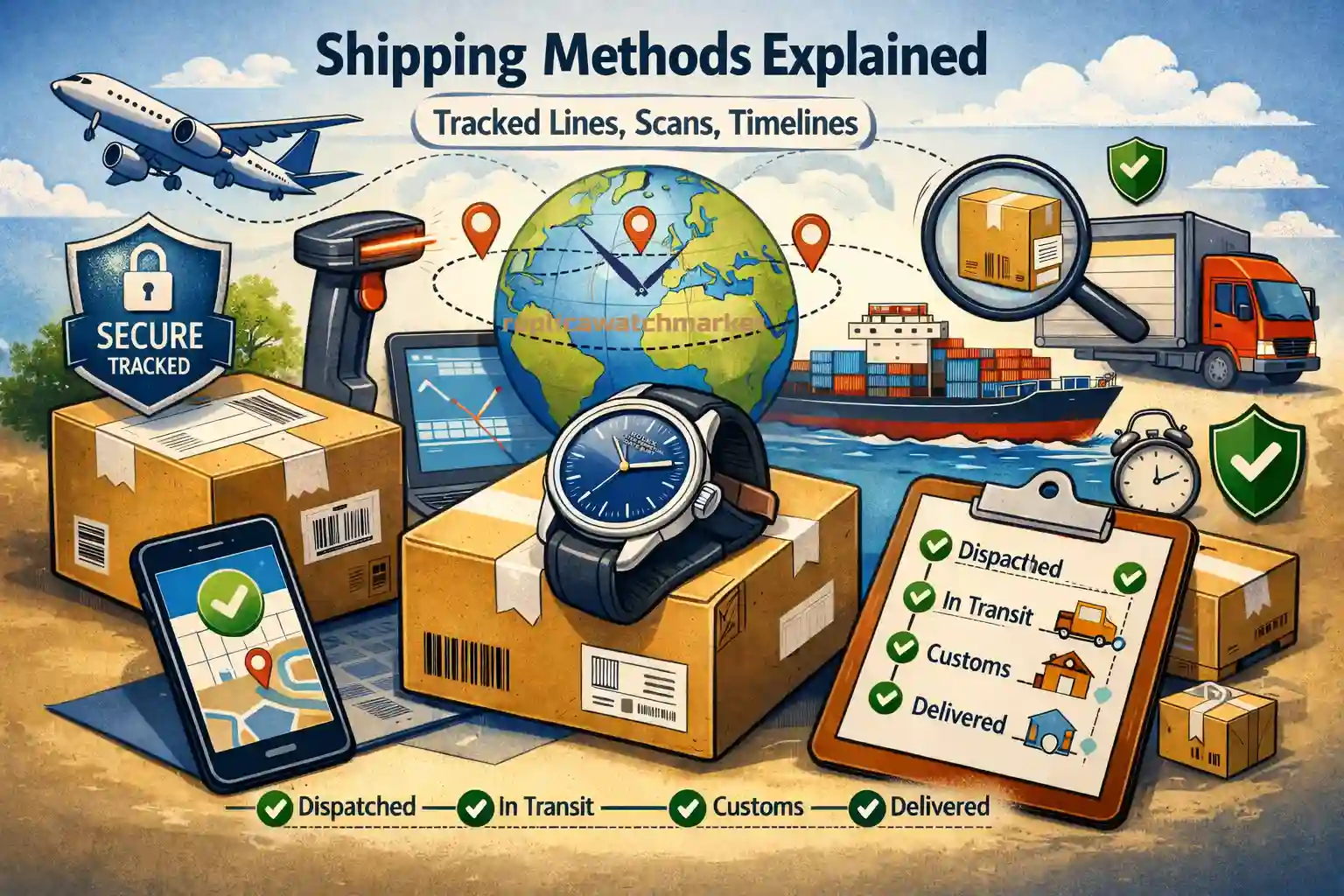
A "tracked line" means the parcel receives an initial acceptance scan, moves through one or more consolidation hubs, and then generates destination-country events — arrival, customs processing, and out-for-delivery — before the final scan. Tracking is not a live GPS feed. It is a sequence of milestone scans created each time the parcel changes hands or crosses a checkpoint. Between those checkpoints, the tracking page shows nothing — not because the parcel has stopped moving, but because no scan-generating event has occurred.
On international lines this means gaps of 3–7 or more days with no new status are completely normal. It also means that when a hub finally processes a backlog, multiple scans can appear simultaneously, making it look as if nothing happened for a week and then everything happened at once. Both patterns are features of how international postal networks operate, not signs of a problem.
Common Replica Watch Shipping Methods
Standard International Tracked
Usually the most affordable tracked option. Scan cadence is inconsistent — long gaps are common between hubs — and delivery is steady rather than fast. This is the best fit for buyers who can tolerate tracking gaps and are not working to a specific deadline.
Priority / Faster Tracked Lines
"Priority" in this context is typically a routing tier rather than a true express courier service. Parcels on priority lines move faster between hubs and reach the destination carrier earlier, which can result in shorter overall timelines — but scan gaps are still present, and the experience is not comparable to a next-day domestic delivery. The benefit is slightly better predictability, not dramatically reduced transit time.
Triangle / Forwarding Routes (Indirect Routing)
Some shipments route through an intermediate hub country before the final destination. This approach aims for smoother cross-border handling in regions where direct lines are less consistent. The tradeoff is that tracking can look confusing — the apparent origin may differ from the actual shipping country, and early scans are often minimal. Once the parcel reaches the final destination country, tracking typically becomes more frequent.
Local Carrier Handoff (Final Mile)
Even when an order begins on a cross-border postal line, the final step usually hands off to the local national carrier or a last-mile courier. The handoff scan is often the point at which updates become more frequent and predictable — many buyers experience the majority of their tracking anxiety in the international segment, then see normal domestic scans appear in quick succession once the local carrier takes over.
What Good Shipping Looks Like From a Buyer's Perspective
No international shipping route can guarantee consistent scan timing — that is a function of postal infrastructure, not seller quality. What a reliable seller can control is the starting point: using shipping options with documented tracking milestones rather than untracked or unclear methods, sharing active tracking as soon as the parcel enters the carrier network rather than when the label is merely created, and having a clear process for following up when tracking stalls beyond normal ranges.
The difference between a good and poor shipping experience is usually not the transit time itself — it is whether the buyer has enough information to interpret what they are seeing. A seller who can explain what "Label Created" means, at what point "In Transit" becomes genuinely overdue, and what steps are taken when tracking stalls at 30–40 days is providing a meaningfully different service from one who simply sends a tracking number and goes silent.
Tracking Status Glossary
Below are the most common tracking statuses on international replica watch shipments, what they typically mean, and the appropriate response at each stage.
| Status | What It Usually Means | What to Do |
|---|---|---|
| Pre-Shipment / Label Created / Electronic Info Received | Label exists; parcel may still be in consolidation before first carrier scan | Wait 3–7 days for acceptance scan |
| Accepted / Received by Carrier | First meaningful scan; movement has begun | Normal — no action needed |
| Departed Facility / Export Processing | Leaving an origin hub or export stage | Normal — expect scan gaps |
| In Transit | Generic status; can remain unchanged for days between hubs | Wait 5–10 days before escalating |
| Arrived in Destination Country | Parcel has entered the destination country's network | Positive — more frequent updates likely soon |
| Customs Processing / Held at Customs | Usually a routine processing queue, not a final verdict | See customs guides below; do not panic |
| Out for Delivery | Final-mile delivery attempt in progress | Be available; confirm address and contact number |
| Delivered | Completed | Confirm delivery location |
For a full breakdown of what "Held at Customs" means and what happens next, see Replica Watch Order Held at Customs: What Happens Next? and Customs Risks When Ordering Replica Watches Explained.
Realistic Delivery Timelines
Timelines vary by destination country, seasonal congestion, and route. The right mental model is ranges, not specific dates. A delivery window of 7–14 days represents a smooth, fast outcome. The 14–25 day range is the most common baseline — this is where the majority of straightforward orders land. Deliveries in the 25–40 day range still happen regularly, particularly during peak postal periods, hub congestion, or on routes with longer scan gaps. At 40+ days with no meaningful tracking movement, the order is not automatically lost — but it is the appropriate threshold for contacting the seller with a structured follow-up request.
Timelines stretch for a predictable set of reasons: consolidation delays before the first acceptance scan, flight capacity constraints at origin hubs, backlog at transit sorting facilities, customs workload spikes at the destination, and local carrier scheduling. None of these are signs of a problem with a specific order — they are the normal variability of international postal infrastructure.
Real Examples of Normal Tracking Patterns
Example 1: "Pre-Shipment" looks stuck, then suddenly moves
The tracking page shows "Electronic Info Received / Label Created" from day one through day six, with no movement. On day seven, an "Accepted / Received by Carrier" scan appears. Days eight through thirteen show nothing. On day fourteen, an "Arrived in Destination Country" scan appears. This is a normal consolidation pattern — the label was created while the parcel waited in a consolidation facility, the acceptance scan was delayed, and the transit between origin and destination hub was silent.
Example 2: "In Transit" for 10+ days, then multiple scans at once
A "Departed Facility" scan appears on day one. From day two through day twelve the tracking shows "In Transit" with no new updates. On day thirteen, three scans appear within a few hours: arrival at destination, customs processing, and dispatch to local carrier. This is a scan posting delay — the parcel was moving normally throughout, but the intermediate milestones were not posted until the destination hub processed the batch.
Example 3: "Held at Customs" is a stage, not a verdict
The parcel arrives in the destination country on day sixteen. From day seventeen through day twenty-four the tracking shows "Customs Processing / Held." On day twenty-five, a "Released / Handed to Local Carrier" scan appears, followed by "Out for Delivery." This example illustrates one possible release outcome, not a prediction; the authority’s notice and destination rules determine the result.
Tracking Tools: One Simple Tip
Always check tracking on the official carrier website first. Third-party tracking aggregators can lag behind the carrier's own system, display status labels in confusing ways, or fail to show the most recent scan even when the carrier has posted it. If the third-party view looks stuck, check the carrier directly before drawing conclusions.
What You Can and Cannot Control
Buyers have meaningful control over a small but important set of variables. Address accuracy — correct name, door number, and postcode — directly affects final-mile delivery success. Being available during a delivery attempt, or having a safe drop-off arrangement, prevents the frustrating cycle of repeated failed delivery notifications. Keeping the order confirmation and tracking number in one accessible place makes follow-up faster if it becomes necessary. Patience with scan gaps — not escalating before the appropriate thresholds — avoids creating noise in a situation that would have resolved itself.
The things buyers cannot control are customs queue speed, how quickly intermediate hubs post their scans, and flight timing between origin and destination. These are infrastructure variables that no seller or buyer can influence once a parcel is in transit.
What to Do if Tracking Hasn't Updated
Still showing "Pre-Shipment / Electronic Info Received"
Wait 3–7 days for the first acceptance scan. This stage often reflects consolidation rather than inactivity — the parcel exists and is being processed, but has not yet reached the first scan point in the carrier network.
Showing "In Transit" with no new scans
Wait 5–10 days before escalating. International movement between hubs is frequently "silent" — the parcel is moving, but no scan-generating checkpoint has been crossed. This is the most common source of buyer anxiety and the most commonly self-resolving situation.
Showing "Held at Customs"
Do not panic. This status is most often a processing queue rather than an active seizure. Most parcels showing this status are released and continue to delivery. Follow the customs timeline guidance at Replica Watch Order Held at Customs: What Happens Next?
Transit time has passed 30–40+ days
This is the appropriate point to contact the seller with a structured request. Provide your order ID, tracking number, destination country, and the date and text of the last scan. The seller can then review the route behaviour and destination carrier patterns to determine whether the situation is still within normal variation or requires escalation.
When to Contact Support: Clear Thresholds
Contact the named carrier or seller according to the carrier’s current published enquiry window. Keep the order ID, tracking number, destination and last scan available; do not rely on a universal day threshold across routes.
Shipping Red Flags: When to Act Earlier
Some situations justify earlier action regardless of elapsed time. If the tracking number does not match any recognisable carrier format when entered on the official carrier site, that is a seller credibility issue to raise immediately. If tracking shows repeated "Delivery Attempt Failed" notifications but you were available and expecting a delivery, there may be an address or contact information error to resolve urgently. If the tracking shows the parcel as delivered to a different city or postcode than your address, this needs immediate investigation. If customs issues a notice requesting documentation from the recipient — which is rare but does happen in some jurisdictions — that notice has a response deadline that should not be missed.
Before You Order: Buyer-Protection Checklist
When evaluating a seller's shipping approach before committing to a purchase, the following questions help separate reliable operations from ones likely to cause frustration:
- Do they provide active tracking — a number that works on the carrier's official site — rather than just a label reference?
- Can they explain what normal scan gaps look like and at what point they consider a delay worth investigating?
- Do they have a defined follow-up process for orders that reach 30–40+ days?
- Do they set realistic delivery expectations before payment rather than after a problem occurs?
Related Glossary Terms
QC (Quality Check) · Trusted Dealer (TD) · Replica Watch Factory · Miyota Movement
Official sources and jurisdiction note
Carrier scans and customs procedures differ by destination. Use the carrier's official tracking guidance and the destination authority's current import rules.
Frequently Asked Questions
Why does replica watch tracking look "stuck" for days?
International tracked lines update by milestone scans, not continuous movement. Gaps of 3–7 or more days between scans are completely normal, particularly between consolidation hubs or during the transit leg before destination-country events appear. The parcel is moving — it just has not crossed a scan-generating checkpoint.
What does "Label Created / Electronic Info Received" mean?
It means a shipping label has been generated, but the parcel may still be in consolidation or waiting for the first acceptance scan at the carrier. This status can remain unchanged for several days before visible movement begins — typically 3–7 days before the first "Accepted / Received by Carrier" scan appears.
How long should I wait for the first "Accepted / Received by Carrier" scan?
A common range is 3–7 days. If no acceptance scan has appeared after approximately 10 days, it is reasonable to contact the seller with your tracking number and ask for a route status check.
Is it normal for multiple tracking updates to appear at once?
Yes. Some postal lines post scans in batches, or tracking aggregators display several milestones simultaneously after a delay in their own update cycle. What matters is whether the milestones progress logically — accepted, in transit, destination events — rather than whether they appear in real time.
What's the most common delivery timeline for replica watch orders?
There is no universal delivery baseline across carriers and destinations. Compare the shipment with the carrier’s current route estimate and published claim window.
When should I be concerned that the package is lost?
Use the named carrier’s current enquiry or missing-mail window. When that window is reached, contact the carrier or seller with the order ID, tracking number, destination and last scan; the correct timing varies by service.
What does "Arrived in Destination Country" mean?
It is a positive milestone — the parcel has entered the destination country's postal network. After this scan, updates typically become more frequent once the local carrier takes over the final-mile delivery.